Quick tip · 2 min
The Child Who Looks Fine
A teenager with good grades and teachers who say she’s fine can still be anxious and exhausted.
A minute to read, 3 things to try · open it
Quick tipsand things to do together
This page shows what the library holds, by kind: chapters to read properly, one-minute tips for tonight, things to do together, tools for you as a parent, and the books, podcasts and films we recommend.
Each band below shows a selection, to give a sense of the range; search covers everything the library holds. The pieces themselves, and the films, podcasts and books alongside them, open with a subscription.
The library holdsToday
24 chapters · 195 quick tips · 38 activities · 33 printables · 8 self-care tools · 447 books · 98 podcasts · 138 videos · 105 further reading
Across 38 subjects, from sleep and screens to friendships, anxiety, exams and grief. A selection of each is below; search reaches everything.
Free, and already openNothing to join
Every subject we cover has two free pages, written to be printed and kept. One says what to do first, what helps and a few things to try this week. The other names organisations outside this library, what each one does, when it is the right call and how to reach it. You don’t need an account for either.
Anxiety Sleep Friendships Behaviour Screens Separation
Every subject, and every organisation we would send a parent to · Finding a therapist
PrintablesFree to print and pass on
Plans to make with your child on a calm day, cards for the fridge, first sentences to keep in a pocket, and notes for the meeting with school. 33 sheets, each one a PDF to print at home. Eleven are free to anyone, and these are some of them; the rest come with a subscription.
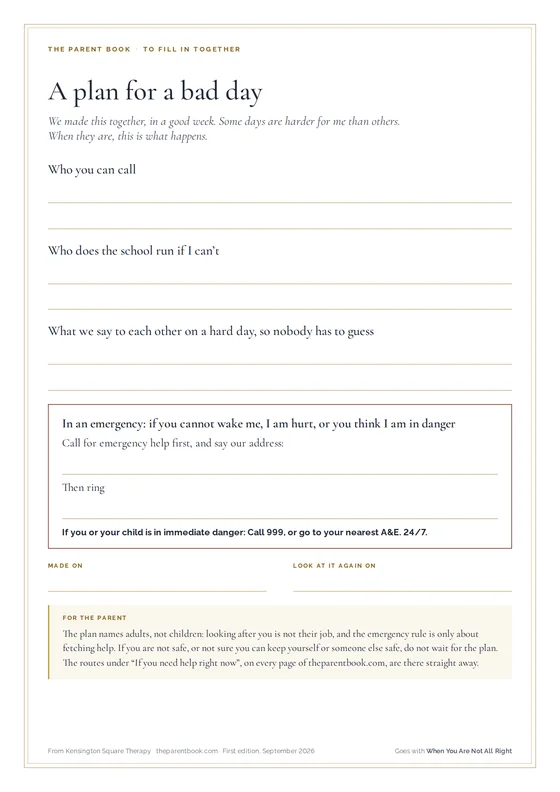 A plan for a bad day
To fill in together · A4
A plan for a bad day
To fill in together · A4
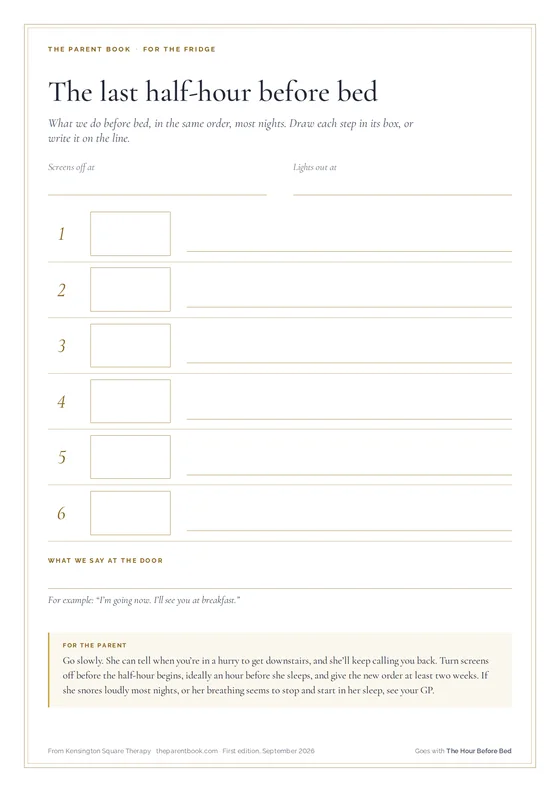 The last half-hour before bed
For the fridge · A4
The last half-hour before bed
For the fridge · A4
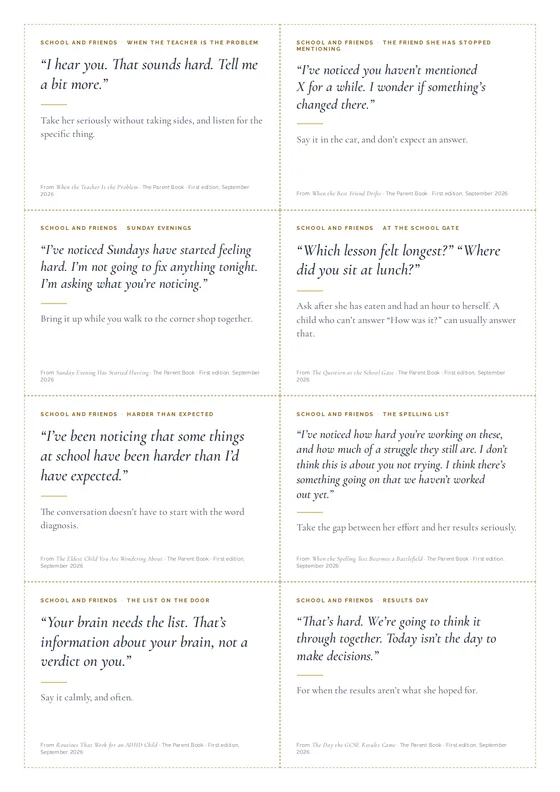 What to say: school and friends
Cards to cut out · A4, eight cards to cut
What to say: school and friends
Cards to cut out · A4, eight cards to cut
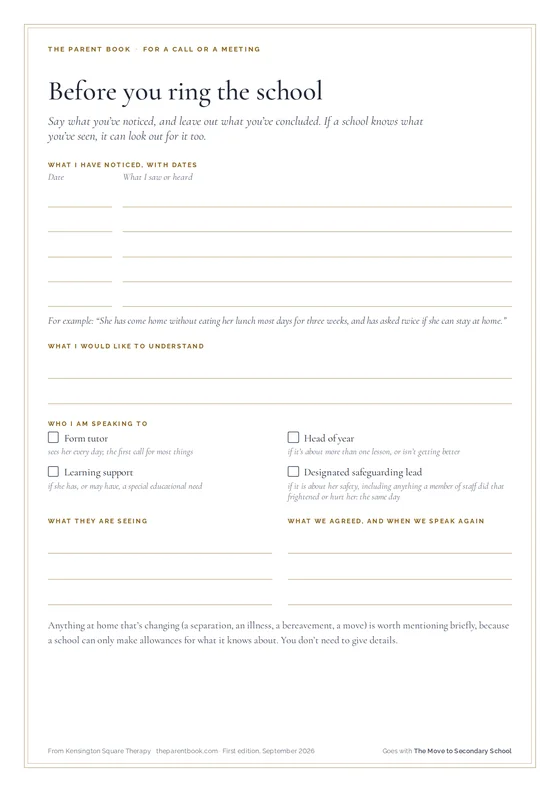 Before you ring the school
For a call or a meeting · A4
Before you ring the school
For a call or a meeting · A4
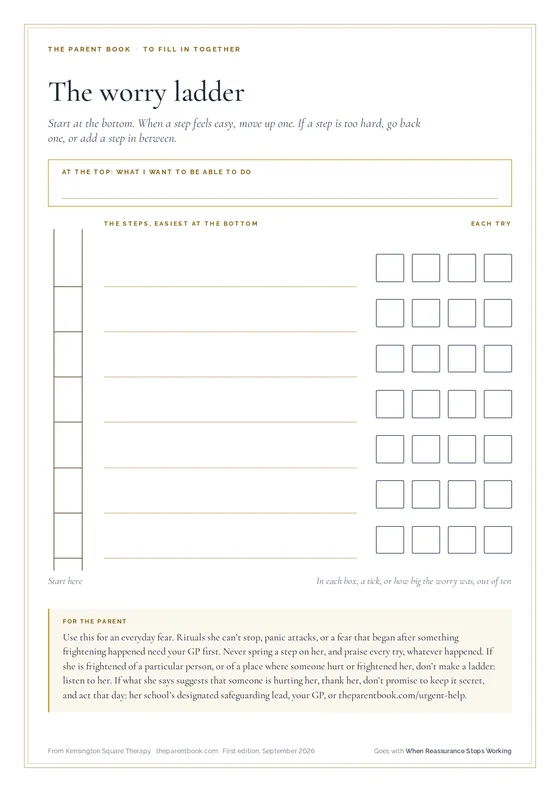 The worry ladder
To fill in together · A4
The worry ladder
To fill in together · A4
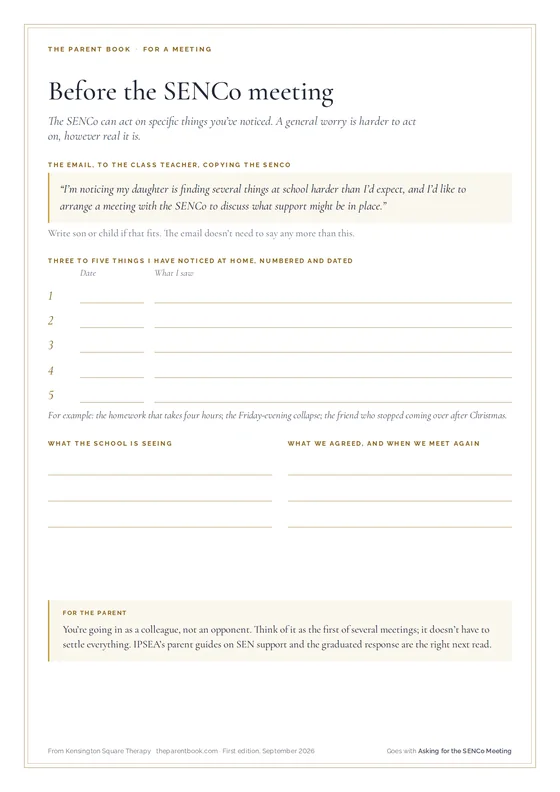 Before the SENCo meeting
For a meeting · A4
Before the SENCo meeting
For a meeting · A4
Read for your child’s ageAdjust any time
Showing everything
Quick TipsOne-minute reads
Quick tips195 in the library
Each quick tip is one idea, short enough to read in a minute and use the same evening. Twelve are shown here, from across the subjects the library covers.
Quick tip · 2 min
The Child Who Looks Fine
A teenager with good grades and teachers who say she’s fine can still be anxious and exhausted.
A minute to read, 3 things to try · open it
Quick tip · 2 min
When She Is Frightened at Night
At this age a monster can feel real, so what settles her is a room that stays the same all night and a parent who comes back when promised.
A minute to read, 3 things to try · open it
Quick tip · 2 min
When She Hits Her Brother
Stop it, go to the child who was hurt, and leave the talking until she has calmed down.
A minute to read, 3 things to try · open it
Quick tip · 2 min
School Re-entry After a Long Absence
After a long absence, her place at school is still there, but stepping back into it takes planning.
A minute to read, 3 things to try · open it
Quick tip · 2 min
The Party She Cannot Walk Into
Her stomach ache is real, and pushing her through party after party makes the next one harder.
A minute to read, 3 things to try · open it
Quick tip · 2 min
The School’s First Conversation About the Condition
The school needs the medical specifics, and your child needs to be known for more than her condition.
A minute to read, 3 things to try · open it
Quick tip · 2 min
What a SENCo Actually Does
Most schools have a SENCo, though most newly arrived parents haven’t met theirs.
A minute to read, 3 things to try · open it
Quick tip · 2 min
The Night Before the Assessment
Keep the evening before an assessment as much like any other evening as you can.
A minute to read, 3 things to try · open it
Quick tip · 2 min
The Room He Will Not Leave
Time on a headset is often time with friends, so start by asking about it.
A minute to read, 3 things to try · open it
Quick tip · 2 min
When You Are the One Not Sleeping
Lying awake night after night is a sign of overload, and a reason to see your GP.
A minute to read, 3 things to try · open it
Quick tip · 2 min
Sunday Evening Has Started Hurting
When Sunday evenings start to hurt, there is usually more than one reason, so slow down before deciding which conversation to have.
A minute to read, 3 things to try · open it
Quick tip · 2 min
The Day She Gets a Mental Health Diagnosis
A diagnosis puts a name to what she has been going through.
A minute to read, 3 things to try · open it
Activities38 in the library
Activities are things to do with your child. Each one says what it is for, how to do it at your child’s age, what your part is, and when to ask for more help. Eight are shown below; where one has a sheet to print, the card says whether the sheet is free.
Activity · Talking, side by side
The walk with no agenda
Walk with her at the same time each week, side by side. Some weeks she will talk, and you still go on the weeks she does not.
About 20 minutes · five steps and your part in it · open it
To print, with a subscription The walk with no agenda (A4, four cards to cut, PDF) From the chapter, When They Stop Talking to You →Activity · Handling feelings, practised when calm
Where a feeling sits
On a plain outline of a body, she marks where she first notices anger, worry and sadness.
About 20 minutes · five steps and your part in it · open it
To print, with a subscription Where a feeling sits (A4, two sides, PDF) From the chapter, Big Feelings and Co-Regulation →Activity · Mistakes, pressure and trying
A mistake each, at a weekly meal
Once a week, at one meal, everyone says one thing they got wrong, starting with you. Nobody comments on anyone else’s.
About 5 minutes · five steps and your part in it · open it
From the chapter, Perfectionism →Activity · School, friends and change
The route, twice, and the map
Before term, do the route once together and once with her leading, and draw the few rooms that matter.
Two trips, and an afternoon · five steps and your part in it · open it
To print, with a subscription The new place (A4, PDF) From the chapter, The Move to Secondary School →Activity · Home, screens and harder weeks
One meal without phones, yours first
One regular meal where every phone in the house, starting with yours, stays in another room.
About 30 minutes · five steps and your part in it · open it
From the chapter, Screen Time →Activity · Talking, side by side
Cooking one thing together
Cook one dish together each week, side by side, and give her a real job. If she wants to talk, she can do it while she chops.
About 45 minutes · five steps and your part in it · open it
To print, with a subscription Jobs in the kitchen, by age (A4, PDF) From the chapter, When They Stop Talking to You →Activity · Handling feelings, practised when calm
A place to settle, with you nearby
A comfortable corner, chosen with her, for when a feeling gets too big. While she is small you go there together, and nobody is ever sent there.
About 20 minutes · five steps and your part in it · open it
From the chapter, Big Feelings and Co-Regulation →Activity · Mistakes, pressure and trying
Learning something new, badly, together
Each of you takes up something none of you can do, and practises it where the others can see. There is no show at the end.
About 10 minutes · five steps and your part in it · open it
From the chapter, Perfectionism →Chapters24 in the library
Chapters are the long reads, each on one situation. Six are shown here, and the first chapter you open is free to read in full.
Chapter · 11 min
When the Best Friend Moves On
For parents whose child’s best friend has drifted away, with no falling-out to explain it.
Chapter · 12 min
The Hour Before Bed
For parents whose child’s bedtime has turned into an hour of worries, questions and meltdowns.
Chapter · 12 min
When They Stop Talking to You
For parents whose teenager hardly talks to them any more.
Chapter · 13 min
What to Do When School Is the Problem
For parents whose child has started dreading school.
Chapter · 13 min
What Screen Time Actually Is
For parents who feel they have lost the argument about screens.
Chapter · 13 min
When Parents Separate
For parents in the middle of a separation who are watching closely to see how their child is coping.
Self-care tools for parents8 in the library
Short, practical tools for looking after yourself.
For you
Breathing Space
A two-minute breathing exercise you can do anywhere.
For you
Settling Your Nervous System
For a day that has left you on edge.
For you
The 60-Second Reset
For the minute between one room and the next.
For you
The Kitchen at Six PM
For the parenting witching hour.
For you
The Self-Compassion Break
For the moment after you have shouted again.
For you
Help for Restless Nights
For the night your mind won’t switch off.
For you
Three Things to Put Down Today
Three questions about what you can hand over, drop or leave for a day.
For you
When You Cannot Sleep Because You Cannot Stop Worrying
For the 3am parent.
Books for parents211 in the library
The books we recommend to parents, each with a line on why we chose it. Six are shown here.
Book for parents
The Book You Wish Your Parents Had Read
Philippa Perry, 2020
A therapist’s humane, anecdote-rich book about the relationship between parent and child, and how understanding your own upbringing helps you respond
Book for parents
The Emotional Lives of Teenagers
Lisa Damour, 2024
Damour explains that teenage emotion is not a malfunction to fix, and shows parents how to listen, when to step in, and how to help teens handle feeli
Book for parents
The Whole-Brain Child
Daniel J. Siegel and Tina Payne Bryson, 2012
A psychiatrist and a child therapist turn brain science into simple phrases such as ‘name it to tame it’, helping parents of children aged about 2–12
Book for parents
How to Talk So Kids Will Listen and Listen So Kids Will Talk
Adele Faber and Elaine Mazlish, 2022
A classic for good reason. Through cartoons, dialogues and exercises it teaches parents to acknowledge feelings, invite cooperation without nagging an
Book for parents
Helping Your Child with Fears and Worries
Cathy Creswell and Lucy Willetts, 2019
A step-by-step programme showing parents how to guide an anxious child of about 4–12 through facing fears, using the parent-led CBT approach tested in
Book for parents
Unlocked
Pete Etchells, 2025
A psychologist who studies screens sets out what the research does and does not show, then helps families move from counting minutes to asking what th
Books to read together236 in the library
Books to read with your child. We chose them because they help a conversation get started.
Read together
The Colour Monster
Anna Llenas, ages 3–6
A muddled monster sorts his tangled feelings into coloured jars with a little girl’s help. It gives very young children simple names for joy, sadness,
Read together
Ruby’s Worry
Tom Percival, ages 3–6
Ruby’s small worry grows every time she ignores it, until a boy in the park shows her he has one too, and talking makes both shrink. A gentle invitati
Read together
Michael Rosen’s Sad Book
Michael Rosen, ages 5–8
Michael Rosen writes about the sadness he feels since his son Eddie died, sometimes hidden, sometimes angry. It is for children and adults together, a
Read together
The Teenage Guide to Stress
Nicola Morgan, ages 13–18
A calm, well-organised guide to what stress does to body and mind, with separate chapters on exams, friendships, sleep and bigger worries. Teenagers c
Podcasts98 in the library
Podcast episodes we think are worth your time, each with the reason we chose it.
Podcast
Ask Lisa: Untangling Family Life
Dr Lisa Damour and Reena Ninan
Podcast
Thriving Kids
Dr Dave Anderson (Child Mind Institute)
Podcast
Grief In Common
Child Bereavement UK
Podcast
Screen Sense: Parenting in a Digital World
Prof Pete Etchells and Prof Andy Przybylski
Videos138 in the library
Talks, films and video channels we think are worth your time.
Video
The single most important parenting strategy
Dr Becky Kennedy, TED, 14 min
Clinical psychologist Becky Kennedy argues that repair, going back after a rupture to take responsibility and reconnect, matters more than getting thi
Video
Dr. Dan Siegel’s Hand Model of the Brain
Dr Dan Siegel, YouTube, 8 min
Psychiatrist Dan Siegel uses a closed fist to show what happens when we ‘flip our lid’ in anger or fear, and how calm returns. Simple enough to teach
Video
3 steps of anxiety overload — and how you can take back control
Dr Lisa Damour, TED, 21 min
Psychologist Lisa Damour explains that anxiety is a normal, often helpful alarm, and describes when it tips into overload and practical ways to bring
Video
The mysterious workings of the adolescent brain
Prof Sarah-Jayne Blakemore, TED, 14 min
Cognitive neuroscientist Sarah-Jayne Blakemore shows how the adolescent brain is still developing, especially the regions for planning and social awar
Further reading105 in the library
Articles by other writers and organisations that we think are worth your time.
Elsewhere
Self-care for all parents and carers
Anna Freud
A short, kind page on why looking after yourself is part of looking after your child, with small realistic steps: asking for help, protecting sleep, a
Elsewhere
How to Avoid Passing Anxiety on to Your Kids
Child Mind Institute
For the anxious parent of an anxious child. It explains how children learn from what they see us do with worry, and why saying how you cope, out loud,
Elsewhere
Using praise and reward with children
Place2Be
How specific, warm praise and small rewards shape behaviour better than criticism, why it can feel hard to do consistently, and simple activities to b
Elsewhere
Dealing with child behaviour problems
NHS
The NHS basics for toddler and preschool behaviour: be consistent, stay calm, praise the good, avoid smacking, and know when to ask a health visitor f
↑ ↓ to moveEnter to openEsc to close