The Parent Book·From the library
The Move to Secondary School
For parents whose child is about to go from being one of the oldest in her school to one of the youngest.
An eighteen-minute read · Published 23 September 2026
For the whole of the last year, she has been one of the oldest people in the building. She knew which door stuck when it rained and which teacher would let you stay in at break. In September that ends overnight. She’ll walk into a school where she’s one of the youngest, and where the corridors are full of people a head taller than she is.
Most children manage this better than their parents fear, and the research, such as it is, agrees. In a government-funded study of more than five hundred families in England, most children said, a term in, that they were happy at their new school, and only three in a hundred said they were still worried or nervous. A minority don’t settle so easily, and some settle and then come unstuck later in the year. This chapter is about the move for all of them: how to help a child settle in, and how to tell, as the autumn goes on, which of these children you have.
Nearly all the research on this move follows children leaving state primary schools at eleven. We’ve found almost nothing on the move at thirteen, from prep school to senior school, and nothing reliable on starting to board. Where this chapter draws only on our own work, it says so.
What the move asks of her
The move changes three things at once, which is part of why the first weeks are more tiring than parents expect.
The first is the building. Whether she comes from a primary school with one teacher and one classroom, or from a prep school where she has had subject teachers and sets for years, the new school is usually bigger: more corridors and more pupils, a timetable and a map, a bag that has to have the right books in it on the right day, and a bell that keeps telling her to be somewhere else. If she moves at thirteen, she may also be joining a year group whose friendships formed at eleven.
The second is the people. The friendships she arrives with are rearranged within weeks, there are older pupils in every corridor, and the adults don’t know her the way her last school’s teachers did.
The third is the one parents most often miss: her place. At primary school a child is somebody, the one who draws or the one who’s good in goal. In the first weeks of secondary school she’s a name on a register, and she has to become somebody again in front of people who have no idea yet what she’s like. That’s the real task of the first term. It’s harder to see than learning the timetable, and it takes longer.
Researchers from Cardiff University and University College London followed about two thousand children through the move, and asked both the children and their parents what worried them. The lists overlapped: bullying, homework, friends. But there was one telling difference. Parents worried more about their child making new friends. The children worried most about losing their old ones.
Keep that difference in mind during the first week, because it changes the question you ask at the end of it. Have you made any friends yet? is the parent’s worry. She may need you to let her miss the friends she had.
The worries a child arrives with also change once she’s there, and at different speeds. Getting lost is the great fear before the move, and in that study it had begun to fade within the first term and was out of the top five by the end of Year 7. Worry about losing old friends went the other way: it rose to the top as soon as term began, and stayed there. Worry about being bullied dropped out of the top five in the first term and was back, at third, by the end of the year, as other worries fell faster than it did. Keep an ear open for that one all year.
The summer before
In our experience, the most useful thing a family can do over the summer is talk about the move, and let her talk about it, without the conversation turning into a campaign. The same study found that where parents and children were worried about the same things, children had fewer worries once they started, and the authors took that as a reason for families to talk worries through together. The exception was the family in which the parent was very worried indeed.
In practice, that means saying your worries at their real size. I think the bus will take a bit of getting used to is a worry she can cope with alongside her own. If you’ve plainly been lying awake over it, you’ve given her a second thing to manage, which is you.
Mark the end of primary school properly: the last day, the shirt everyone signed, the card for the teacher she’ll miss. Anna Freud’s booklet for parents, listed at the end of this chapter, makes the same point. In our work, the child whose last weeks at primary were rushed past on the way to the new blazer is often the one who misses it most in the autumn.
Do the route before term starts, once together and once with her leading. The second trip is the more useful of the two. If she’ll be taking a bus, let her pay, and let her make the small mistake of waiting on the wrong side of the road while you’re still there to laugh about it.
If she has an older sibling who has made the move, borrow them for an afternoon of advice. In the government study, children with an older brother or sister settled better, and in our experience advice from someone a few years ahead, a cousin or a neighbour’s child as much as a sibling, counts for more than a parent’s does.
Keep her old friendships going over the summer, including with friends who are going to other schools. If she knows anyone who’ll be at the same school, it’s worth arranging to meet once before September. It doesn’t need to become a friendship; one face she recognises on the first morning is enough.
Start moving bedtime back towards term time a week or two before term begins, a little earlier each night, not all at once on the last Sunday. The Royal College of Psychiatrists’ rule of thumb is between ten and eleven hours of sleep for a school-age child. A longer day, with a great deal more to take in, makes sleep more important.
The first half-term
In our work, parents of new Year 7s describe exhaustion in the first weeks more often than anything else, including unhappiness. She has been concentrating all day on things that will soon be automatic: where the room is, which teacher wants the date underlined, who she can sit next to at lunch. By the end of the school day there’s very little left, and if you ask questions as soon as you see her, she has nothing to answer them with.
Coram Family Lives advises parents not to ask too much when a child first gets home tired, hungry and short-tempered. Give her something to eat and an hour before the first question. Then ask something small and specific: Which lesson felt longest? or Where did you sit at lunch? A child who can’t answer How was it? can usually answer those.
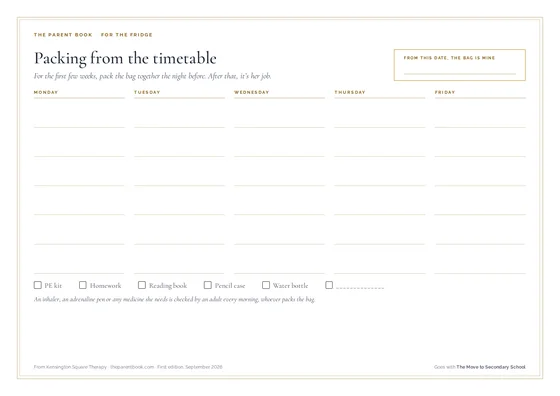
The first weeks also bring lost things: the PE kit left on the bus, the homework she did and can’t find. Some of this is organisation, and some of it shows how much she’s keeping track of at once. What helps is giving her some structure without rescuing her. For the first few weeks, pack the bag together the night before from a timetable on the fridge, and then hand the job over to her. When she forgets something, let the small consequence happen. She’ll get over a sharp word from a games teacher in the first term, and if you drive the kit in every morning, you’ve taken on a job that was hers to learn.
Settling in is rarely a straight line. A good first week followed by a bad second one is common, and it doesn’t mean the first week was a false start. Most schools make allowances early on, and in the government study the children who felt their new school had helped them settle were more likely to have settled well, on every measure the researchers used. If your child’s school offers a buddy, a lunchtime club for Year 7s or a settling-in evening for parents, use it.
The friendship reshuffle
Friendships change more in the first year than most parents expect. In the larger study, only thirty-eight in every hundred children still had the same best friend when Year 7 began, and by the end of the year it was twenty-eight. By the end of Year 7, more than a third no longer counted any of their three closest primary friends among their closest friends. It made no difference whether they were boys or girls.
The same researchers found that children whose friendships lasted tended to do better at school, and that children who belonged to a larger group of friends had fewer worries.
In our experience, the friend of the first fortnight often turns out to be temporary. In September children attach themselves quickly to whoever sits beside them in the form room, and many of those pairs drift apart by half-term. To the child it can feel like being dropped, but usually both of them are still finding out who they’re going to be at this school. When the Best Friend Moves On is about the harder version of this, and much of it applies.
Help her widen her circle while the old friendships are still going. One club, team or activity by half-term, chosen by her, often does more than any advice about who to sit next to, because we find that friendships formed around a shared activity tend to last longer than friendships formed around a shared table. A Saturday with her best friend from primary, now at a different school, gives her something familiar to rely on while the new friendships form. And resist the urge to arrange things. Ringing another parent to set up a friendship, however kindly it’s meant, is usually obvious to both children, and rarely helps either of them.
At some point in the first term she may find out there’s a group chat she isn’t in. It’s one of the sharper hurts of this age, because it’s exclusion she can see. What helps is how you handle that evening. Take it seriously, say that it hurts, don’t send messages to anyone, and let her decide in the morning whether she wants to do anything about it. If it keeps happening with the same children, it may be something the school needs to know.
The child who goes quiet
Sometime in the first term, many parents notice that their child is saying less.
Usually this is normal. She’s tired, and she’s also eleven, which is often when a child starts, bit by bit, to keep more to herself; When They Stop Talking to You is about that longer change. If she’s saying less at home but eating, sleeping, seeing friends and going to school without a fight, then most of the time she’s settling in somewhere you can’t see.
Sometimes it’s something else. The signs that matter are the ones that last, and the ones that spread:
- Not wanting to go most mornings, and not just on the Monday after a bad Friday
- Stomach aches on school mornings that are gone by the weekend
- No longer mentioning anyone by name
- Sleep or appetite that has changed and not changed back
YoungMinds’ guidance for parents draws the line where we would: when changes like these last for several weeks, get worse, or begin to affect daily life, it may be a sign she needs professional support, and her GP is the place to start, alongside the school.
Bullying needs a separate mention. In the government study it was the clearest single mark of a move that had gone badly: children whose parents reported it were much less likely than others to have widened their friendships, grown in confidence or settled well. If you suspect it, at any point in the year, do not wait for it to resolve itself. When Your Child Is Being Bullied sets out what to do and in what order.
Many schools use the October half-term, or the first parents’ evening, to take stock of how new pupils have settled, and it’s a good time for you to do the same. Take stock again after Christmas. Settling in doesn’t keep to a timetable: in the larger study, eight in ten parents thought, at the end of Year 7, that their child had settled in well, which leaves about one parent in five who did not think so. If you’re one of them, that’s a reason to talk to the school, not a verdict on your child.
When to ring the school
We find that parents of new Year 7s tend to ring the school either very early or rather late: in the first week about a lost locker key, or in the spring about something that has been going on since October. The first does little harm. The second is the one to avoid.
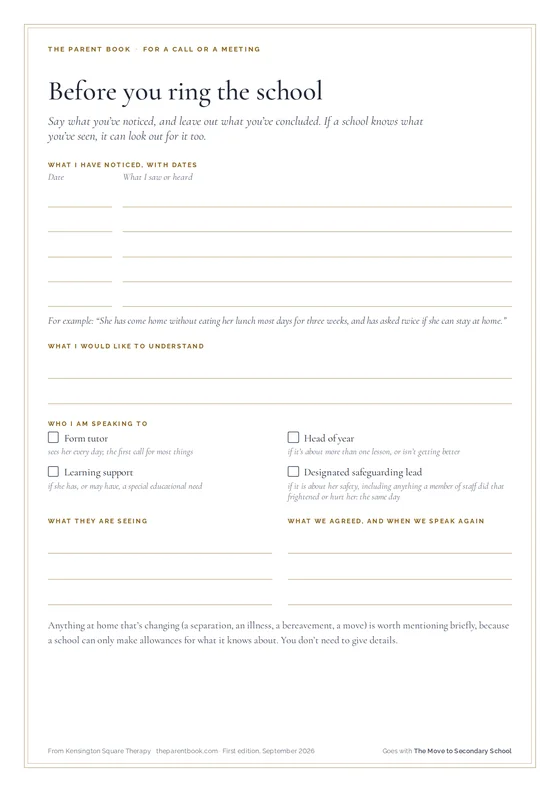
For most things, the first person to contact is her form tutor, who sees her every day and is the person the school expects to hear from. If it concerns more than one lesson, or isn’t getting better, go to the head of year. If she has, or may have, a special educational need, contact the SENCo, or whoever leads learning support at her school.
Describe what you’ve noticed, not what you’ve concluded. She has come home without eating her lunch most days for three weeks, and has asked twice if she can stay at home gives the school something to look for. I think she is being bullied, before you know it, gives them something to answer. Then ask what they’re seeing. A child can be one thing at home and another in the corridor, in either direction, and your view and theirs together tell you more than either does alone.
Tell the school about anything at home that’s changing: a separation, an illness, a bereavement, a move of house. You don’t need to give details. A school can only make allowances for what it knows about.
Ring sooner, and do not wait for a parents’ evening, if there is any suggestion of bullying, if she is refusing to go, or if you are worried about her mood. National guidance asks schools to keep checking how new pupils are settling, and to check more often on those who are finding it harder, so a call from you is part of how that checking works. If the worry is about her safety and cannot wait for the school day, use the routes under If you need help right now, at the foot of this page.
At different ages
If your child is in Year 6. The move is still ahead, and your job is to keep it in proportion. Visits and taster days help, and so does letting her form her own view of the place. Ask her what she’s looking forward to as well as what she’s dreading. In a survey of Year 6 children in Wales, almost one in five were worried about the move and looking forward to it at the same time. It helps a child to hear that she can feel both at once.
If your child is moving at thirteen. This is the move from a prep school into Year 9, often after Common Entrance, and sometimes into boarding. What follows comes from our own work, not from studies. The change in her standing can be steep. At thirteen she may have been a prefect or a captain in a small school, and she may arrive in a year group that has been together since Year 7, with its friendships already made. It’s worth asking the school how new Year 9s are brought together with the pupils who joined at eleven. She’s also further into adolescence, so she’ll tell you less, and you’ll get more from a conversation side by side, in the car or on a walk, than from one across a table. If she’s boarding, agree in advance when you’ll speak and keep to it, and make sure she knows she can ring you at any other time as well. Childline’s pages on moving schools, written for young people themselves, are the only ones we’ve found that speak directly to a new boarder, and they’re worth passing on to her.
If your child is autistic, or has ADHD or another additional need, much of this chapter applies all the more. In the government study, children with special educational needs settled as well as others overall but were more often bullied. In the larger study, some of the preparation that eased anxiety for most children increased it for some children with additional needs. In our experience, the preparation that helps is the kind you plan with her: a visit when the school is less busy, photographs of the rooms and of the adults she’ll meet, and one named person she can go to. Neurodiversity, and the Conversation with the School is about that conversation.
The longer arc
For many children, the move to secondary school is the first time they have to become somebody again among strangers. It won’t be the last. There may be a sixth form, a university or a first job, a new city. If this year goes reasonably well, what she learns is that being new is uncomfortable but survivable, and that the discomfort passes in its own time.
Keep home the one place where she doesn’t have to be new. For most children, the building that was a maze in September is, by the summer, just where they go to school. And one day in July, if you’re lucky, you’ll hear that a group of Year 6 children came to visit and she showed them the way.
NOTES
- Evangelou, Maria, Taggart, Brenda, Sylva, Kathy, Melhuish, Edward, Sammons, Pam & Siraj-Blatchford, Iram. What Makes a Successful Transition from Primary to Secondary School? Research Report DCSF-RR019. Department for Children, Schools and Families, 2008. The government-funded study of 550 children and 569 parents in six local authorities in England, surveyed in the first term of Year 7: the figures on how children felt a term in, on help from the secondary school, on older siblings, on bullying, and on children with special educational needs. Its measures of a successful move split children at the median, so it gives no single success rate.
- Rice, Frances, Frederickson, Norah, Shelton, Katherine, McManus, Chris, Riglin, Lucy & Ng-Knight, Terry. Identifying Factors that Predict Successful and Difficult Transitions to Secondary School. Report to the Nuffield Foundation (the School Transition and Adjustment Research Study, STARS), 2015. About two thousand children in South-East England, questioned in May 2012 (Year 6), November 2012 and May 2013 (Year 7): parents’ and children’s worries and how they changed, friendship stability, and preparation that raised anxiety for some children with special educational needs. Figure 1 draws the order of the five worries pupils rated highest at each point. For the end of Year 6 it follows the report’s Graph 1, the 2021 paper below and the study’s booklet for parents, which agree; the report’s own Figure 2 lists places two to five of that column in reverse. On Graph 1, discipline and detentions and being bullied are tied at that point, so their order rests on the booklet. Figure 2 draws section 5.1. The figure of eight in ten parents is from the booklet for parents.
- Rice, Frances, et al. “Pupil mental health, concerns and expectations about secondary school as predictors of adjustment across the transition to secondary school”. School Mental Health, 2021, 13(2), 279–298. The peer-reviewed account of the same study: concerns fell across Year 7, getting lost fastest, and more slowly for girls, without girls settling less well.
- Ng-Knight, Terry, et al. “‘Best friends forever’? Friendship stability across school transition and associations with mental health and educational attainment.” British Journal of Educational Psychology, 2019, 89(4), 585–599. Children who kept the same best friend had higher attainment and fewer conduct problems.
- Jindal-Snape, Divya & Cantali, Dianne. “A four-stage longitudinal study exploring pupils’ experiences, preparation and support systems during primary–secondary school transitions.” British Educational Research Journal, 2019, 45(6), 1255–1278. Worries declined over time, but for some pupils problems emerged later.
- Moore, Graham F., et al. “Socio-economic status, mental health difficulties and feelings about transition to secondary school among 10–11 year olds in Wales.” Child Indicators Research, 2021, 14(4), 1597–1615. 2,218 Year 6 children: 18.7 per cent both worried about and looking forward to the move.
- National Institute for Health and Care Excellence. Social, Emotional and Mental Wellbeing in Primary and Secondary Education (NG223), 2022, recommendations 1.5.2 to 1.5.5: preparing children for educational transitions, and checking on an ongoing basis whether they are settling, more often where a child is at higher risk.
- Royal College of Psychiatrists. Sleep problems for parents, information for parents and carers, 2015. The rule of thumb on hours of sleep, and the case for consistent bedtimes.
- Jindal-Snape, Divya, et al. “Systematic literature review of primary–secondary transitions: international research.” Review of Education, 2020, 8(2), 526–566. The caution behind this chapter’s opening: outcomes often dip across the move, but the research cannot yet say how far the move itself is the cause, or how long any dip lasts.
Where to go further
Place2Be, Helping your child prepare for Secondary or High School The best single page we know of for parents on this move, from Place2Be’s Parenting Smart series. It covers what changes, when to check in, what to watch for in friendships and online, and when to talk to the school. It’s a ten-minute read, with a short film.
Anna Freud, Supporting children’s transition to secondary school: guidance for parents and carers A short booklet you can print, written with clinicians and teachers. It sets out the signs that a move has gone well, and gives practical advice under four headings for the months either side of it. It’s worth putting on the fridge in the summer before the move.
Lisa Damour, Untangled Damour writes about girls, but the first two of her seven transitions, parting with childhood and joining a new tribe, are what most children go through in their first year at secondary school. If the move has come with the first signs of adolescence, read those two chapters first.
What helps a child starting secondary school
Most children settle, some faster than others, and settling is rarely a straight line. These are the things that, in our work and in what research there is, help it along.
- Say your worries at their real size. In our experience, talking the move through together helps, and a parent’s worry turned up too high doesn’t. “I think the bus will take a bit of getting used to” is a worry she can manage alongside her own.
- Let her lead the route once. Do the route to school before term, once together and once with her in charge. Let her pay, and let her make a small mistake while you’re still there.
- Feed her first, ask later. The first weeks are exhausting, so give her food and an hour before asking anything. Then ask something small and particular: where she sat at lunch, which lesson felt longest.
- Help her organise, then step back. Pack the bag together from a timetable on the fridge for the first few weeks, then hand the job to her. A forgotten kit and its small consequence teach her more than a parent driving it in.
- Widen the circle, keep the old friends. Most children don’t have the same best friend by the end of Year 7. One club or team she has chosen helps new friendships form, and a Saturday with an old friend gives her something familiar while the new ones grow.
- Watch for changes that last. An off week is normal. Changes that last several weeks, get worse, or start to affect her daily life are worth a call to the school and her GP. Bullying is worth a call to the school at once.
- Tell the school what you notice. Start with the form tutor. Describe what you’ve seen, not what you’ve concluded, ask what they’re seeing, and tell them about changes at home.
What helps at 9 to 11
- Keep the move in proportion. Visits and taster days help. Ask what she’s looking forward to as well as what she dreads; many children feel both at once.
- Mark the ending. Make something of the last day, with the signed shirt and the card for the teacher she’ll miss. An ending that has been marked is easier to leave.
What helps at 11 to 13
- Ask one specific question. Give her food and an hour first. Then ask one particular question, not “How was it?”
- Take stock at half-term, and again after Christmas. Settling doesn’t keep to a timetable. If what worried you in October is still there after Christmas, talk to the school.
What helps at 13 to 16
- Plan for starting at thirteen. Ask how new Year 9s are brought together with those who joined at eleven. Talk side by side, in the car or on a walk. If she boards, agree when you’ll speak, keep to it, and make sure she knows she can ring you at any other time as well.
Put it into practice
What this chapter looks like in practice: one-minute ideas for tonight, things to do together and sheets to print and keep.
Quick tipsOne minute each
- The Friend of the First FortnightMany September friendships loosen by half-term, and usually neither child has done anything wrong.
- The Group Chat She Is Not InBeing left out of a group chat hurts; take it seriously, and send no messages tonight.
- The Question at the School GateIn the first weeks at a new school, children are often too tired to answer questions at the gate.
Six quick tips on this in the library
To do togetherActivities
- Running the moment throughOn a calm day, you play the other child and she tries out what she might say. Keep it short and light, and do it once or twice at most.About 10 minutes · with a sheet to print
- The route, twice, and the mapBefore term, do the route once together and once with her leading, and draw the few rooms that matter.Two trips, and an afternoon · with a sheet to print
- Marking the endingIn the last weeks at a school, offer her a few pages for what she will miss, and perhaps a card for a teacher. It is up to her, and she keeps what she makes.About 30 minutes · with a sheet to print
Seven activities on this in the library
To printWith this chapter
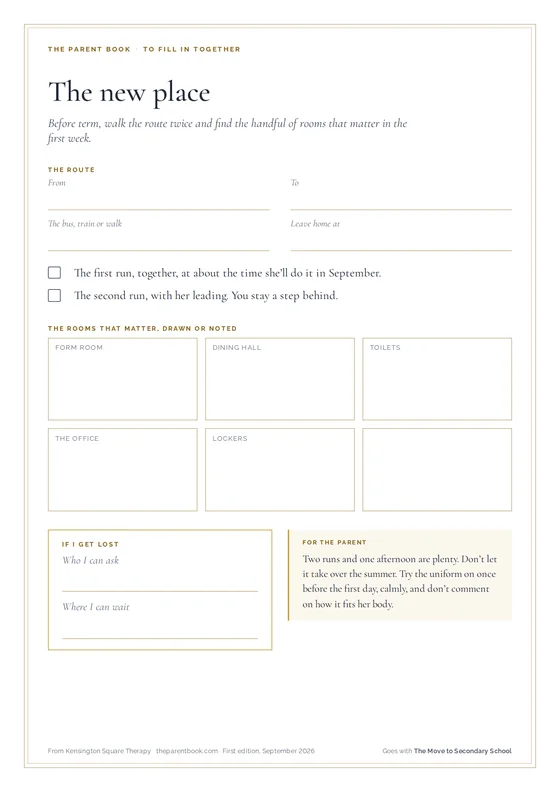
The quick tips and activities are for subscribers; the sheets that go with this chapter are yours to print. What a subscription includes.
Who else can help
Place2Be
Parenting Smart, written by the child mental health specialists who work in primary schools: short, practical articles and films on friendships, behaviour, worries and routines.
Anna Freud
The Anna Freud Centre’s family wellbeing resources: careful, research-led reading on children’s emotional development, separation, self-care for parents, and supporting a child through treatment.
YoungMinds
The UK’s young people’s mental health charity, with a free Parents Helpline, webchat and email, and a plain A to Z of the things parents worry about.
0808 802 5544 · Mon, Thu, Fri 9.30am-4pm; Tue, Wed 9.30am-6pm
Outside those hours the parents line is closed. The urgent routes on this page are open when it is not.