The Parent Book·From the library
Big Feelings and Co-Regulation
For parents whose child has just had a meltdown, on how to help her through it.
A fourteen-minute read · Published 25 May 2026

A three-year-old is lying face down on the floor, screaming about a banana. His mother broke it in half as she was handing it to him, and now it’s on the floor in two pieces. He’s been told he can have a new one. He doesn’t want a new banana. He wants this banana, the broken one, to be whole again, and he feels in his bones that his mother should somehow be able to make that happen. He’s beside himself with rage. His mother has had a long day at work. She looks at the banana, then at him, then at the clock. The small part of her that’s still functioning starts to argue with the larger part, which would like to go upstairs and shut the bathroom door for ten minutes.
Ten years later, the same scene looks different. A thirteen-year-old has slammed her bedroom door so hard that the picture on the landing has tilted. The argument began with whether she could go to Maya’s house on Saturday, and it has turned into the bigger argument that has been running under the surface for weeks: her mother doesn’t understand her, has never understood her, and is currently the worst person on the planet. Her mother, out on the landing, would also, if she’s honest, like to shut a bathroom door for ten minutes.
Both of these come up often in our work with parents, and in both the child needs the same thing. When a child’s feelings have grown bigger than she can manage, she needs a calmer person beside her while she finds her way back. It’s easy to read that as a discipline problem and leave it there. The literature calls what she needs co-regulation, and it’s an unglamorous, everyday practice.
What is actually happening
In The Whole-Brain Child, Daniel Siegel and Tina Payne Bryson give parents a simple model for this. There’s an upstairs brain, which thinks, plans and considers what happens next, and a downstairs brain, which handles alarm and survival. When the two stop working well together, they call it flipping the lid. The model is a simplification, and the more precise point behind it is this: when a child is very distressed, the part of her that reasons, waits and thinks beyond the next thirty seconds becomes much harder for her to reach. It comes back gradually, and it can’t be called back on command. The three-year-old on the floor has flipped his lid. So has the thirteen-year-old behind her bedroom door, though people use the phrase less often about teenagers.
A child flips her lid when what she’s dealing with, in that moment, is more than the self-regulation she has developed so far can cope with. A four-year-old can wait a little, settle herself a little and tolerate a disappointment for a short while. She has far less of this than an adult, and what she has deserts her quickly when she’s tired, hungry or frightened. A thirteen-year-old has more of it, but she’s having to use it in a body that is going through one of the most hormonally disruptive periods of its life. In both children, this ability is still developing.
This changes what you do next. Once you understand that reasoning won’t get through to her for the next few minutes, you can stop trying. Instead, you lend her your own calmer nervous system until her own is easier to reach. That’s co-regulation: lending her your capacity until she has grown more of her own.
Co-regulation is not staying calm
The advice you see everywhere online is stay calm. It sounds like the right instruction, but in practice it’s almost useless, because it tells you what state to be in without telling you how to get there.
Co-regulation has three parts. The first is your body. At times like this, your body is the calmest thing in the room. Breathe more slowly, relax your face, lower your voice, keep your hands open and loose, and move closer to her. Her nervous system reads these signals long before her conscious brain takes in any words. When a two-year-old stops crying once she’s picked up, nobody has talked her round. She’s being held by an adult whose body is calm, and her own body is starting to match it.
The second is being there. Co-regulation needs you to actually be present: off your phone, and not running a commentary on whether this is happening because of the screen time or the sugar. Give her your attention, even if it’s only for sixty seconds. Karen Treisman writes well about this in her work on felt-safety. A child who feels she has been heard doesn’t need to keep escalating to be heard.
The third is repair. Co-regulation ends with the conversation that comes afterwards, hours or sometimes a day later, in which you name what happened and show her that the two of you are all right. It’s the part most parents skip, often because they’re exhausted, and skipping it costs more than they realise. A child who has been through a meltdown with no repair afterwards is left with the memory of having gone off the rails on her own. Compare a child whose mother, an hour after the same meltdown, sits on the edge of her bed and says, “That was really hard for both of us, wasn’t it? I’m sorry I was sharp with you. I love you very much.” That child comes to see the meltdown as something she got through, in a relationship that didn’t break.
Why your child melting down activates you
A child’s meltdown is physiologically contagious. By the second minute, what is happening in the screaming three-year-old’s body is happening in yours: your cortisol rises and your breathing gets shorter. Your flight instinct tells you to leave the room, your fight instinct tells you to shout, and your freeze instinct tells you to stand on the rug and let your face go blank.
Reacting like this isn’t a character flaw. In those minutes you’re being asked to stay regulated while someone right beside you isn’t, and your bond with them makes the signal louder. If you’ve had three of these in a day, on top of the morning meeting and the laundry, you’re worn out.
Realistically, you will have your own reaction. The aim is to build up, over time, a few habits that help you manage it well enough to stay in the room. Some are things you do yourself: a long out-breath, cold water on your wrist, deliberately dropping your shoulders. Some are about your surroundings: a partner who can take over, a worktop to put your hand on. And some, over the longer term, mean looking at why your child’s meltdowns set you off in this particular way, which a counsellor of your own can sometimes help with. Parenting often brings up things that have been waiting twenty years.
What about time-out
Time-out, which most parents of my generation grew up with, has become one name for several different things. A brief, calm, predictable pause, used after a clear boundary and followed by coming back together, isn’t the same as sending an overwhelmed child away in anger, or making a spectacle of her in front of her brother. The evidence does not support saying that time-out is generally harmful. It does support paying close attention to how you use it: how long it lasts, how you announce it, and what your child is left to work out about whether you’re coming back. When a child has already come undone, we prefer to stay close, use few words and help things settle before trying to teach anything. The reason is the one this chapter started with: what she’s short of at that point is a calmer person beside her, and a child sent off to find that on her own has further to go.
There’s one kind of stepping back we do recommend, and in it the person who steps back is usually the parent. The clearest case is an older child who has worked out for herself that she needs a few minutes, and a parent who gives her that time by leaving the room. “I’m going to step out of the room for a minute. I’ll be back. You can come and find me when you’re ready.” You’ve made it clear the door is still open, and what she sees is you looking after your own state. Nobody has removed her from the room. In a two-parent household, a silent handover, with one of you tagging out and the other tagging in, does the same job, and it’s worth practising before the evening you need it.
The general rule in our work is that co-regulation happens with the parent in the room, and that a meltdown isn’t in itself a behaviour to punish, because it comes from where she is in her development. If a health visitor taught you a short, calm, predictable pause when your child was small, or a school or parenting programme did, and it’s working in your house, nothing here is asking you to stop. On what to do after a meltdown, the book we most often find ourselves giving parents is Siegel and Bryson’s No-Drama Discipline, the practical companion to The Whole-Brain Child. It’s unusually good on the difference between discipline (teaching) and punishment (making the child feel worse for what has just happened).
What actually helps in the moment
Start with your body, before any words. Before you say anything about the banana, lower your voice, slow your breathing and get down lower than your child. Sit down; don’t stand over him. A two-year-old looking up at his mother sees a giant looming over him. Sitting on the floor, she’s the same mother, but far less likely to make things escalate. Keep your hands open and your face relaxed, and name the feeling before you try to fix anything: “I can see how upset you are. The banana broke, and that was so hard.” Siegel calls this name it to tame it. Once a feeling has been named out loud in a calm voice, a child finds it easier to cope with than one nobody has acknowledged.
Next, be with her before you try to teach her anything. The lesson, if there is one, comes later, and it’s smaller than you think it needs to be. A child can’t take in a lesson at the peak of her distress. What she’s taking in, down on the floor, is whether the adult next to her stays. Everything else can wait.
Repair the rupture afterwards. An hour later, sit on the edge of her bed and name what happened: “That was a really hard moment for both of us, wasn’t it? I was sharp with you, and I’m sorry. I love you.” Keep it short and true, and say it in a calm voice; it doesn’t need to be a speech. In attachment terms, repair restores what the rupture strained. A child in a household where repair happens reliably learns that ruptures don’t end relationships, and that’s one of the most important things a young adult can take into her own friendships.
And stop trying to work out the cause while it’s happening. The conversation about whether it was the screen time, the sugar, the lack of sleep or the way Granny spoke to her on Sunday isn’t a useful one in the middle of a meltdown. Leave the post-mortem until the children are in bed.
For primary-age children, we send parents to Place2Be’s Parenting Smart articles on big feelings, which are written by school-based counsellors and are plain and practical. If you want something more clinically grounded, particularly if the meltdowns have started to seem more sustained than is usual for her stage of development, Anna Freud’s resources on emotional regulation in younger children are the next step. Family Lives runs a confidential helpline, which is the right call when your question is about the family as a whole and not a clinical concern about your child.
At different ages
Dysregulation, and the co-regulation it calls for, looks different at every age. The bands below are a rough guide.
If your child is between four and seven. Meltdowns are at their loudest and most frequent at this age, because her brain is still developing. Start with your body: get down to the floor, lower your voice and name the feeling. Don’t try to reason with her in the middle of a meltdown. “You wanted the blue cup and I gave you the green one. That’s so disappointing.” Naming it matters even when she can’t yet respond. For this age, The Whole-Brain Child is more useful than any other single book we know.
If your child is between seven and nine. Meltdowns are less frequent now, and often more verbal. A seven-year-old can tell you what’s wrong in the middle of a meltdown, often inaccurately. Take in what she says without arguing about whether it’s accurate: “That sounds really hard. I’m sorry it’s been like that.” Then put a hand on her shoulder and let the evening go on. At this age a meltdown is often the first sign of a hard day at school that she hasn’t mentioned until then.
If your child is between nine and eleven. With secondary school approaching, she’s becoming more self-conscious, and more and more of her meltdowns happen behind a closed bedroom door. What helps is to knock, let her know you’re there, and then wait patiently outside: “I’m here when you’re ready.” Say it calmly, then sit on the landing for ten minutes. Don’t force your way in, and don’t go away altogether. Stay in between: on the landing, available, not asking her to talk and not visibly doing anything except being there.
If your child is in early secondary, eleven to thirteen. Teenage rage has arrived. It’s louder than you expected, comes faster than it did at nine, and is often aimed at you in particular. The upstairs and downstairs brain applies to her too: when a thirteen-year-old has flipped her lid, reasoning doesn’t work much better in those minutes than it did when she was four. So start with your body, as before. Lower your voice, don’t crowd her and don’t match her volume. Leave the conversation about what the row was really about until the next morning, in the car, with the radio on low, and come at it indirectly.
If your child is in mid to late secondary, thirteen and beyond. At this age dysregulation is sometimes less explosive but lasts longer: a bad week, where it used to be a bad afternoon. What helps is being there without asking anything of her: offering a walk, bringing a cup of tea to her room without comment, giving her a lift to a friend’s house and saying almost nothing on the way. After a row, the repair is a brief acknowledgement a few days later: “I’ve been thinking about what we said on Saturday. I’m sorry I was sharp. I love you.” Say it in passing, and don’t make it a sit-down conversation at the table.
The longer arc
You aren’t aiming for a child who never melts down. What you’re building is a child who has borrowed your calm often enough to learn regulation from the inside. The capacity is learned, laid down through ten thousand everyday moments in which the adult next to her stayed put, slowed her own breathing and let the outburst pass without joining in. She grows up into an adult who can do this for herself, and then, often, for her own children.
This is the slowest part of parenting. You won’t see results inside a week. Over years, though, it produces a person who can stand her own feelings, and everything else is built on that. We think it’s the most important outcome there is, even if it isn’t a flashy one.
In the great majority of cases, the three-year-old on the floor eventually picks himself up, eats half of the new banana and is soon asking for a story. The thirteen-year-old behind the closed door eventually opens it, and a few hours later she sits at the table, subdued, picking at the dinner you plated up for her. Both are the lid coming back on, and in the long run both are evidence that what you’re doing is working, however slowly. It’s fine to be tired. In those moments you’re also doing more than you realise.
NOTES
- Siegel, Daniel J. & Bryson, Tina Payne. The Whole-Brain Child. Bantam, 2011. The “name it to tame it” move and the upstairs/downstairs brain model both originate here.
- Siegel, Daniel J. & Bryson, Tina Payne. No-Drama Discipline. Bantam, 2014. The discipline-as-teaching frame, and the distinction between connection and correction.
- Sunderland, Margot. What Every Parent Needs to Know. DK, 2016. Sunderland’s developmental neuroscience for parents: body before brain, and the steadier nervous system a child borrows from.
- Roach, Alex, McLean, Rebecca, Mendoza Diaz, Antonio, Hawes, David & Dadds, Mark. “Time-out under scrutiny: examining the relationships among the discipline strategy time-out, child well-being and attachment and exposure to adversity.” The British Journal of Psychiatry, 2025, 227(2), 538-544. The paper at the centre of the current time-out argument, and the reason this chapter states a position rather than a verdict: 474 Australian caregivers of six-to-eight-year-olds, surveyed once. Appropriately implemented time-out was associated with better mental health and attachment, and inappropriately implemented time-out with worse child outcomes. Exposure to adversity moderated the picture in one direction only: children who had experienced adversity were the most likely to show attachment benefit from time-out used well. It is cross-sectional, so it cannot establish which way the causation runs.
Where to go further
Daniel J. Siegel and Tina Payne Bryson, The Whole-Brain Child The clearest single introduction we know to how a child’s brain handles a strong feeling, why reasoning gets so much harder when she’s overwhelmed, and what you can do about it in practice. We mention it in the chapter above, and it’s short enough to read in two evenings.
Margot Sunderland, What Every Parent Needs to Know An illustrated guide, by a UK child therapist, to the science behind everyday emotion. The chapters on tantrums, on bedtime regulation and on what a child borrows from a calmer adult are the ones we send parents to most often.
What helps a child learning to regulate
Children learn to manage their feelings through thousands of moments of calming down alongside the adults around them. These are the practical, evidence-informed moves that, in our work, help that learning along most reliably.
- Settle yourself first. Young children can’t calm themselves down yet; they calm down by being near an adult who is calm. So before you say anything, slow your own breathing and lower your voice. That does more than the words.
- Name the feeling simply. Try “You’re really frustrated right now.” That’s all you need to say. Naming the feeling moves brain activity from the emotional centre towards the language centre, and that in itself is calming.
- Talk less during a meltdown. Mid-meltdown, the part of her that listens and reasons is much harder for her to reach, so words don’t get through. What helps is you sitting nearby, breathing slowly. Save the conversation for later.
- Say sorry after you lose your temper. Every parent loses it sometimes. Putting it right afterwards matters more than the outburst itself: “I’m sorry I shouted. That wasn’t fair. You didn’t deserve that.” It shows your child that a row doesn’t break the love between you.
- Build a calm-down corner. Set up a corner with cushions, soft toys, a book and a sensory item. It’s a place to go to settle, and never a punishment. Children use it more than parents expect, especially older primary-age children who are too proud to ask.
- Use breathing tools they can do without you. Try Lazy 8: trace a figure 8 in the air, breathing in on the way up and out on the way down. Or finger breathing: trace round your hand, breathing in up each finger and out on the way down. Both are simple physical tools they can use anywhere, including at school.
- Talk about feelings when things are calm. Have the conversation about anger later, when things have settled, and not at the height of the tantrum. The learning happens between outbursts.
Put it into practice
What this chapter looks like in practice: one-minute ideas for tonight, things to do together and sheets to print and keep.
Quick tipsOne minute each
- The Tantrum Over the Broken BananaA broken banana is more than a tired three-year-old can take.
- When the Lid Has FlippedWhen a child is overwhelmed, a few words usually reach her better than a lot.
- When You Have SnappedAfter you’ve snapped at your child, go back, apologise and put it right.
Twelve quick tips on this in the library
To do togetherActivities
- Hands busy, side by sideColour, build or make things side by side, each of you on your own thing. Nothing is asked of her, and nothing she makes is marked.About 20 minutes
- A film, and the conversation you do not forceChoose a film with some care, watch it side by side, and do not ask questions afterwards. If she wants to talk, she will.The length of a film
- Play me somethingShe picks a song and plays it to you. You listen to the end, and ask one question about it.About 10 minutes
Eight activities on this in the library
To printWith this chapter
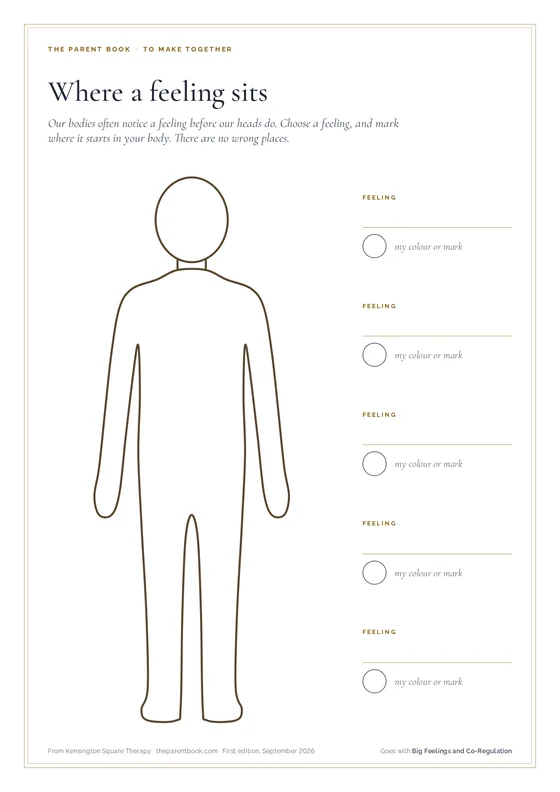

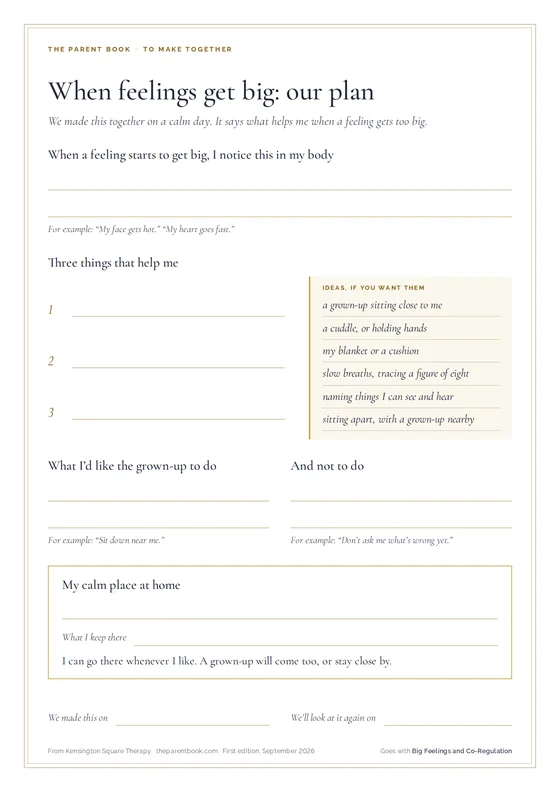
The quick tips and activities are for subscribers; the sheets that go with this chapter are yours to print. What a subscription includes.
Who else can help
Place2Be
Parenting Smart, written by the child mental health specialists who work in primary schools: short, practical articles and films on friendships, behaviour, worries and routines.
Coram Family Lives
A free, confidential helpline for any parenting or family worry, by phone, live chat, WhatsApp or email, staffed by trained family support workers.
0808 800 2222 · Mon-Fri 9am-9pm; weekends 10am-3pm; closed bank holidays
Outside those hours the line is closed. Samaritans answer at any hour on 116 123, and Shout answer if you text the word SHOUT to 85258.
coramfamilylives.org.uk/how-we-can-help/confidential-helpline
Anna Freud
The Anna Freud Centre’s family wellbeing resources: careful, research-led reading on children’s emotional development, separation, self-care for parents, and supporting a child through treatment.