
Friendships
Friendships
A child’s friendships run alongside her family life and shape her as much as anything you do at home. These pages cover losing a best friend, a group that has changed, the child with no one to sit next to, and the social media side of all of it. They’re for the parent watching from the sidelines.
What the library says about this, on one page. It is also online at theparentbook.com/help/friendships
What to do first
Friendship trouble is a big deal to a child, and it doesn’t mean anything has gone wrong with her. Groups reshuffle, and it hurts when they do.
- Listen without trying to fix it, and don’t criticise the other child, however tempted you are. She’ll repeat what you say, at school, on Monday.
- Make time outside school with one child she is already comfortable with: a walk, a swim, an hour at the park. It is for keeping a friendship going, not for making one, and one person is enough.
- Tell her form tutor what you’ve heard. Schools can change where a child sits, and often that’s all it takes.
What helps
- Listen first, advise second. Sit down, and don’t argue with the feeling: “That sounds really hard. Tell me what happened.” Let them finish before you offer a single suggestion.
- Make home a secure base. Children with a stable home are very good, in time, at finding friends they fit with. Time you put into home life helps them socially too.
Some tips to try
Short pieces from the library, and a first thing to try from each.
-
No One to Sit With at Lunch.
A lonely child generally seems fine, which is why loneliness is so easy to miss.
- Ask yourself whether any child has sought her out this week.
-
The Friend of the First Fortnight.
Many September friendships loosen by half-term, and usually neither child has done anything wrong.
- Help her find one club, team or activity by half-term, chosen by her.
-
The Group Chat She Is Not In.
Being left out of a group chat hurts; take it seriously, and send no messages tonight.
- Take it seriously and say that it hurts.
- If it keeps happening with the same children, tell her form tutor what you have seen.
The rest of each tip, with more to try and why it works, is in the library.
Something to do together
A film, and the conversation you do not force. Choose a film with some care, watch it side by side, and do not ask questions afterwards. If she wants to talk, she will.
What it is for. Someone else’s friendship can be easier to think about than her own. Watching a film side by side gives you a story in common, and she does not have to explain herself.
- The first step. Choose the film carefully. Read what the film is about, and check its age rating and the content advice that comes with it: a film about a death, a suicide or a child being bullied may help one child and be too near for another.
Safety. If it is streamed, watch in a shared room with autoplay off, so that nothing follows it.
When to get help. If the film opens something serious, and she tells you that someone is hurting her, that she is hurting herself, or that she does not want to be alive, stay with her, thank her for telling you, do not promise to keep it secret, and act that day, using the routes under “If you need help right now”, at the foot of every page. If she is still very sad about a friendship after several weeks, or it is affecting her sleep, eating or school, talk to her school and your GP.
The other four steps, and your part in it, are in the library.
If you want to read further
- When the Best Friend Moves On. For parents whose child’s best friend has drifted away, with no falling-out to explain it. theparentbook.com/reader/best-friend-moves-on
- When They Stop Talking to You. For parents whose teenager hardly talks to them any more. theparentbook.com/reader/when-they-stop-talking-to-you
Worth your time
- A book for you: Best Friends, Worst Enemies, Michael Thompson and Catherine O’Neill Grace, with Lawrence J. Cohen. A wise tour of children’s friendships from nursery to adolescence, explaining popularity, cliques and teasing, and why parents usually help most as calm observers rather than fixers.
- A book to read together: Enemy Pie, Derek Munson. A boy’s dad agrees to bake an “enemy pie” to get rid of the new kid, but there is a condition: he has to spend a whole day with him first. A funny story about how enemies can become friends. uk.bookshop.org/p/books/enemy-pie-derek-munson/0f4097308a01050c
- Something to watch: How can I help my child build positive, healthy friendships? I Child Mind Institute, Child Mind Institute, YouTube. A psychologist explains how parents can support children’s friendships, coaching social skills, making room for playdates and helping children through fallings out. www.youtube.com/watch?v=yLnT8dN9czA
- Something to listen to: 264: Best of Ask Lisa: Friendship Breakups & Conflict, Ask Lisa: Untangling Family Life, 23 min. When a child is dropped by a friend group or left out: why it happens at this age, how conflict differs from bullying, and how to help. podcasts.apple.com/gb/podcast/264-best-of-ask-lisa-friendship-breakups-conflict/id1525689066?i=1000756941490
Who else can help
This usually starts at school rather than at the surgery. The adults who see your child every day are the first people to tell, and often the fastest route to a change. The GP is there if it persists or deepens.
- Your child’s school. The pastoral lead, the head of year, or the form tutor. Free, already knows your child, and often the quickest way to get something changed at school. Before or alongside anything else. A school cannot act on what it has not been told, and what you bring is often what it did not have.
- Your GP. The gateway to everything the NHS offers a child: paediatric assessment, a referral to CAMHS, and support for you as the parent. Ask for a double appointment. Describe the pattern over weeks rather than the worst single day, and say plainly what you are worried about. Bring a written list; the ten minutes go quickly. www.nhs.uk/service-search/find-a-gp
- Place2Be. Parenting Smart, written by the child mental health specialists who work in primary schools: short, practical articles and films on friendships, behaviour, worries and routines. For a child of five to eleven, when you want something you can read in ten minutes and try tonight. Place2Be’s counselling itself is only through partner schools. parentingsmart.place2be.org.uk
- YoungMinds. The UK’s young people’s mental health charity, with a free Parents Helpline, webchat and email, and a plain A to Z of the things parents worry about. When you want to talk through a worry about your child with someone who has heard it before, or read a clear first explanation of a named concern. Not a crisis line. Parents Helpline 0808 802 5544 · Mon, Thu, Fri 9.30am-4pm; Tue, Wed 9.30am-6pm · Webchat Mon-Fri 9.30am-4pm; email parents@youngminds.org.uk · Outside those hours the parents line is closed. The urgent routes on this page are open when it is not. www.youngminds.org.uk/parent/parents-helpline
- Coram Kidscape. The UK’s anti-bullying charity. A free Parent Advice Line by phone, WhatsApp or email, staffed by people who know how schools work. When you have raised bullying with the school and it has not stopped, or you want help preparing for that conversation. The phone hours are short, but WhatsApp and email are answered outside them. Kidscape Parent Advice Line 0300 102 4481 · Mon-Tue 9.30am-2.30pm; reduced over the summer holidays. Voicemail, email and WhatsApp accepted outside hours · If a child is at risk of harm now, do not wait for a reply: call the police on 101, or 999 if anyone is in immediate danger. coramkidscape.org.uk/parent-advice-line
The full list for friendships, with what each organisation does and when it is the right call, is at theparentbook.com/help/friendships/services
Published by Kensington Square Therapy. Company No. 16707111. Written by therapists registered with the British Association for Counselling and Psychotherapy (BACP) and the National Counselling and Psychotherapy Society (NCPS). This page is not therapy, and not a substitute for professional support. The full library is at theparentbook.com.
Everything the library holds on friendships
Go further
Chapters
- When the Best Friend Moves OnFor parents whose child’s best friend has drifted away, with no falling-out to explain it.
- When They Stop Talking to YouFor parents whose teenager hardly talks to them any more.
- The Move to Secondary SchoolFor parents whose child is about to go from being one of the oldest in her school to one of the youngest.
- When Your Child Is Being BulliedFor parents whose child has just told them she is being bullied.
Quick tips
- No One to Sit With at LunchA lonely child generally seems fine, which is why loneliness is so easy to miss.
- The Friend of the First FortnightMany September friendships loosen by half-term, and usually neither child has done anything wrong.
- The Group Chat She Is Not InBeing left out of a group chat hurts; take it seriously, and send no messages tonight.
- The Party She Was Not Invited ToA party for four and a whole class minus one mean different things, so find out which it was, and let her be sad before you try to fix it.
- The Relationship You Do Not Approve OfShe’s chosen someone you wouldn’t have chosen for her.
- When She Says Nobody Likes HerDon’t argue with “nobody”; ask what happened today, then keep an eye on the next few weeks.
- When the Best Friend DriftsWhen a best friendship slowly fades, it’s usually part of growing up, and it helps to say you’ve noticed.
- Her First HeartbreakA first heartbreak is real grief, so take it seriously.
- Left Out on Purpose, AgainWhether it’s a falling-out or bullying decides what you do next, so find out which before you act.
- The Party She Cannot Walk IntoHer stomach ache is real, and pushing her through party after party makes the next one harder.
All 14 quick tips on friendships
Quick tips open with a subscription.
Things to do together
- A film, and the conversation you do not forceChoose a film with some care, watch it side by side, and do not ask questions afterwards. If she wants to talk, she will.
- Running the moment throughOn a calm day, you play the other child and she tries out what she might say. Keep it short and light, and do it once or twice at most.
- When a friend comes roundFor a visit she has asked for: one friend, one thing to do together, you within earshot, and a warm, clear ending.
- Marking the endingIn the last weeks at a school, offer her a few pages for what she will miss, and perhaps a card for a teacher. It is up to her, and she keeps what she makes.
Activities open with a subscription.
To print
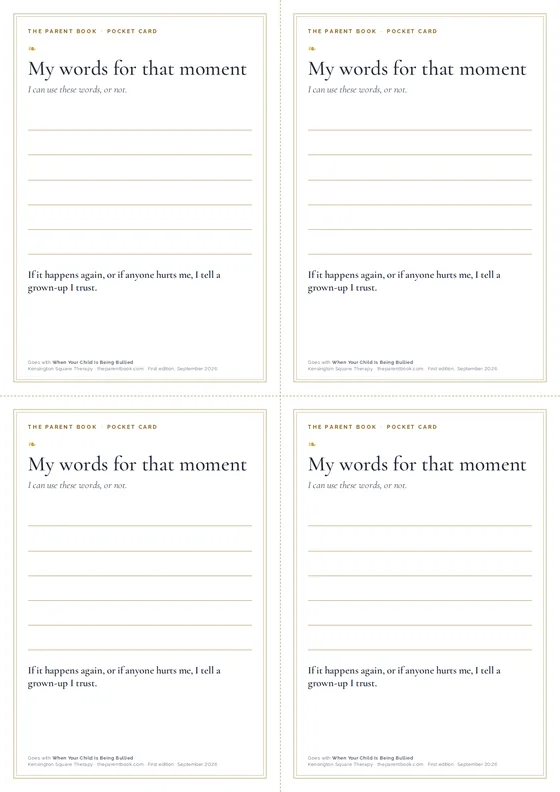 My words for that moment
Pocket card · A4, four cards to cut · PDF, 46 KB · With a subscription
My words for that moment
Pocket card · A4, four cards to cut · PDF, 46 KB · With a subscription
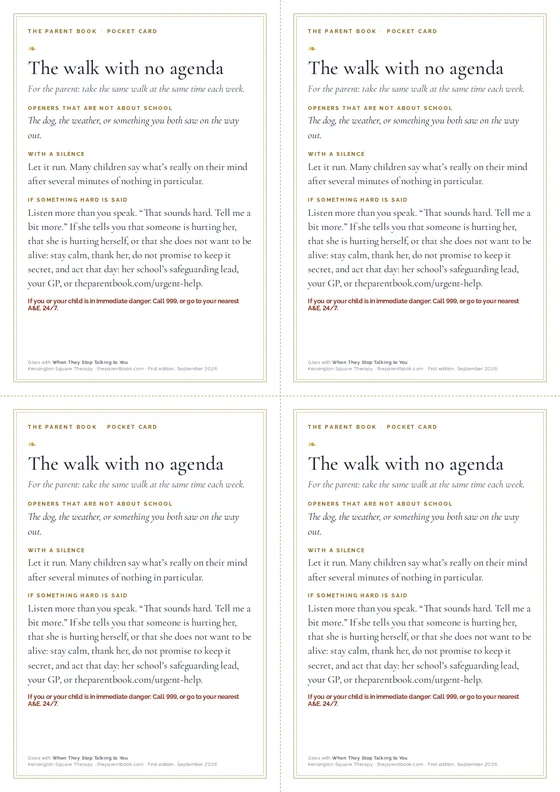 The walk with no agenda
Pocket card · A4, four cards to cut · PDF, 62 KB · With a subscription
The walk with no agenda
Pocket card · A4, four cards to cut · PDF, 62 KB · With a subscription
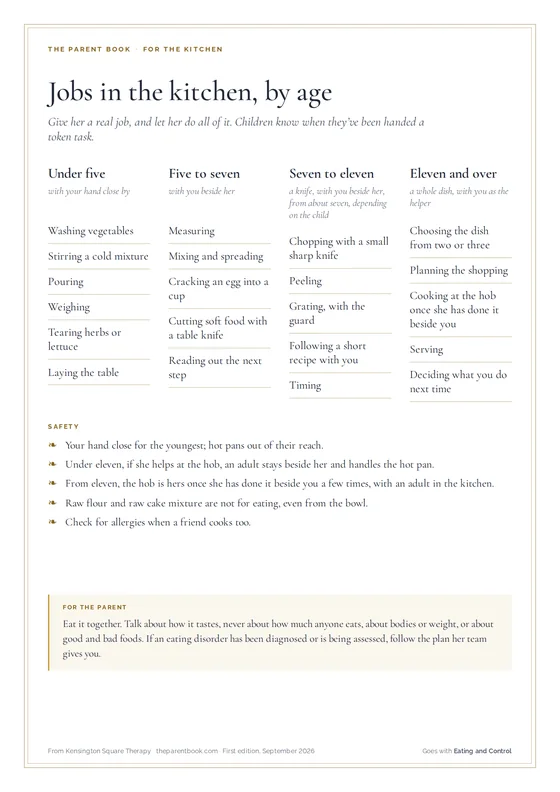 Jobs in the kitchen, by age
For the kitchen · A4 · PDF, 60 KB · With a subscription
Jobs in the kitchen, by age
For the kitchen · A4 · PDF, 60 KB · With a subscription
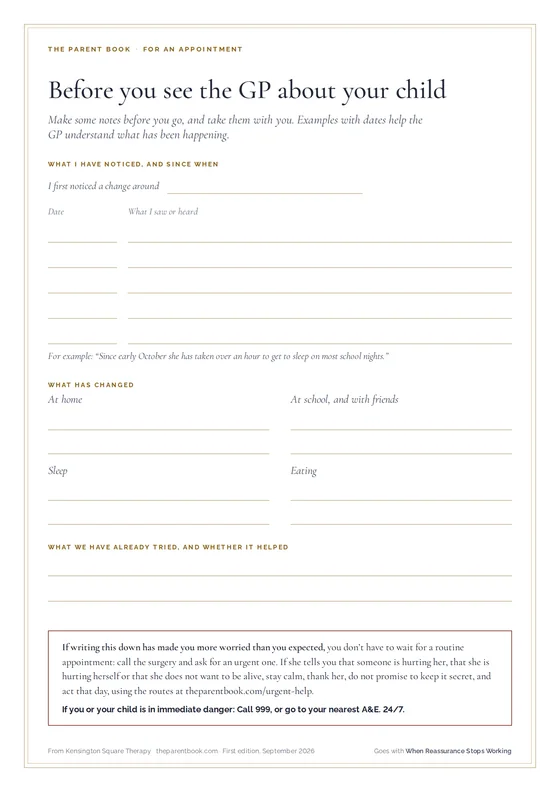 Before you see the GP about your child
For an appointment · A4, two sides · PDF, 72 KB · Free
Before you see the GP about your child
For an appointment · A4, two sides · PDF, 72 KB · Free
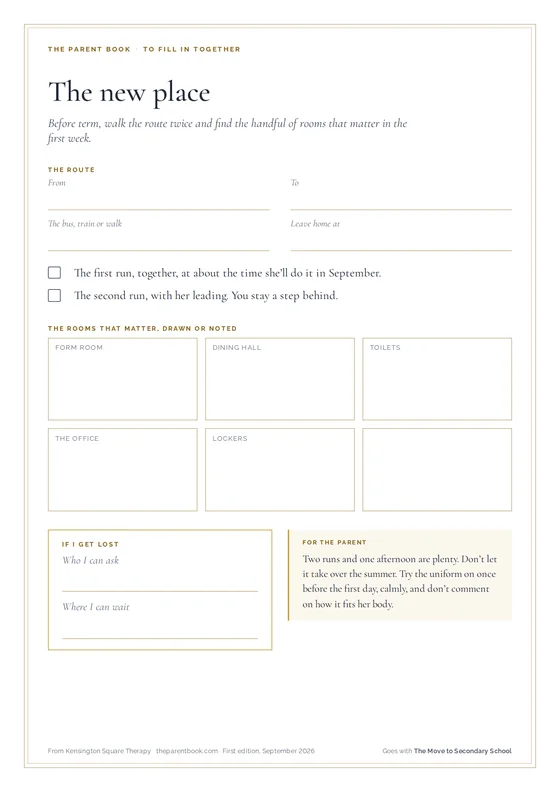 The new place
To fill in together · A4 · PDF, 52 KB · With a subscription
The new place
To fill in together · A4 · PDF, 52 KB · With a subscription
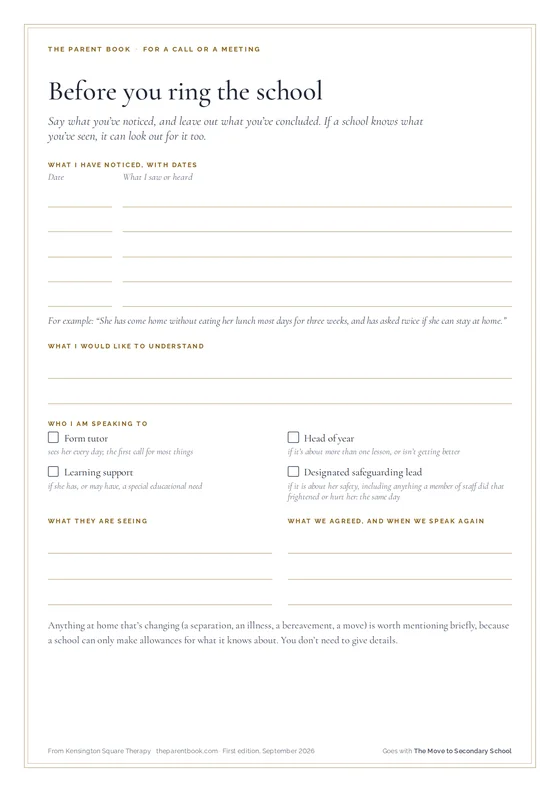 Before you ring the school
For a call or a meeting · A4 · PDF, 58 KB · Free
Before you ring the school
For a call or a meeting · A4 · PDF, 58 KB · Free