
Bullying
Bullying
This covers the harm done to a child at school, on a bus or in a group chat after lights out. These pages are for the parent who has just found out what’s happening, and for the longer process of helping a child get back on her feet without rushing her past what she has felt.
What the library says about this, on one page. It is also online at theparentbook.com/help/bullying
What to do first
If your child has told you she’s being bullied, she has already done the hardest part. Next, she needs to see you calm and organised, not furious.
- Write down what she has told you: what happened, when, where and who saw it. Do it while it’s fresh, and with her if she’s willing.
- Do not contact the other child’s parents, and do not tell her to hit back. Both usually make the next week worse.
- Raise it with the school in writing, ask what their anti-bullying policy commits them to, and ask for a date by which you’ll hear back.
Some tips to try
Short pieces from the library, and a first thing to try from each.
-
Left Out on Purpose, Again.
Whether it’s a falling-out or bullying decides what you do next, so find out which before you act.
- Ask who, where and how often before you decide what it is.
- For bullying, keep a short diary and ask to see her class teacher.
- If it’s bullying, keep a short diary of what happened and when, and ask to see her class teacher. Every school should have a written anti-bullying policy, so ask to see it, and ask what the school will do and when you’ll hear back. If the school hasn’t been able to sort it out, the specialist anti-bullying charity has an advice line for parents. Coram Kidscape, 0300 102 4481. WhatsApp 07496 682785. Email pal@coramkidscape.org.uk. Mon-Tue 9.30am-2.30pm; reduced over the summer holidays. Voicemail, email and WhatsApp accepted outside hours. If a child is at risk of harm now, do not wait for a reply: call the police on 101, or 999 if anyone is in immediate danger. Help is free.
- If she stays low, eats or sleeps differently, or stops enjoying things she used to love, talk to your GP as well as the school.
-
She Has Just Told You About the Bullying.
What you do in the first ten minutes decides whether she tells you the next thing.
- Thank her for telling you, and sit on the edge of the bed.
- Unless she is in danger, don’t act tonight; the school and the next steps can wait until tomorrow.
- You’ll want to do something at once: ring the school, ring the other parent, take the phone off her. Each of those is you, alarmed, reaching for the feeling of having done something, and none of them is what helps in the first ten minutes. Unless she is in danger, the phone, the school and the next steps can wait until tomorrow.
- If the school hasn’t been able to sort it out, the specialist anti-bullying charity has the clearest advice for parents we know on what to do next, and its own advice line. Coram Kidscape, 0300 102 4481. WhatsApp 07496 682785. Email pal@coramkidscape.org.uk. Mon-Tue 9.30am-2.30pm; reduced over the summer holidays. Voicemail, email and WhatsApp accepted outside hours. If a child is at risk of harm now, do not wait for a reply: call the police on 101, or 999 if anyone is in immediate danger. Help is free.
-
When She Is the One Doing the Bullying.
Hear the facts first, then be clear with her that it stops and that she’ll help put it right.
- Hear the school’s whole account, and ask for its anti-bullying policy.
The rest of each tip, with more to try and why it works, is in the library.
Something to do together
Running the moment through. On a calm day, you play the other child and she tries out what she might say. Keep it short and light, and do it once or twice at most.
What it is for. Adults usually hand a worried child the words to say. Running the moment through lets her find her own, without you stepping in for her.
- The first step. Choose a calm time, and avoid the hour after school. The next morning or the weekend is often better.
- If she is being targeted (the same child or group, again and again, on purpose), stop there. The rehearsal is not the response: tell her you are going to talk to the school, and what you will say, before you do it.
Safety. If it is happening in a group chat, rehearse nothing to send, and send nothing tonight. If it keeps happening, it goes to the school.
When to get help. If it sounds like bullying, contact her class teacher or form tutor this week, saying what you have noticed rather than what you have concluded. If she tells you that someone is hurting her, that she is hurting herself, or that she does not want to be alive, stay calm, thank her for telling you, do not promise to keep it secret, and act that day, using the routes under “If you need help right now”, at the foot of every page.
The other three steps, and your part in it, are in the library.
If you want to read further
- When Your Child Is Being Bullied. For parents whose child has just told them she is being bullied. theparentbook.com/reader/when-your-child-is-being-bullied
- Your Child’s Online World. For parents who have seen something on their child’s phone that they can’t unsee. theparentbook.com/reader/online-life-beyond-screens
Worth your time
- A book for you: 8 Keys to End Bullying, Signe Whitson. A compact guide from social worker Signe Whitson on spotting bullying, talking with a child who is being targeted, handling online cruelty and working constructively with the school.
- A book to read together: All the Things That Could Go Wrong, Stewart Foster. Alex has OCD and Dan is the boy who makes his life miserable; one summer they are made to build a raft together. Told in both voices, it shows the bully’s own troubles without excusing him. uk.bookshop.org/p/books/all-the-things-that-could-go-wrong-stewart-foster/d5af271afffa4f1b
- Something to watch: Anti-Bullying Alliance Definition of Bullying - Subtitled, Anti-Bullying Alliance, YouTube. The Anti-Bullying Alliance’s short, clear definition of bullying, which helps parents and children tell repeated, intentional harm from ordinary falling out. www.youtube.com/watch?v=EiTxGTFkLYM
- Something to listen to: 166: My Kid Is Being Bullied. What Should I Do?, Ask Lisa: Untangling Family Life, 33 min. A 12-year-old is being taunted by older boys on the school bus. Damour explains the difference between conflict and bullying, why children bully, and step by step how adults should step in. podcasts.apple.com/gb/podcast/166-my-kid-is-being-bullied-what-should-i-do/id1525689066?i=1000652582735
Who else can help
Tell the school first, in writing, and ask what they will do and by when. Ask for the designated safeguarding lead by name if you think your child is at risk.
- Your child’s school. The pastoral lead, the head of year, or the form tutor. Free, already knows your child, and often the quickest way to get something changed at school. Before or alongside anything else. A school cannot act on what it has not been told, and what you bring is often what it did not have.
- The designated safeguarding lead at your child’s school. Every school has one, by law. They are trained for exactly this conversation and they have the routes a parent does not. As soon as you have a concern about a child’s safety. Ask for them by role; you do not have to explain yourself to the office first.
- Coram Kidscape. The UK’s anti-bullying charity. A free Parent Advice Line by phone, WhatsApp or email, staffed by people who know how schools work. When you have raised bullying with the school and it has not stopped, or you want help preparing for that conversation. The phone hours are short, but WhatsApp and email are answered outside them. Kidscape Parent Advice Line 0300 102 4481 · Mon-Tue 9.30am-2.30pm; reduced over the summer holidays. Voicemail, email and WhatsApp accepted outside hours · If a child is at risk of harm now, do not wait for a reply: call the police on 101, or 999 if anyone is in immediate danger. coramkidscape.org.uk/parent-advice-line
- Anti-Bullying Alliance. Clear guidance on what counts as bullying, what a school in England must do about it, and how to raise it with them, from the body that sets the standard. Before the meeting with school, so you know what you are entitled to ask for. Information; Kidscape is the line to ring. anti-bullyingalliance.org.uk/tools-information/advice-and-support/advice-parents-and-carers
- NSPCC. The NSPCC helpline is for adults worried about a child. You do not have to be sure, you can call anonymously, and they will tell you whether it needs to go further and help you take that step. When something has been said or seen and you do not know what to do with it. Childline, 0800 1111, is the line for a child to call themselves. NSPCC Helpline (for adults) 0808 800 5000 · Mon-Fri 10am-4pm by phone; email 11am-4pm, seven days a week. An email sent when the service is closed is not received. · If the NSPCC service is closed and the concern cannot wait, call the police on 101. You can also contact the child’s local out-of-hours children’s social care, social work or social services team. If a child is in immediate danger, call 999. www.nspcc.org.uk/keeping-children-safe/reporting-abuse/nspcc-helpline
The full list for bullying, with what each organisation does and when it is the right call, is at theparentbook.com/help/bullying/services
Published by Kensington Square Therapy. Company No. 16707111. Written by therapists registered with the British Association for Counselling and Psychotherapy (BACP) and the National Counselling and Psychotherapy Society (NCPS). This page is not therapy, and not a substitute for professional support. The full library is at theparentbook.com.
Everything the library holds on bullying
Go further
Chapters
Quick tips
- Left Out on Purpose, AgainWhether it’s a falling-out or bullying decides what you do next, so find out which before you act.
- She Has Just Told You About the BullyingWhat you do in the first ten minutes decides whether she tells you the next thing.
- When She Is the One Doing the BullyingHear the facts first, then be clear with her that it stops and that she’ll help put it right.
- When the Sibling Has Become a BullyMost sibling conflict is rivalry, but some of it crosses the line into bullying.
Quick tips open with a subscription.
Things to do together
- Running the moment throughOn a calm day, you play the other child and she tries out what she might say. Keep it short and light, and do it once or twice at most.
- The school day, drawn as a lineShe draws her day from gate to gate and marks where it feels heavy. You take the one moment she marks, not a conclusion, to the school.
Activities open with a subscription.
To print
 My words for that moment
Pocket card · A4, four cards to cut · PDF, 46 KB · With a subscription
My words for that moment
Pocket card · A4, four cards to cut · PDF, 46 KB · With a subscription
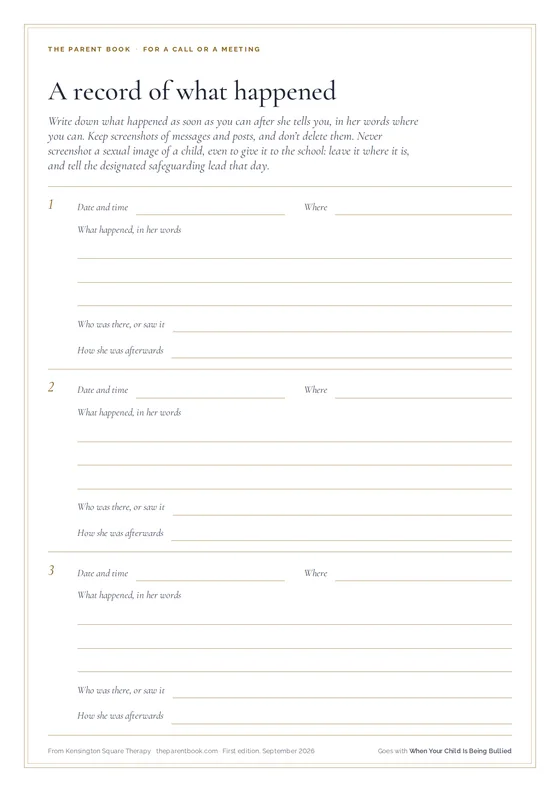 A record of what happened
For a call or a meeting · A4, two pages · PDF, 57 KB · Free
A record of what happened
For a call or a meeting · A4, two pages · PDF, 57 KB · Free
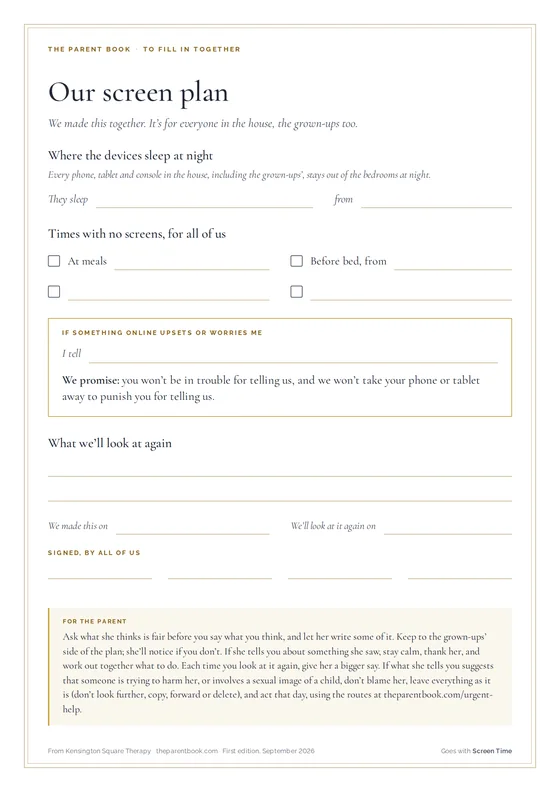 Our screen plan
To fill in together · A4 · PDF, 53 KB · With a subscription
Our screen plan
To fill in together · A4 · PDF, 53 KB · With a subscription
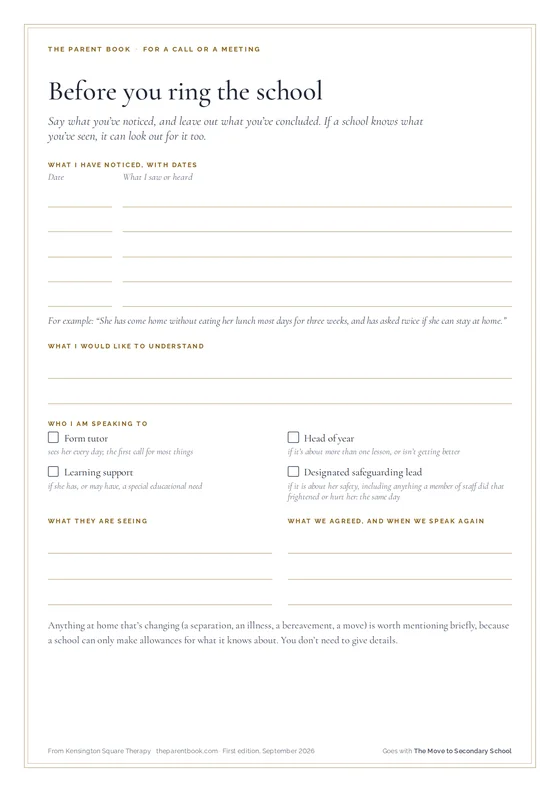 Before you ring the school
For a call or a meeting · A4 · PDF, 58 KB · Free
Before you ring the school
For a call or a meeting · A4 · PDF, 58 KB · Free
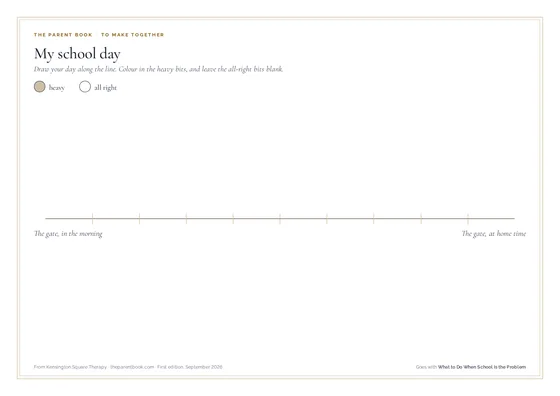 The school day, drawn as a line
To make together · A4 landscape, two pages · PDF, 63 KB · With a subscription
The school day, drawn as a line
To make together · A4 landscape, two pages · PDF, 63 KB · With a subscription