The Parent Book·From the library
Your Child’s Online World
For parents who have seen something on their child’s phone that they can’t unsee.
A sixteen-minute read · Published 25 May 2026

A father picks up his twelve-year-old daughter’s phone from the kitchen counter to plug it in for the night. A notification lights up the screen, and he reads it in the half-second before it disappears. He puts the phone down and stands there for a minute, then picks it up again. When he scrolls back, he finds that the notification was only the start of something he hadn’t known was there.
This chapter is about the conversation that follows, in the next hour and then over the next several weeks. Conversations about screen time are about how long, when and where. This one is about what your child has come across, what has come looking for her, and what your family does next.
In our work, this comes up more often than most people would expect. What parents find varies. It might be a message from someone the child does not seem to know, a group chat in which her name is being spoken about, an image she has been sent and not been able to put down, or an account that has been following her for months and that, at second glance, is not what it said it was. Whatever it turns out to be, the parent’s stomach drops in much the same way.
What is actually happening
For a child, a screen is the way into the places where her life now happens: the video game, the group chat, the platform. The algorithm decides which of these she goes into next, by a logic she doesn’t understand and hasn’t, in any real sense, consented to.
Parents are usually told to police screen time, which puts the focus in the wrong place. The harder questions are what’s on the screen, who is on the other side of it, and what the algorithm is putting in front of her this week that it wasn’t putting in front of her last week. A child can spend two hours a day on cookery videos and animal clips and be doing nothing a parent would worry about. Another child can spend twenty minutes a day on a platform that has, in a fortnight, served her a hundred pieces of content about self-harm because she paused on one and the system decided that was who she was.
Online concerns fall broadly into three categories. The first is content: what the child is encountering, deliberately or not. Eating-disorder material, self-harm content, pornography, violent imagery, the radicalising rabbit hole. The second is conduct: what the child is doing or having done to her by other children. Cyberbullying, the group chat that has become the venue for what used to happen in the corridor, the intimate image sent in a relationship and now circulating after it has ended. The third is contact: an adult who is not what they have said they are, building a relationship with the child for purposes the child cannot, by her age, recognise. Each calls for a different conversation, and the first step is often to work out which one you’re dealing with.
The NSPCC’s online-safety hub for parents is, in our view, the clearest single UK starting point on all three. Its pages are calm, organised by age, and tell parents what they can do. The UK Safer Internet Centre covers the same subjects from a slightly different angle, and its written guidance is worth reading; its own helpline is for professionals working with children, not for parents.
The moment you have found something
In the first ten minutes, the instinct is to act: to confiscate the phone, confront your child, or ring the other parent or the school. Each of these is an alarmed parent reaching for the feeling of having done something. In nearly every case we see, the first thing that helps is slower than the instinct.
Put the phone in a drawer, not in your pocket and not back where your child left it. That takes it out of circulation while you think. Don’t tell her you’ve done it until you’re ready to talk. Sit down for ten minutes. If there’s another adult in the house, tell them what you’ve seen, briefly and without drama. Before you go upstairs, decide what you’re going to say to your child.
All the first conversation has to do is leave the door open. In our experience, the opening that helps says what has happened and puts you on her side: “I saw a message on your phone. I haven’t read everything. I’m not cross. I want you to tell me what’s going on, and I want to help.” Sit on the edge of her bed to say it; don’t stand in the doorway. Have your hands free, and keep your voice low.
After that, don’t interrogate her. She knows more than you do, and if she has any sense that you’re not going to punish her, she’ll start to tell you, slowly and in pieces. Don’t rush to the next question. The first conversation almost never gets to the bottom of it. It gets you part of what’s happening, and a way into the next conversation.
What doesn’t help is taking the phone away on the spot as a punishment, saying “I told you not to”, or listing all the rules she has broken. The bullying chapter makes this point, and it applies just as much here: by saying anything at all, she has taken a risk. If you punish her for telling you, she won’t tell you next time. Things may need to change with the phone in time, but the first hour isn’t the time for that lesson.
What to do with the device
Parents often ask what to do about the device itself, so here is the practical side.
If what you have found is sexual imagery of anyone under 18, including imagery of your own child, it is handled differently from anything else on the phone. Never view, copy, print, share, store or save it, or ask a child to share or download it. A screenshot is a copy. If you have already seen it, stop looking. Do not return to the chat or image, and do not delete or alter anything. Treat the device as potential evidence, leave it as it is, and stop using it.
If instead it is a threat of violence, an adult making sexual contact with your child, grooming, or an adult asking her for personal information, photographs or video, that handling rule does not apply. What does apply is this: do not investigate it yourself, and do not forward the material on. Leave it where it is and let the services below decide what happens next.
The routes are the same in both cases, in this order. If your child is in danger now, 999. Otherwise the police on 101, and CEOP at ceop.police.uk/safety-centre, which is the route for online sexual abuse and grooming. In school hours, tell your child’s designated safeguarding lead as well. Let those services direct what happens to the device and to what is on it. Their starting point should be your child’s safety and welfare, and it is worth telling her that; do not promise her what they will or will not do, because that is not yours to promise.
If sexual imagery of your child is online, the Internet Watch Foundation accepts anonymous reports at iwf.org.uk/en/uk-report and works to have it removed. If the image is of your child and she is under 18, Report Remove, run by Childline with the Internet Watch Foundation, allows her to report it through childline.org.uk.
If the picture is sustained cyberbullying, the device may need to come out of her bedroom for a while, but the account itself needs to stay live in the short term so that messages can be screen-shotted and the school can see the pattern. Screenshots belong here, where what needs recording is words, accounts and dates. Never screenshot an image of a child that is sexual, even to give it to the school. The school is the route. The Designated Safeguarding Lead holds the safeguarding side, the head of year or pastoral lead the day-to-day work; both need to know. Kidscape, the UK’s specialist anti-bullying charity, know this territory calmly and well; the Parent Advice Line on 0300 102 4481 is one of the few specialist UK routes when the school’s first efforts have not changed the picture.
If the picture is content (self-harm material, eating-disorder content, pornography, radicalisation), the algorithm is the active problem and the platform itself is now part of the conversation. Reset the algorithm where you can: clear the recommendations, reset the watch history, change the account. Block specific accounts. Move the device out of her bedroom at night, when the algorithms feed the worst content. Then talk to the school’s pastoral lead about what the child has been encountering; schools often hear the same accounts named by several children, and a pattern across families is information they can use.
If the picture is contact (an adult on the other side, building a relationship), the conversation has tipped into safeguarding. Do not contact the adult. Do not pretend to be your child and message them. Both interfere with the police’s ability to act. Report to CEOP. Talk to the school’s DSL. Your GP is, in time, the route for the child’s emotional aftercare.
The conversation that follows
The hard conversation goes on over the next several weeks. Keep giving her chances to talk, again and again, in low-key places: the car, a walk to the corner shop, bath time for younger children, bedtime with the light off for older ones.
There are three things to get across, spread out over days.
The first is that what happened was not her fault. Children almost always find a way to make the encounter their own responsibility. “I should not have clicked. I should not have replied. I should have blocked her. I should not have sent the picture.” The parent’s job is the slow, repeated naming that the adult on the other end of a grooming conversation has done this before, knew exactly what they were doing, and the child has, by her age, been outmatched. The message in cyberbullying conversations is similar: she is being targeted by a pattern not of her making. The shame is the bully’s, not hers.
The second is that the family is going to live a little differently for a while, and that this isn’t a punishment or a judgement on her. The phone might stay out of her bedroom overnight, the platform might come off the device for now, and on Sunday afternoons the devices might go in a basket by the door. It’s like a family that has had a small fire putting in a smoke alarm.
The third is that you’re going to keep talking. Don’t do it constantly, and don’t interrogate her; bring it up in passing, with curiosity. “Has anything come up. Have you had any messages from anyone you don’t know. Do you want to show me what you’ve been watching this week.” In most cases we see, the second and third disclosures come weeks after the first.
The but everyone has it argument
The argument parents lose most often is about the platform itself, and a child whose social life depends on the answer makes it with absolute conviction: “Everyone has Snapchat. I’m the only one not allowed.”
Answer with the question she isn’t asking: “I hear that everyone has it. Tell me what you’d do with it that you can’t do at the moment.” A teenager who can give a real answer (the group chat is on it, and she’s missing the plans for Saturday) is asking for something real, and you can move on to practical options: a basic phone, a watch with messaging, or waiting until the end of the summer. A teenager who can’t give a real answer is asking because of social pressure, and the answer can be a warm no: “Not yet, and we’ll look at it again at the end of the summer.” When parents want an age-by-age view of what each platform actually is, we send them to Common Sense Media’s platform-by-platform breakdowns.
Your own digital footprint
The chapter on screen time makes this point too: your child is watching what the adults do with their devices. Families who change their own habits alongside hers find the conversation easier, because the rules apply to everyone. If phones go in the basket by the door on Sundays, yours goes in too. If phones stay face down at the table, so does yours, and your phone charges overnight in the same place as everyone else’s. Your child notices.
At different ages
The online world is a different place for a six-year-old, a ten-year-old and a sixteen-year-old. The bands below are a rough guide.
If your child is between four and seven. At this age the device is still mostly yours, so keep it that way. Choose the apps yourself, have her use it in a shared part of the house, and make sure an adult is in the room while it’s on. The first online-safety habit to teach her is telling you. “If you ever see something on the iPad that you do not understand, or that makes you feel funny, you come and tell me, and you will not be in trouble.” Say it calmly, and say it again every so often.
If your child is between seven and nine. This is when she starts using a device on her own, often a hand-me-down phone or a borrowed iPad. Once a week, sit next to her on the sofa and ask her to show you the channels she likes. Be curious, and don’t turn it into an audit. At the end of the day the device still goes back to a shared room; her bedroom isn’t the right place for it yet.
If your child is between nine and eleven. This is when the first phone arrives, with the first WhatsApp group, and when some of her standing with friends starts to be decided online. Put the household routines in place before the phone becomes a battleground: a family charging station in the hallway, say, and no phones at supper. The conversation about strangers online needs to be had at this age explicitly: “if anyone you have not met in person asks you for a photograph, your address, your school, anything at all, you come and tell me, and you will not be in trouble”. The DSL at her primary school will be running the online-safety teaching in PSHE; ask her teacher what has been covered, so your conversations dovetail with the school’s.
If your child is in early secondary, eleven to thirteen. By now she is fully on social media, whether or not the platforms are nominally allowed: Snapchat, TikTok, or whatever has replaced them by the time this chapter is next revised. Be present, but don’t keep her under surveillance. Notice if she stops mentioning a platform, stops replying to a friend, or has been on her phone until two. Ask in passing, at breakfast: Anything going on this week. If anything tips into the safeguarding range, the school’s DSL is the right adult to bring in. Most schools take online safeguarding concerns seriously and will work in partnership with the family.
If your child is in mid to late secondary, thirteen to sixteen. Most of what she does online is now out of your sight. The passcode and the platforms are hers, and the parental-control software that worked at seven is now easy for her to get round, and ethically dubious to use. Make home the place where conversations about online life happen, by being around without watching over her shoulder. The intimate-images conversation, calmly, in this band: “if you are ever asked for a picture, by anyone, you come and tell me. Anyone you trust enough to send a picture to is anyone who will respect that you do not have to.” Her PSHE lessons at school will have covered this; hearing it at home backs it up. If imagery has been shared, CEOP, the IWF, and the school’s DSL are the right routes; do not assume she will tell you straight away.
If your child is sixteen and beyond. The conversations are now adult to adult, and you can talk more openly about your own online life: the platforms you have left, the wellness-grift you nearly fell for, the political content that radicalised your friend’s brother last year. A brief, truthful account of how you manage it yourself is the example she needs. At this age, it mostly comes down to being a household she still wants to come back into, with a sofa she still wants to sit on, even once she is free to go anywhere on the internet she chooses.
The longer arc
Your child is growing up with the internet all around her, and no parent of this generation can opt her out of it. What you can realistically aim for is a household where an adult stays close to the ways she gets online, where an adult gets told when something goes wrong, and where the device is one part of home life, along with a sofa, a walk on a Saturday and parents who put their own phones down some of the time. The school is the partner in this, particularly the DSL when something serious has happened; the police, through CEOP, are the partner when something has tipped into the criminal.
The father who read that notification has, by noticing it and not panicking, already done the most important thing this chapter can ask of him. The hour that follows is going to be slow and unglamorous. He is going to talk to the school. He may, depending on what he finds, talk to CEOP. He is going to be the adult who was on his daughter’s side when she came up against something bigger than her.
NOTES
- Livingstone, Sonia & Blum-Ross, Alicia. Parenting for a Digital Future: How Hopes and Fears about Technology Shape Children’s Lives. Oxford University Press, 2020. Their research with UK families on how parents actually manage digital technology at home.
Where to go further
Sonia Livingstone and Alicia Blum-Ross, Parenting for a Digital Future: How Hopes and Fears about Technology Shape Children’s Lives A UK academic’s calm, evidence-based book on what digital childhood is like from day to day. It’s the right read if you’ve had enough of alarmist material and want a UK source you can trust.
Jonathan Haidt, The Anxious Generation A widely debated 2024 book arguing that smartphone-based childhood has rewired adolescent mental health. It has become the reference point for the current debate, and parts of it are contested. It’s useful to read alongside Livingstone, who takes the longer view.
What helps in the first twenty-four hours
When you’ve found something, the first thing that helps is slower than your instinct. The aim of the first conversation is to get her talking to you.
- Slow down before you act. Put the phone in a drawer while you think. Take ten minutes, have a brief word with the other adult if there is one, and decide how you’ll handle the conversation before you go upstairs.
- Open without blame. “I saw a message on your phone. I haven’t read everything. I’m not cross. I want you to tell me what’s going on, and I want to help.” Sit on the edge of her bed and keep your voice low.
- Don’t punish her for telling you. Confiscating the phone on the spot as a punishment teaches her not to tell you next time. The phone arrangements may need to change in time, but not in the first hour.
- Know the safeguarding routes. Sexual imagery involving a child, and only this: never view, copy, print, share, store or save it; a screenshot is a copy. Do not return to the chat or image, do not delete or alter anything, and leave the device as it is. Threats, grooming or an adult contacting your child: do not investigate it yourself, and do not forward the material on. Both: 999 if your child is in immediate danger; otherwise the police on 101, then CEOP’s Safety Centre, and the school’s safeguarding lead in school hours. Let them say what happens to the device. Sexual imagery of your child online: the Internet Watch Foundation. Sustained cyberbullying: the school’s safeguarding lead, with Kidscape alongside.
Put it into practice
What this chapter looks like in practice: one-minute ideas for tonight, things to do together and sheets to print and keep.
Quick tipsOne minute each
- The Feed Full of Diets and BodiesIf your daughter’s feed is full of diets and bodies, reset it with her and explain how it works.
- The Game Rated Above Her AgeTwo games with the same age rating can be very different, so check why it got its number and watch it being played before you decide.
- Before the First Loot BoxHave the money conversation, and set the controls, before she plays a game with a shop in it.
Eight quick tips on this in the library
To do togetherActivities
- Show me three thingsOnce a week she shows you three things: the funniest she has seen, the weirdest, and one she thinks you should see. You watch without comment.About 10 minutes
- Play her game with herShe picks a game she plays and teaches you how it works. You play beside her as a beginner, and find out what the game involves, including who she can talk to in it.About 30 minutes
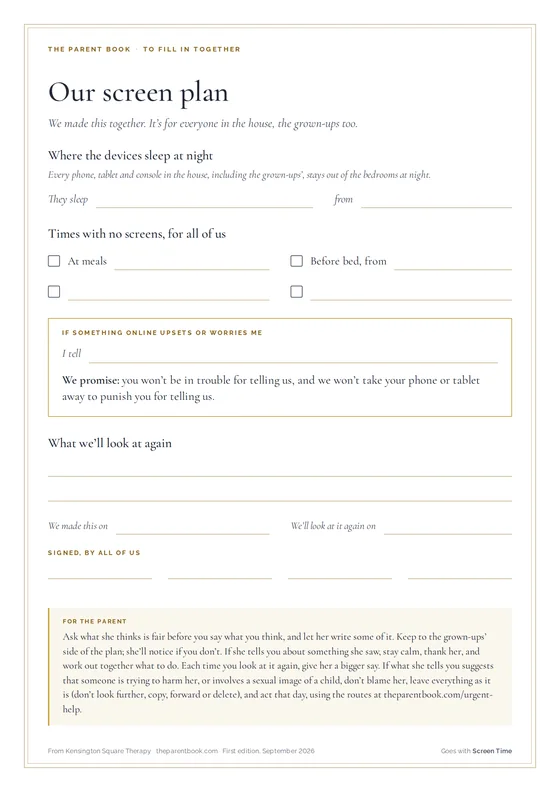
The quick tips and activities are for subscribers; the sheets that go with this chapter are yours to print. What a subscription includes.
Who else can help
NSPCC
The NSPCC helpline is for adults worried about a child.
0808 800 5000 · Mon-Fri 10am-4pm by phone; email 11am-4pm, seven days a week. An email sent when the service is closed is not received.
If the NSPCC service is closed and the concern cannot wait, call the police on 101. You can also contact the child’s local out-of-hours children’s social care, social work or social services team. If a child is in immediate danger, call 999.
nspcc.org.uk/keeping-children-safe/reporting-abuse/nspcc-helpline
Coram Kidscape
The UK’s anti-bullying charity.
0300 102 4481 · Mon-Tue 9.30am-2.30pm; reduced over the summer holidays. Voicemail, email and WhatsApp accepted outside hours
If a child is at risk of harm now, do not wait for a reply: call the police on 101, or 999 if anyone is in immediate danger.
Coram Family Lives
A free, confidential helpline for any parenting or family worry, by phone, live chat, WhatsApp or email, staffed by trained family support workers.
0808 800 2222 · Mon-Fri 9am-9pm; weekends 10am-3pm; closed bank holidays
Outside those hours the line is closed. Samaritans answer at any hour on 116 123, and Shout answer if you text the word SHOUT to 85258.
coramfamilylives.org.uk/how-we-can-help/confidential-helpline