The Parent Book·From the library
When Your Child Is Being Bullied
For parents whose child has just told them she is being bullied.
A fourteen-minute read · Published 25 May 2026

A ten-year-old is sitting on the side of her bed one evening, her hair still wet from the shower, and she has just said the thing she has been keeping to herself. She practised it in the bathroom mirror first. There’s a girl at school. She’s been doing things, and she’s been doing them since before Easter. The ten-year-old doesn’t want her mother to ring the school. She doesn’t want her father to know. She doesn’t want anyone to make it worse.
Her mother, on the edge of the bed, realises three things at once: her daughter has kept this secret for most of a term; whatever she had imagined doing if this ever happened is no use now; and her own heart is pounding in a way she hasn’t felt for a very long time.
We often see parents who have just been through some version of this evening. The details vary, but two things don’t: the parent is alarmed, and what she does next matters more than almost anything else we see a parent do.
What is actually happening
Bullying is repeated and intentional, and it involves an imbalance of power. The first row in a friendship isn’t bullying. A week of being left out of a group chat isn’t bullying on its own. Arguments between brothers and sisters usually aren’t bullying either, even when they turn ugly, though bullying can happen at home too, and Siblings and the Fights That Aren’t Fair is about that. Bullying is when one child, or a group, targets another child again and again, on purpose, and the child being targeted has no practical way to stop it.
The difference matters because the everyday hurts of friendship need a different response from bullying. A child whose best friend has moved on is grieving, and there’s a separate chapter on that in this book. A child who is being bullied is being hurt, and she knows the person hurting her means to do it.
These days bullying rarely looks like the playground confrontation most people imagine. Far more often it’s a slow exclusion that an adult walking down a corridor wouldn’t see: the seat at lunch that is somehow always taken, being removed from the group chat, comments pitched just below what a teacher would pick up, a whispering campaign. In most cases we see, the online bullying is the same problem in a different place. The cruelty in the WhatsApp group is the cruelty from the lunch hall, continuing on the bus home and through the night.
Children rarely describe what is happening as bullying. What you see instead is the stomach ache, falling apart on Sunday evenings, a friend’s name that has stopped coming up, a new reluctance to go to school, or a phone put face down on the counter. It often shows in her body and her behaviour for weeks before she says it in her own words.
What it does to the child, and the long shadow
The deeper injury is the message she receives, slowly and over weeks, that her peers have judged something about her and found it unacceptable. A child who is being bullied is building up evidence, in her own mind, that she isn’t the kind of person other people want to be around. Children have no way of checking how acceptable they really are to others, so they take the message at face value. Brené Brown’s writing on shame describes this most clearly. She distinguishes between “I did a bad thing”, which is guilt and can be acted on, and “I am bad”, which is shame and stays in the body until something or someone helps take it apart. Weeks of being shut out have taught the bullied child the second sentence. Much of her long recovery comes from being treated, again and again, in ways that show her it isn’t true.
So recovery takes more than the bullying stopping. She also has to undo, slowly, the verdict she has come to believe about herself. A child who was bullied for two terms and then moves to a new school where she is made welcome still feels, inside, like the child who was bullied. The repair comes from experience that builds up over time and, in many cases, from someone (a parent, a teacher, a counsellor) helping her see that what she was being told about herself wasn’t true.
Bullying has effects that last. In many cases, adults who were bullied still expect to be judged, flinch in social situations, and find it hard to trust that a friendship they’re offered is real. None of this is inevitable. The child you have now can be helped through it.
What the parent feels
The mother on the edge of the bed is reacting in a way that has nothing to do with the calm adult she would like to be. Often there’s a history behind a reaction this strong. Many of the parents we see were bullied themselves. A mother who was bullied at twelve is, for a moment, twelve again, and the fury rising in her chest is partly her child’s and partly her own, left over from thirty years before.
This is useful information. A parent who notices that some of what she feels belongs to her own past is best placed to keep her response in proportion to what is happening now. A parent who can’t notice it tends to overreact: she rings the other parent that evening, marches into the school the next morning and demands a meeting with the headteacher by Friday. Each of these is her own past trying to get the resolution it never got.
The opposite mistake belongs to the parent who plays it down. She was told as a child to stand up to bullies, and now she repeats the line: “Stand up to her. Hit her back. Don’t let her see you cry.” To the parent saying them, these words feel strong. The child hears that she has been left on her own. She took a risk in telling you anything at all, and a reply that leaves her to deal with it herself confirms her worst fear: that telling an adult won’t, after all, lead to anything useful.
In the first few minutes, do less than either of these parents. Listen, and then say something like: “Thank you for telling me. I’m glad you said it out loud. I’m going to think carefully about what we do next, and I’m going to talk to you about it before I do anything.” She doesn’t need a promise that it will all be sorted out. She needs to see that you’ve taken in what she told you and that you aren’t, right now, going to make it worse.
What to do, and what not to do
The single most common mistake parents make with bullying is ringing the other child’s parent. The instinct is understandable, but the call almost never does what you hope. The other parent defends her own child, then talks to her about the call, and by the next morning the child doing the bullying knows that your child told. For the next twenty-four hours, your child is worse off than she was the day before. More than once, parents who made this call against our advice have come back to tell us we were right.
What works is going through the school and working with them. Start with an email to the class teacher, or at secondary school the head of year. Say calmly what your child has told you, ask what the school has noticed, and ask for a meeting. For example: “Ella told me last night that there has been a sustained pattern of being excluded by Maya and the group around her over the last several months. I’m sure there’s more context I don’t have. I’d like to come in and talk it through with you.” Keep it collaborative, and meet in person. Don’t make it about whose child is at fault; talk about what is going on, and what you and the school can do together to change it.
Schools can do more than most parents realise. Most UK schools have an anti-bullying policy, a pastoral system and several adults whose job it is to deal with exactly this. What a school can’t always do is see bullying without being told. What you bring to the meeting is very often information the school didn’t have.
If the school’s response is inadequate, put the concern in writing to the headteacher, ask for the school’s policy on bullying, and request a meeting under it. Schools respond more carefully to a written record than to a corridor conversation. Most local authorities have a guidance framework on serious bullying; ask for it if you need it.
If you’ve been through the school process and nothing has changed, we send parents to Kidscape, the UK’s specialist anti-bullying charity. The Kidscape Parent Advice Line is one of the few specialist services in the country that still helps when the school’s first attempts haven’t. Their phone, WhatsApp and email service is open on Mondays and Tuesdays from 9.30am to 2.30pm, with messages picked up outside hours. It’s staffed by people who hear this conversation every day. They’re also the right people to ask when the bullying has an online side you aren’t sure how to handle.
In parallel, the NSPCC’s pages on bullying are the right wider safeguarding pointer when the picture has tipped beyond what the school can handle. For the effect on mental health, the YoungMinds parent pages on bullying are the clearest single guide we know. Place2Be is often the right route to support in school, where the school has an in-house counsellor or works in partnership with them; ask the pastoral lead.
Some things rarely help. One is telling her to stand up to the bullies. Bullying has an imbalance of power built into it by definition; if she could stop it by standing up to them, she would have done so by now. Telling her she mustn’t let it bother her, that it’s just children being children, or that she should rise above it, rarely helps either. All of these tell her that her experience has been filed as unimportant. She needs the opposite: to know it has been filed as important enough for an adult to do something about it, with her, over the next few weeks.
At different ages
What bullying looks like, and what practically helps, changes as your child grows. The bands below are a rough guide.
If your child is between four and seven. Sustained bullying is rarer in the early years; what you usually see is small children working out social rules. Go directly to the Reception class teacher. Don’t teach your four-year-old how to retaliate. Ask the school to step up its supervision.
If your child is between seven and nine. Leaving other children out becomes more marked in Years 3 and 4. A child who is being targeted often has stomach aches on Sunday evenings and is reluctant to go to an after-school activity. The way in is a side-by-side conversation in the car: instead of asking whether she’s being bullied, ask who she had lunch with. Take whatever you pick up, even in pieces, to the class teacher. The adults who are with the children at lunch, whether lunchtime supervisors or teachers who eat with them, are an underused source of information.
If your child is between nine and eleven. Children this age are becoming self-conscious as secondary school gets closer. Bullying now often has a leader and a few followers, and the followers matter because the target’s old friends are being drawn in among them. Ask in writing, in advance, for a meeting with the class teacher and the pastoral lead, and be specific about what has happened. If a move of school is coming up, the choice of secondary becomes a social decision more than an academic one.
If your child is in early secondary, eleven to thirteen. Friendship groups have reorganised, the online world has arrived in full force, and bullying in a Year 7 corridor is, in most cases, continuing in the WhatsApp group after school. The first step is an email to the head of year asking for the named pastoral adult for your child. Don’t start by asking her to leave the group chats: in her reckoning, what leaving would cost her socially is often worse than the bullying she is putting up with. Ask the school to help with what happens in school first. In our experience, the online side follows.
If your child is in mid to late secondary, thirteen to sixteen. Bullying at this age is often part of something more complicated. Her identity becomes a target: a child whose sexuality is becoming visible, whose ethnicity is being remarked on, or whose neurodiversity is now in the open can be bullied in ways aimed at the person she is becoming. What’s needed at this age is a conversation between you and the school, adult to adult, supported by an outside specialist where the situation calls for it. For many parents we have sent to Kidscape’s advice line, it was the first time the situation had been taken seriously by someone who had seen it before. Where the bullying touches protected characteristics, the school’s safeguarding lead and the local authority’s anti-bullying officer are the right route.
Your own bullying, and the longer arc
Sometimes, when a mother listens to her ten-year-old, her own twelve-year-old self is listening too: the girl who was bullied and didn’t get the help from an adult that she now wants to give. Being the adult her ten-year-old needs means, in part, keeping that twelve-year-old in mind separately. Where you have the resources, that means a counsellor of your own, a friend you trust, or half an hour to yourself. In the families we see, bullying that people are still living with as adults is one of the things we work with most.
Your child needs to see that what she told you has affected you, and that you can still function. A parent who pretends to be unmoved comes across as not believing her. A parent who falls apart becomes someone the child has to manage. A parent who lets her see that this matters, and who is also clearly in charge of what happens next, is the kind of adult she is watching and learning to be.
In the great majority of cases we have seen, the bullying ends: sometimes because the school steps in, sometimes because she changes school, and sometimes because the year group slowly rearranges itself as the children grow. Recovery comes more slowly than the end of the bullying. Over the months that follow, you are the person who helps her rebuild a sense of herself that isn’t the one the bullies offered her. “I noticed you laughing with Ava in the kitchen yesterday. It’s good to have her in the house.” Say it as you pass through the room, and keep it brief, specific and true.
The ten-year-old who practised her sentence in the bathroom mirror did a brave thing by telling you. Your job this week is to thank her for telling you, not to panic, and not to make it worse. Get the school in the room, find Kidscape if you need them, and stay close while, slowly, this takes up less and less of her life.
In time she’ll be all right, and so will you.
NOTES
- Brown, Brené. Daring Greatly. Avery, 2012. Brown’s account of shame and vulnerability.
- Sunderland, Margot. What Every Parent Needs to Know. DK, 2016. Sunderland’s developmental neuroscience for parents: body before brain, and the regulated nervous system as the regulating tool.
- Anti-Bullying Alliance. Our definition of bullying. The definition the Alliance and its members agreed: “the repetitive, intentional hurting of one person or group by another person or group, where the relationship involves an imbalance of power”. It can be physical, verbal or psychological, face to face or online.
Where to go further
Brené Brown, Daring Greatly A research-based book on shame, vulnerability, and the difference between “I did something bad” and “I am bad”. It helps a parent understand what the bullying has left in her child, and what the slow recovery has to undo.
Margot Sunderland, What Every Parent Needs to Know An illustrated guide, by a UK child therapist, to what drives children’s emotions. Some of its sections pair well with Kidscape’s material for parents: those on emotional first aid, on the parent as the calm presence, and on what helps a child who is going through something hard.
What helps when your child is being bullied
When you find out, you’ll want to act tonight. What changes things is slower, and it goes through the school.
- Don’t ring the other parent. The call almost never gets you what you hope for, and by morning the bullying child usually knows yours told. The route that works is through the school.
- Approach the school as a partner. Email the class teacher or head of year: say what your child has told you, ask what the school has observed, and request a meeting. Meet in person, and don’t make it about whose child is at fault.
- Bring specifics, and keep a written record. The school often can’t see bullying unless someone tells them, and your information is frequently new to them. If the response isn’t good enough, write to the head and ask for the anti-bullying policy.
- Call the specialists if nothing changes. Kidscape’s Parent Advice Line is there for exactly this: parents who have been through the school process and seen nothing change.
Put it into practice
What this chapter looks like in practice: one-minute ideas for tonight, things to do together and sheets to print and keep.
Quick tipsOne minute each
- She Has Just Told You About the BullyingWhat you do in the first ten minutes decides whether she tells you the next thing.
- Left Out on Purpose, AgainWhether it’s a falling-out or bullying decides what you do next, so find out which before you act.
- When She Is the One Doing the BullyingHear the facts first, then be clear with her that it stops and that she’ll help put it right.
Six quick tips on this in the library
To do togetherActivities
- Running the moment throughOn a calm day, you play the other child and she tries out what she might say. Keep it short and light, and do it once or twice at most.About 10 minutes · with a sheet to print
- The school day, drawn as a lineShe draws her day from gate to gate and marks where it feels heavy. You take the one moment she marks, not a conclusion, to the school.About 20 minutes · with a sheet to print
To printWith this chapter

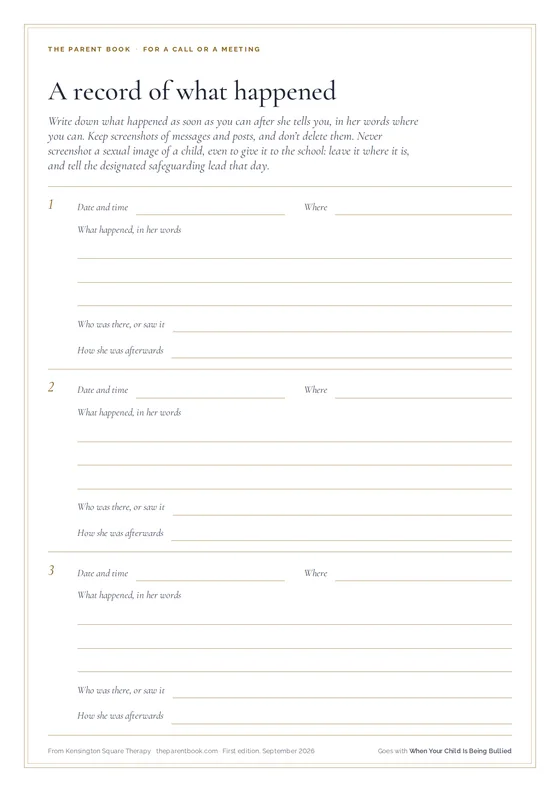
The quick tips and activities are for subscribers; the sheets that go with this chapter are yours to print. What a subscription includes.
Who else can help
Coram Kidscape
The UK’s anti-bullying charity.
0300 102 4481 · Mon-Tue 9.30am-2.30pm; reduced over the summer holidays. Voicemail, email and WhatsApp accepted outside hours
If a child is at risk of harm now, do not wait for a reply: call the police on 101, or 999 if anyone is in immediate danger.
NSPCC
The NSPCC helpline is for adults worried about a child.
0808 800 5000 · Mon-Fri 10am-4pm by phone; email 11am-4pm, seven days a week. An email sent when the service is closed is not received.
If the NSPCC service is closed and the concern cannot wait, call the police on 101. You can also contact the child’s local out-of-hours children’s social care, social work or social services team. If a child is in immediate danger, call 999.
nspcc.org.uk/keeping-children-safe/reporting-abuse/nspcc-helpline
YoungMinds
The UK’s young people’s mental health charity, with a free Parents Helpline, webchat and email, and a plain A to Z of the things parents worry about.
0808 802 5544 · Mon, Thu, Fri 9.30am-4pm; Tue, Wed 9.30am-6pm
Outside those hours the parents line is closed. The urgent routes on this page are open when it is not.