The Parent Book·From the library
When the Best Friend Moves On
For parents whose child’s best friend has drifted away, with no falling-out to explain it.
An eleven-minute read · Published 25 May 2026

Your child comes home from school and says less than usual at supper. When you ask if anything’s wrong, she says nothing is. By the second week she has stopped mentioning her best friend, a name you have heard at every meal for two and a half years. By the fourth week you realise she hasn’t asked for a playdate, her texts have gone unanswered, and the friendship is over.
This comes up often in our work with parents. It’s one of the most painful things that happen in a primary or early-secondary school year, and one of the least dramatic. There’s no incident to point to and no falling-out she can clearly describe, and often there isn’t another child to be cross with either. The friendship has faded slowly over a term, while you were thinking about other things.
What follows is roughly what we tell those parents.
What is actually happening
In most cases, friendship change in childhood and early adolescence is a normal part of development. Between the ages of roughly seven and twelve, children’s friendships reorganise in stages. They start in pairs, with one inseparable best friend, then move into groups of four or five, and then, around the start of secondary school, into looser networks of smaller, overlapping friendships that look much more like adult social life. Each of these changes involves a loss. A best-friend pair that has lasted two years stops being what a child needs; a group draws one of the pair in, and the other is left behind, often without anyone meaning it to happen.
The child who is left behind has usually done nothing wrong. She and her friend are moving through these stages at different speeds, and the one who moves first doesn’t really choose to. She finds herself part of a new group, and on the playground her friend, who hasn’t moved yet, is suddenly the third person in a conversation between two. That’s where the slow drift starts.
We find it helps parents to know this. Often the child is telling herself that there’s something wrong with her, that she has been measured and found wanting. A truer explanation is that, for now, her friend is at a different stage, and being at a different stage isn’t the same as being liked less.
What the child is feeling, and what you might not be hearing
A child rarely describes this loss the way an adult would. She doesn’t say she’s grieving, because she doesn’t know to call it grief. She says she’s bored, or that she doesn’t feel like going to ballet, or that her stomach hurts on Sunday evenings. She feels it in her body before she can put it into words. If you’re waiting for her to sit down with you and explain what has happened, you’ll often find that conversation never comes, because she can’t explain it yet.
What she can often manage instead is a conversation side by side, with both of you looking at something else: in the car, on a walk to the corner shop, or at bedtime with the light off, when she may suddenly find it easier to talk. In our experience, conversations about a lost friendship almost never happen face to face across a table.
The other thing parents miss is how much the friend who has moved on is still in her thoughts. For months, the lost friend is often the person she imagines telling about every small triumph and every small humiliation. She hasn’t learned yet, because nobody has taught her, that this is what loss does, and that part of grieving is slowly finding new people she wants to tell. If you notice this and put it into words, you’re doing something for her that no other adult is likely to do.
What to do, and what not to do
When you realise what’s happening, the instinct is to act: to ring the other parent, set up a playdate, take her somewhere bright and distracting at the weekend, or make a list of new friends she might try to make. Some of these instincts are useful, and most are not.
What helps, roughly in order of usefulness:
The first is to say what you’ve noticed, without making a project of it. You might say something like “I’ve noticed you haven’t mentioned Eva for a while, and I wonder if something’s changed there.” Say it when you’re side by side, and don’t expect an answer. It helps even if she doesn’t reply, because she now knows you’ve seen her and that the loss isn’t invisible. It also helps that you aren’t looking at her. Across a table, with eye contact and a serious face, the same sentence sounds like an interrogation.
The second is to be a bit more available at home than usual for the next few weeks. Don’t fill the time with noise, activities or suggested distractions. Be around, don’t expect her to look as if she has recovered, and be happy to sit on the sofa and watch something undemanding with her for an hour after school. She’s in the middle of a developmental change, and it’s exhausting her. The closest framework we know for this is what Dan Hughes calls PACE, the stance of playfulness, acceptance, curiosity and empathy: you stay close to her without making the loss the subject. In most houses, the practical version is letting the after-school hour be slower than usual for a few weeks. Let her have her snack on the sofa, leave the question about homework until after supper, and make the kind of allowance that tells her “I’ve noticed you’re tired, and I’m not going to add to it tonight”.
The third is to keep her social life going without trying to run it. Stick with the activities she already does, and say yes to the invitations that come. Except in very particular circumstances, don’t organise a new round of playdates with children she hasn’t chosen herself. What that tells her is “I, your parent, don’t believe you can recover from this on your own”, and that’s rarely what she needs to hear. There’s one exception: an older relative or family friend she already likes spending time with, such as a cousin or a godmother. That’s an existing relationship she can lean on while things at school rearrange themselves, and there’s nothing new for her to manage.
A fourth thing that helps is less obvious: a friendship outside school, through Brownies, a football team or a weekend swimming squad. A child whose friendships at school have come apart copes much better if there’s one other part of her week where she has a place that doesn’t depend on playground politics. Don’t start three new activities this term. Keep her going to the one she already does, and take her there on the days she’d rather not go.
Some things rarely help. Ringing the other parent for an explanation is one: if there is an explanation, it’s about the stages they have each reached, and a phone call will only make things awkward on both sides. Asking the school to step in along the lines of please make them be friends again is another, and so is suggesting she makes a new best friend by Friday. The same goes for stories from your own childhood about a friendship that ended and how it all worked out fine. She’ll hear them as a request to feel better faster, which is exactly what she can’t do.
For more practical guidance, we send parents to Place2Be’s Parenting Smart articles on friendship change. They’re written by school-based counsellors, in plain language that we find parents can actually use, and the piece on supporting a child through a friendship ending is particularly good. If the loss has tipped into something that is starting to look like low mood or anxiety, and is not lifting after a few weeks, the YoungMinds A-Z page on a child’s friendships is the clearest UK guide we know of for parents wondering when normal friendship grief begins to need a different kind of attention. It’s the piece we sometimes ask parents to read before their next session.
At different ages
What a lost friendship looks like, and what helps, changes as your child grows. The bands below are a rough guide: a small ten-year-old can be socially closer to seven, and a tall eight-year-old can already be moving towards where the eleven-year-olds are.
If your child is between four and seven. At this age, the best friend is the child she sat next to in Reception. These friendships are mostly about who happens to be nearby, and they break up and re-form within weeks. A four-year-old who has stopped mentioning Lily on Monday is often back to mentioning her on Friday. Try not to read too much into it. When she tells you, take it at face value: “I see, you played with Otto today instead.” Take the change calmly and, where you can, set up things that happen regularly, such as a weekly playdate with a different family or an after-school routine that stays the same from week to week. In most cases her friendships will rearrange themselves, and all you need to do is not look surprised.
If your child is between seven and nine. By now there is a real best friend. Her name comes up every time your child talks about school, and losing her, when it happens, hits harder than parents expect. A seven-year-old doesn’t yet have the words to call this grief. Instead she has stomach aches on Sunday evenings and goes suddenly flat. What helps is the side-by-side conversation, a slower after-school hour, and keeping up the one activity outside school that she already does. Don’t start three new ones this term. Take her to the one she has, even on the days she’d rather not go.
If your child is between nine and eleven. The move from pairs into groups is well under way, and at this age it is often visibly painful. With secondary school coming, friendships are already being sorted by who will be where in September. A child who finds herself outside the group forming around her old best friend may say almost nothing about it; silence is how children this age grieve. Say what you’ve noticed, without making a big thing of it: “I’ve noticed Eva hasn’t been over for a while.” Say it when you’re both looking at something else. Then be a bit more available at home than usual, put off the homework battle, and let the after-school hour be slower for a few weeks while she gets used to a new arrangement she had no say in.
If your child is in early secondary, eleven to thirteen. Friendships now come with conditions, in a way the primary years didn’t prepare her for. Much of this happens in group chats: she’s included in some and left out of others, and which ones changes from week to week. At this age, a friendship that moves on often does so visibly online before it does in the corridor. Try not to get caught up in the detail of the group chats. Be around at home after school, broadly available, with a snack and no questions. She’ll tell you things in her own time, usually in bits and usually when you’re looking at something else.
If your child is mid to late secondary, thirteen and beyond. Losing a friend is now part of something bigger. Around this time she is choosing who she will be in the sixth-form year, and a friend who is no longer in her life is sometimes one she has simply outgrown. That doesn’t make the grief any smaller. Talking side by side still works at this age, as it does for the rest of adolescence, and so does being there when she comes to find you late at night. Resist the urge to comment on her new friends. However positive the comment, it’s the one she won’t forgive.
If your child is eighteen and beyond. The specific loss at this age is the friend who doesn’t make the move to university, or who does and changes once there. The school friendship that filled every weekend for six years thins out within a term, and the child on the phone to you in October is sometimes mourning someone who is, technically, still on the other end of a WhatsApp. The best help here is restrained. Answer when she calls, send the occasional message that doesn’t need a reply, and trust that the new friendships forming around her in the new city will, by the end of the year, be doing what the old ones did.
The longer arc
A friendship that ends in childhood is almost never the one that defines her social life by the time she is fifteen. The child eating her sandwich on her own in the corner of the dining hall this autumn will, in the great majority of cases, be in a group of four by next September. You can’t make that happen. What you can do is stay close through the months when it doesn’t yet feel as if it will.
It’s also a loss for you, though parents often don’t let themselves notice it. For two years the other family was part of your weekends, and chatting to the other parent at pick-up had become a friendship of its own. There’s almost no public language for that. If it hurts more than you expected, that’s because it’s a bigger loss than it looks, and it makes sense to mind. Let yourself be sad about it somewhere away from her, and you’ll be calmer when you’re with her. That shows her that loss is real, and also survivable.
It almost always is survivable, but it’s slow. The drift took weeks, the recovery takes months, and both are normal.
NOTES
- Damour, Lisa. Untangled. Atlantic, 2017. The developmental tasks of adolescence framework: Damour’s reading of the seven transitions teenagers move through.
- Sunderland, Margot. What Every Parent Needs to Know. DK, 2016. Sunderland’s developmental neuroscience for parents: body before brain, and the regulated nervous system as the regulating tool.
Where to go further
Lisa Damour, Untangled: Guiding Teenage Girls Through the Seven Transitions into Adulthood This is the book we give parents of girls whose friendships are regrouping, from pairs into groups and then wider networks. Damour’s account of the seven transitions is the clearest writing we know on why friendships change, and why it isn’t your daughter’s fault when they do.
Margot Sunderland, What Every Parent Needs to Know An illustrated guide, by a UK child therapist, to what lies behind children’s emotions. It’s a good read if you can see that your primary-age child is grieving but hasn’t used the word.
What helps a child with friendship difficulties
Friendship is one of the hardest things to help with from outside, because most of it has to happen between the children themselves. What parents can do is everything around the edges, and if you do it consistently, it helps more than it seems to.
- Listen first, advise second. Sit down, and don’t argue with the feeling: “That sounds really hard. Tell me what happened.” Let them finish before you offer a single suggestion.
- Make home a secure base. Children with a stable home are very good, in time, at finding friends they fit with. Time you put into home life helps them socially too.
- Help them describe what’s happening. “It sounds like Maya and Iris were close today. That can feel really hard when you wanted to play too.” Putting it into words helps a child make sense of what happened, without you solving it for them.
- Don’t try to rearrange the friendships. You can’t fix it from outside. Don’t email the other child’s parent, and don’t try to steer the group towards a solution. The friendships in a class belong to the children, and most attempts from outside backfire.
- Build friendships outside school. It might be a cousin, a child from a club or a weekend playdate. One reliable friendship outside school gives your child somewhere their sense of who they are doesn’t depend on how things are going in the playground.
- Read books about friendship together. Try The Invisible Boy, Enemy Pie or Wonder. A story about social difficulty is an indirect way into conversations they’d never have if you asked directly.
- Tell the school about specific, ongoing worries. Send the form teacher a short, factual note: “We’ve noticed she’s been coming home upset about lunchtimes for a couple of weeks now. Anything you’ve noticed?” The pastoral team will often have seen things that fill in the gaps.
Put it into practice
What this chapter looks like in practice: one-minute ideas for tonight, things to do together and sheets to print and keep.
Quick tipsOne minute each
- When the Best Friend DriftsWhen a best friendship slowly fades, it’s usually part of growing up, and it helps to say you’ve noticed.
- No One to Sit With at LunchA lonely child generally seems fine, which is why loneliness is so easy to miss.
- The Party She Needs to LeaveSome children run out of social energy long before the party ends, and going home is how they recover.
Nine quick tips on this in the library
To do togetherActivities
- The walk with no agendaWalk with her at the same time each week, side by side. Some weeks she will talk, and you still go on the weeks she does not.About 20 minutes · with a sheet to print
- Hands busy, side by sideColour, build or make things side by side, each of you on your own thing. Nothing is asked of her, and nothing she makes is marked.About 20 minutes
- A film, and the conversation you do not forceChoose a film with some care, watch it side by side, and do not ask questions afterwards. If she wants to talk, she will.The length of a film
Five activities on this in the library
To printWith this chapter
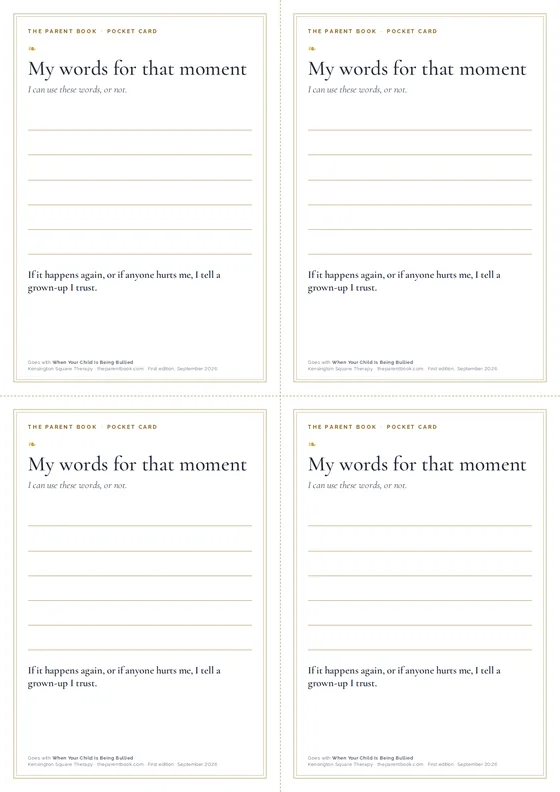
The quick tips and activities are for subscribers; the sheets that go with this chapter are yours to print. What a subscription includes.
Who else can help
Place2Be
Parenting Smart, written by the child mental health specialists who work in primary schools: short, practical articles and films on friendships, behaviour, worries and routines.
Coram Family Lives
A free, confidential helpline for any parenting or family worry, by phone, live chat, WhatsApp or email, staffed by trained family support workers.
0808 800 2222 · Mon-Fri 9am-9pm; weekends 10am-3pm; closed bank holidays
Outside those hours the line is closed. Samaritans answer at any hour on 116 123, and Shout answer if you text the word SHOUT to 85258.
coramfamilylives.org.uk/how-we-can-help/confidential-helpline
YoungMinds
The UK’s young people’s mental health charity, with a free Parents Helpline, webchat and email, and a plain A to Z of the things parents worry about.
0808 802 5544 · Mon, Thu, Fri 9.30am-4pm; Tue, Wed 9.30am-6pm
Outside those hours the parents line is closed. The urgent routes on this page are open when it is not.