The Parent Book·From the library
What to Do When School Is the Problem
For parents whose child has started dreading school.
A thirteen-minute read · Published 25 May 2026

It often starts on a Sunday evening. Your child has been mostly cheerful all weekend, but as the evening goes on she says less and less. Then she has a stomach ache, and by bedtime she’s crying. On Monday morning she can’t get out of bed, and she isn’t putting it on. You have a meeting first thing, and you’re standing in her doorway in your coat, trying to work out whether this is the day to push through or the day to ring in sick.
A week later, it’s starting on Sunday afternoons. A month later, it has spread into Saturday evenings. By the second half-term, the child who used to skip into the playground walks in with her shoulders hunched on the better days, and on the worse days doesn’t walk in at all.
We see a lot of parents in this position. The school says, with all its authority, that she has to come in. Your child says, very clearly, that she can’t bear it. You’re the one standing between them, and the one who knows her best.
What is actually happening
School refusal (the clinical term, and not a very good one) is almost always a stack of things, and your first job is to slow down enough to find out what’s in the stack. These are the things we look for, in the order we usually look, which isn’t an order of importance:
Physical. A child with a low-grade virus that isn’t quite a fever will look like a child refusing school for as long as she’s unwell. If you push her through it, you end up two weeks later with a child who is both physically ill and afraid of school. If she has been off her food, sleeping badly, or complaining of headaches or stomach aches that move around, the GP is the first step.
Friendship. A child who has lost a friend or fallen out of a group can suddenly find school unbearable, and she’s unlikely to tell you that first. Children don’t come home and say “I have no one to sit next to at lunch”. They say their tummy hurts.
Learning. A child who has been finding the work harder than her classmates, perhaps for a year, and getting by through masking, copying and sitting near the back, will at some point reach a level where that stops working. You’ll find out by asking the class teacher directly how she’s coping with the work.
Bullying, which we list separately from friendship because it’s a different problem. These days it’s rarely the playground confrontation people imagine. It’s the group chat she has been removed from without a word, a passing comment in the lunch queue, weeks of low-level exclusion that an adult walking down the corridor wouldn’t see. If you suspect it, ask the school what they have observed; do not ask the child.
Anxiety, the most common in our work. A child whose nervous system is already on high alert finds school, which is big and loud and full of social risk, unbearable in a way she can’t explain. She doesn’t have the word for it; she has a stomach ache.
The family. Something at home has changed: a separation, a bereavement, a parent’s new job, a new baby. Your child picks up on every change in the mood at home, and school is the one place she can refuse to go, so that’s where a feeling she can’t manage comes out. Changes like these show up as school problems first.
You’re unlikely to know what’s in the stack in the first week, but asking why is the right question.
What to do with the school
Most parents find the conversation with the school the hardest part, because you and the school have different priorities and still have to agree on a way forward. The school has attendance to think about and, in some cases, a behaviour policy that treats not coming in as a matter for discipline. At an independent school you may carry other worries of your own: the fees running on while she is at home, or a hint that she might be happier somewhere else. The school’s first instinct is to get your child back into the building. You have a child crying on the stairs.
Try not to fight the school, and try not to simply give in to it either. Be cooperative in how you go about it and clear about what you need. Open with something like “something is going on with her that I want to work with you on”. The school that has been sending letters about her absence will, in most cases, also have a pastoral lead, a SENCo and at least one adult who cares about your child. Ask who that adult is, ask for a meeting with them, and ask what they’ve noticed.
What you want from the meeting is information: the friend the teacher has noticed she has stopped sitting next to, the lesson where she no longer puts her hand up. The school sees things you don’t, and the meeting is your chance to put what you see next to what they see.
If the school’s response is unhelpful, put your request in writing, ask for the school’s policy on emotionally based school avoidance, and ask for a meeting that includes the SENCo. Most local authorities have guidance on this, and the schools that are good at it know the guidance exists.
Write the email carefully. Open with what you’re seeing at home, in concrete terms: “for the last three weeks, Ella has been waking with stomach pains on Sunday evenings, and on Monday mornings she has not been able to leave the house without significant distress”. Ask what the school has noticed, particularly about the social side of lunch and PE. Offer two or three times for a meeting, and sign off warmly. An email that opens “something is going on with her that I want to work with you on” gets a different response from one that opens “I am writing to complain”, because the first asks the school to work on it with you.
If you want something structured to take to the meeting, we send parents to YoungMinds. Its guidance for parents on school anxiety is the clearest UK resource we know on the difference between avoidance driven by anxiety and the older idea of truancy, and it’s the page we sometimes ask a parent to email to a member of staff who still thinks in the old terms. If you want something more substantial for the SENCo, Anna Freud’s school-refusal resources are the next step, and they’re written for professionals as well as parents. If the school has an in-house counselling partner, it’s often Place2Be, and a good first question for the pastoral lead is whether your child can be put forward for it.
The Monday morning
On the morning of a school-refusal day you have the least in reserve, and it feels as if the most is at stake. A few practical steps make Mondays bearable for most parents.
The first is to do as much of Monday morning on Sunday as you can. Lay the uniform out the night before, so you aren’t hunting for it in a panic on Monday. Have her pack her bag with you on Sunday afternoon, and get the PE kit out. How Sunday winds down matters more than how Monday goes, because the Sunday-evening collapse starts at about the moment she realises the week has begun.
The second is to keep the morning conversation short. If she has already decided that she isn’t going, she doesn’t need a lecture about consequences. She needs a parent who is calm. Suzanne Zeedyk writes about what she calls the dance of attunement, the unspoken back-and-forth in which a child’s nervous system takes its sense of safety from the calm adult next to her. Her writing on it is the clearest account we know of what these mornings ask of you. The sentence that works in most homes is “I can see you’re finding this very hard. We’re going to walk to school together and see how we get on at the gate.” Leave the decision until you get to the gate. With the teaching assistant standing there ready to take her, she will often just walk in, whatever she has said at home.
The third is what to do if her feet won’t move. At some point you’ll have a Monday when she can’t get into the building. The most useful sentence is some version of “we’re not going to push it today, we’re going to try again tomorrow, and we’re going to talk to the school about what we’ve noticed”. She needs to know that you aren’t giving up on school, and that you aren’t going to drag her across a line she can’t cross. On the way home, ring the school office where she can hear you: “Ella isn’t in today; I’ll email Mrs M and ask for the meeting.” Hearing that call settles her, because she no longer has to be the one having the argument.
At different ages
School refusal looks different at every age, and so does what helps. The bands below are a rough guide: a small Year 4 child can still belong in the band below, and a Year 9 with a late birthday can still be socially closer to Year 8.
If your child is between four and seven. At this age, refusal is nearly always about separation: what she can’t manage is leaving you. Keep the goodbye short and predictable, and make it the same every morning, with the same sentence at the same point: “I’m going to give you a hug, and then you’re going to go in with Mrs P, and I’ll be here at home time.” Hand her over to the teaching assistant that nearly every Reception class has at the door for exactly this. Don’t stay to watch; the longer you’re visible in the playground, the longer the separation takes. The minute after she goes in is the hardest one, and it’s the minute to walk away.
If your child is between seven and nine. In Years 3 and 4, refusal usually has a specific cause: a friend she has lost, a piece of work she’s finding hard, a teacher whose tone has changed. Slow down enough to find out what it is. A direct question will rarely tell you. Ask the class teacher what has been different over the last fortnight, and ask the friend’s mother whether anything has changed at her end. While you’re finding out, keep getting her into the building. Walk her in yourself if you can, use the side door if the main entrance has become too much, and at bedtime talk her calmly through the morning so that it doesn’t take her by surprise.
If your child is between nine and eleven. In Years 5 and 6, refusal is often about what’s coming. The move to secondary school is in sight, and so are the social calculations that come with it. A child who has been broadly happy at school for six years can become unable to go, for reasons that look puzzling on the surface. Take the move seriously, even though it’s months away. Visit the secondary school beforehand if you haven’t already, and walk the route between the two buildings. Say out loud, where she can hear you, that the change is real and big, and that she’ll get through it. If she’s sitting the 11+, that belongs to this age too, and it’s a pressure of its own. Don’t pretend it isn’t.
If your child is in early secondary, eleven to thirteen. Any pastoral office in the country would recognise the Year 7 collapse. Friendship groups have reorganised, the building is bigger than she expected, and her friends from primary aren’t in her form. Email the pastoral lead and ask who, specifically, is the named adult for your child. Most secondary schools have one; if they don’t, ask for one to be identified. When you talk about it at home, don’t make it about whether she’ll go in. Talk about which lesson she’s dreading and what the school could do to make, say, PE less unbearable. Keep to particular lessons, not the whole school.
If your child is in mid to late secondary, thirteen to sixteen. The GCSE years are different again. Refusal at this age is often, though not always, driven by low mood, intrusive thoughts or a more entrenched pattern of anxiety, and the right thing to do is to stop pushing and ask the GP for an appointment. In most cases the school won’t fix this with a sticker chart. What matters now is keeping her in some education, in whatever form it can take this term, while someone with clinical training looks at what’s behind it. In our experience, a reduced timetable is often what keeps her education going. The YoungMinds page on school anxiety is the one we sometimes ask parents to forward to the head of year.
If your child is in sixth form, sixteen to eighteen. Refusal is rarer at this age, but when it happens it’s more complicated: A-level pressure, questions of independence, and the low-level, grown-up kind of depression that can arrive in seventeen-year-olds who showed no sign of it at fourteen. Talk to her adult-to-adult. Ask her what she would do if she were running her own life from this morning, and listen to the answer. If she says she needs to drop a subject, take a term out or move to a sixth-form college that lets her breathe, those are real options, and the GP and the school’s sixth-form pastoral lead are the people to help you work out how. In most cases, getting her through the year is more important in November than the university place.
When to bring in professional help
Whether you need outside help depends on how long it has been going on and how distressed the child is. The rough markers: refusal sustained beyond three or four weeks; mood flat outside school hours; any glancing talk of not wanting to be here at all; the parent’s own functioning affected. If any one is true, the case for involving someone outside the family is strong.
The GP is the route into NHS services and can refer to CAMHS. Waiting times can be long, so it’s best to ask for the referral early. Many schools, independent schools especially, have a school counsellor; others work with a charity such as Place2Be. Ask how your child can see them, and what stays private between them, because both vary from school to school. Private therapy is another option, and the BACP and NCPS both have searchable directories. Asking for help is usually the thing that makes everything else work.
The parent’s own school days
In many families, a child refusing school brings back the parent’s own memories of school. If you hated school, then on a Monday morning you may have a small girl on the floor crying about the same things you once cried about, and your own twelve-year-old self is in the room too. If you loved school, you may be bewildered, and without meaning to, you may press your own happy memories onto a child whose experience is different.
Both get in the way of seeing your child clearly. Take them to a counsellor, or to a friend you trust who isn’t part of the family, so that the part of your reaction that belongs to you goes to someone other than your child.
The longer arc
In the great majority of cases, a child who has become unable to go to school this autumn will eventually be able to go again. The route back is rarely the one you first imagined. It often involves a partial timetable or a different drop-off, and sometimes a change of school or a period of education at home with the local authority’s support. Recovery comes when the underlying problem is dealt with. If she is argued back into school without anyone dealing with what’s wrong there, she ends up worse off.
You aren’t going to solve this today. Today you can keep her safe, find out a bit more than you knew yesterday, and make the next conversation a bit better than the last one. That’s how it’s done. It’s slow and uneven, but it works.
NOTES
- Zeedyk, Suzanne. Sabre Tooth Tigers and Teddy Bears: The Connected Baby Guide to Attachment. Suzanne Zeedyk Ltd, 2020. Zeedyk’s account of the connected-baby attachment frame and what schools-as-secure-bases looks like in practice.
Where to go further
Eli R. Lebowitz, Breaking Free of Child Anxiety and OCD: A Scientifically Proven Program for Parents This is the SPACE programme, developed at Yale, explained for parents. It’s the clearest single introduction we know to how a parent’s accommodation of a child’s anxiety, however loving, can keep her avoidance going, and to what to do instead.
Suzanne Zeedyk, Sabre Tooth Tigers and Teddy Bears: The Connected Baby Guide to Attachment A UK developmental psychologist explains, in plain language, why a child’s nervous system takes its sense of safety from the adults next to her. The book is aimed at the early years, but the framework still holds in the school-refusal years, and it explains why a parent’s own calm on the doorstep in the morning makes the biggest difference.
What helps when school is the problem
You’ll be working on two things at once: talking to the school, and getting through the mornings at home.
- Start by offering to work together. The school responds differently to “Something is going on with her that I want to work with you on” than to “I am writing to complain”. Ask who her adult at school is, and what they’ve noticed.
- Do Monday morning on Sunday. Put the uniform out the night before, pack the bag together on Sunday afternoon and find the PE kit. How Sunday evening winds down matters more than how Monday morning goes.
- Keep the morning calm and simple. “I can see you’re finding this very hard. We’re going to walk to school together and see how we get on at the gate.” Leave the decision about going in until you get there.
- Plan for the day she can’t go in. “We’re not going to push it today. We’ll try again tomorrow, and we’ll talk to the school about what we’ve noticed.” Saying this means she no longer has to fight you about it.
- Put it in writing if the school stalls. Ask for the school’s policy on emotionally based school avoidance and request a meeting with the SENCo. Schools respond more carefully to a written record.
Put it into practice
What this chapter looks like in practice: one-minute ideas for tonight, things to do together and sheets to print and keep.
Quick tipsOne minute each
- Sunday Evening Has Started HurtingWhen Sunday evenings start to hurt, there is usually more than one reason, so slow down before deciding which conversation to have.
- When the Teacher Is the ProblemTake her seriously without taking sides, and listen for specific incidents you can act on.
- When the School Does Not See HerIf a school misreads your child’s culture, specific examples usually help it adjust.
Sixteen quick tips on this in the library
To do togetherActivities
- The walk with no agendaWalk with her at the same time each week, side by side. Some weeks she will talk, and you still go on the weeks she does not.About 20 minutes · with a sheet to print
- The school day, drawn as a lineShe draws her day from gate to gate and marks where it feels heavy. You take the one moment she marks, not a conclusion, to the school.About 20 minutes · with a sheet to print
- An hour off after schoolFor the child who holds it together at school and comes apart at home. The first hour back asks nothing of her: something to eat, somewhere to recover, and no questions yet.The first hour home
Five activities on this in the library
To printWith this chapter
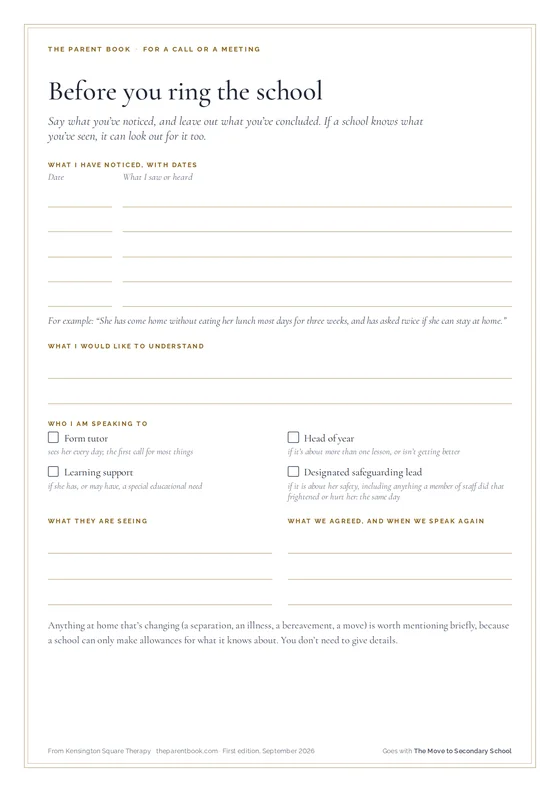
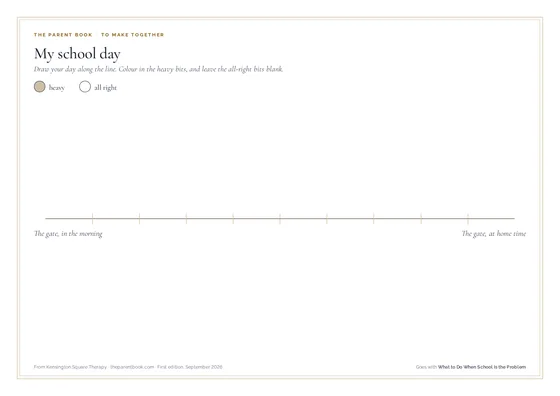
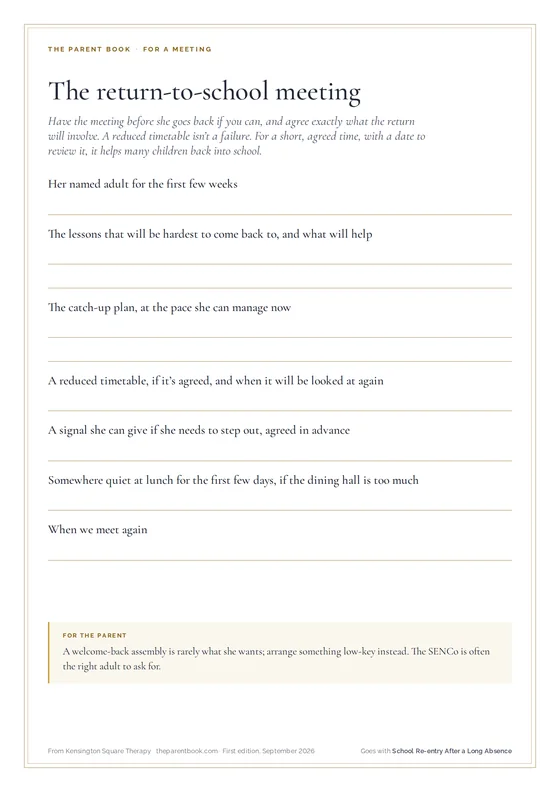
The quick tips and activities are for subscribers; the sheets that go with this chapter are yours to print. What a subscription includes.
Who else can help
YoungMinds
The UK’s young people’s mental health charity, with a free Parents Helpline, webchat and email, and a plain A to Z of the things parents worry about.
0808 802 5544 · Mon, Thu, Fri 9.30am-4pm; Tue, Wed 9.30am-6pm
Outside those hours the parents line is closed. The urgent routes on this page are open when it is not.
Place2Be
Parenting Smart, written by the child mental health specialists who work in primary schools: short, practical articles and films on friendships, behaviour, worries and routines.
Coram Family Lives
A free, confidential helpline for any parenting or family worry, by phone, live chat, WhatsApp or email, staffed by trained family support workers.
0808 800 2222 · Mon-Fri 9am-9pm; weekends 10am-3pm; closed bank holidays
Outside those hours the line is closed. Samaritans answer at any hour on 116 123, and Shout answer if you text the word SHOUT to 85258.
coramfamilylives.org.uk/how-we-can-help/confidential-helpline