The Parent Book·From the library
Perfectionism
For parents whose child can’t bear to get anything wrong.
A fifteen-minute read · Published 25 May 2026

Your child is seven, and she’s been doing a maths worksheet after school for forty minutes. She has done the first question three times. Each time she has looked at it and decided the handwriting wasn’t right, or the working-out wasn’t lined up, or she had only got the answer by guessing and hadn’t understood it. On the third attempt her pencil slips and the four comes out the wrong shape. She tears the worksheet down the middle, something she’s been building up to for the last twenty minutes. For a second there’s no sound at all. Then she’s on the floor next to her chair, sobbing, and nobody in the family can understand why, because the work was fine and the answer was right.
Watching from across the room, you slowly realise that something bigger than the maths is going on. It has been building for longer than this one worksheet, and the worksheet is just where it has spilled over.
We hear about scenes like this often in our counselling work with parents. Sometimes the child is six and in tears over a drawing she crumpled up before anyone had a chance to admire it. Sometimes she’s ten and copying out the same paragraph of homework for the fourth time. Sometimes she’s fourteen and in her bedroom with a B+ on a piece of coursework, and for two days she tells nobody at home that she hasn’t been able to eat since the mark came through. The ages are different, but the pattern is recognisably the same.
We aren’t the definitive book on perfectionism, and we use the word carefully, because it covers a wide range, from the developmentally normal to the clinically concerning. Your first task is to work out which of those you’re seeing in your own child.
What is actually happening
The perfectionism that brings parents to us is rarely about a wish to do well. Almost every child wants to do things well, and that isn’t a problem. What turns aspiration into the kind of perfectionism that costs a child something is a link she has started to make, often without anyone meaning to teach it, between how well she does and how acceptable she is to the adults around her. Her sense of her own worth has come to depend on how she performs. So when her pencil slips on the worksheet, she takes it as evidence of something she fears about herself, though at seven she can’t yet put it into words.
What she has taken in is that she’s loved when she’s doing well, and that the adults around her have less time for the parts of her that aren’t. Parents almost never actually say this. She has put it together from a long run of small observations: a comment about her sister’s mark, the relief in her mother’s voice when she came home with the spelling test, the way her father puts his phone down for her school report but not for the story she’s telling about lunch.
When the perfectionism is more entrenched, something else is happening as well. The child has developed an inner voice that is harsher about her than any adult around her would dream of being. When she crumples a drawing before anyone has seen it, that’s the inner critic at work. At six or seven she’s in no position to question it, because she can’t yet step back and think about her own thinking. For now, she has no way of telling the critic apart from herself.
This affects what happens when you try to reassure her. When the worksheet is torn, your instinct is to say “It was fine, the answer was right, you’re good at maths.” That’s loving and well meant, but in our experience it doesn’t do what parents hope, because she can’t hear you over the critic in her own head.
Helpful aspiration, corrosive perfectionism
High standards aren’t the enemy in themselves, though they can be set too high, and we aren’t arguing for lower ones. A child who is willing to work hard, try the harder thing and redo the writing she knows is sloppy is developing competence, and eventually mastery, and that’s part of what makes a childhood feel worthwhile. It helps to separate two things that look alike on the surface and are, clinically, very different.
Helpful aspiration looks like this. The child’s attention is on the task. She wants to know whether the drawing has worked, and she can put up with a version that isn’t right yet, because that doesn’t mean anything terrible about her. She can stop when she’s had enough and come back to it the next day. She has separated her own worth from the worth of the work.
Corrosive perfectionism looks different. The child’s attention is on what the task is going to reveal about her. She can’t bear a version that isn’t right yet, because to her it’s evidence about who she is. She can’t stop until it’s right, or leave unfinished work alone. Often she can’t even start, because starting means risking getting it wrong, and that’s more than she can stand. She finds feedback very hard to take: she hears the kindest correction as a verdict, and any praise, however small, becomes a bar she has to clear next time. To her, doing maths feels like being weighed.
What links the two is a conditional clause: “I am acceptable if I do this well.” Until she has taken in the unconditional version (she is acceptable, full stop, and the work is something she does on top of that), the standards she sets herself will act as the terms on which she is acceptable. The work will go on feeling like a test she has to keep passing.
If you want to read more, the book we most often give to parents of teenage girls at this stage is Lisa Damour’s Untangled; she writes unusually carefully about how perfectionism develops in girls through the secondary years. For younger children, and for how children learn to regulate their emotions, Siegel and Bryson’s The Whole-Brain Child sets out the integrative approach that parents have found most useful. Karen Treisman’s writing on conditional worth and felt safety covers the trauma-informed side of the subject, for families where a child’s sense that her worth is conditional has its roots in difficult experiences earlier in her life.
The parent’s own contribution
At some point this chapter has to turn to the adults in the household. We don’t mean it as blame.
Children read the people around them. In the great majority of families we work with, the perfectionist child has been reading adults who feel their own worth is conditional too. It might be a mother who, by her own account, is worth what she produces, or a father whose childhood was about achievement and whose adult life has continued the pattern, or a household where talking about how the day went usually turns into talking about what got done. None of this is anyone’s failure. It’s the family system the parents grew up in themselves, handed down without anyone choosing to hand it down.
In small everyday exchanges, the child picks up how much moral importance her parents place on performance: the slight tightness in a parent’s voice when asking if the homework is done, the visible relief when the school report is good, the disappointment nobody says out loud but she notices anyway, because she’s reading every tiny change in their faces. She hears words like clever, good at maths and the bright one. Children whose parents talk in terms of clever and not clever sort themselves into those two boxes early.
The way achievement is talked about more widely at home plays a part too: schools described as places where some children win and others lose, or comparisons, made or implied, even between siblings and even kindly, such as “your brother had this exact problem at your age”. At seven, a child doesn’t know that a comparison like that is meant to reassure her. She knows she has been compared with someone, and that it was done out loud.
If you’ve come this far and recognised yourself in any of this, you’re the person in a position to repair it, and that repair is the most important thing this chapter is for. A pattern like this passes down the generations until somebody decides to look at it. In the families we work with, deciding to look is often the point at which it stops.
What helps, what does not
What helps is smaller and slower than parents tend to want. No single conversation does it. Things change as, over time, the message at home that she is acceptable as she is slowly replaces the message that she is acceptable when she does well.
The first thing is to keep praise of the work separate from praise of the child. That’s a beautiful drawing is praise of the work; you’re so creative is praise of the child. The second sounds warmer, but in practice it’s the one that makes her worth feel conditional. A child praised for being creative learns that there’s a category called creative children, and that she stays in it only as long as she keeps producing evidence. A child told that her drawing is beautiful has been told something about that drawing, and the next drawing is a fresh question. Parents who want to read further usually start with Carol Dweck’s writing on praise and growth. It’s worth knowing that the evidence for growth mindset is more modest than it’s sometimes said to be: two large meta-analyses published in 2018 found its overall effects on school achievement weak, with some sign of benefit for students from poorer families or at risk of falling behind. Our own shorthand for keeping the two kinds of praise apart is “say more about what you can see and less about what you’re deciding she is”.
The second is to talk about your own mistakes, out loud, in front of her. “I’ve left the chicken in too long again, that’s annoying, we’ll see what we can salvage.” “I’m not very good at this jigsaw, I’m going to have another go after supper.” When she watches you make mistakes calmly and recover from them, she learns, faster than any conversation could teach her, that mistakes are part of being a person, not a moral failing she’s uniquely prone to.
The third is to ask her at the end of the day what was interesting and what was hard. What was the best bit is a question a perfectionist child finds difficult, because the right answer feels like a performance. What was the hardest bit and what was the most interesting bit are questions she can answer without being judged. Over weeks, she stops auditioning at supper.
The fourth is to show her that it’s all right to make mistakes, in a way she can actually take in. Saying it’s okay to get it wrong in the abstract doesn’t reach a perfectionist child, because her inner critic has already dismissed it. What reaches her is a parent who reacts lightly when she does get something wrong. Hand back the maths worksheet with three wrong answers without a sigh. When a piece of writing has missed the point, look at it together and say “I can see what you were going for there, let’s think about how to get closer to it next time,” in the voice you’d use to talk about the weather. It’s the repetition that convinces her, more than any single occasion.
What rarely helps is telling her she’s the cleverest, the loveliest, the best at everything. A perfectionist child knows why you’re saying it, and she has already discounted it. More compliments do nothing. She needs a different kind of attention, in which, this evening, she isn’t being assessed at all.
At different ages
Perfectionism looks different at each age, and so does what helps.
If your child is between four and seven. At this age perfectionism tends to show up as meltdowns over minor things: the crumpled drawing, the tower that fell, the line on the page that wasn’t quite straight. Keep your own reaction low-key and matter-of-fact: “That’s a shame, let’s see if we can pick it up.” Don’t turn it into a big rescue, because a rescue tells her the spilled milk really was worth a reaction that size. For the rest of the day, keep what you say about her to who she is, not what she does. Say “I’m glad you’re here” and “I love you” for no reason, at random times, with no condition attached.
If your child is between seven and nine. Now the perfectionism starts to attach itself to schoolwork. She redoes her handwriting three times, rehearses for the spelling test late into Sunday evening, or says in passing that her work is not very good. Lower the temperature around schoolwork in particular. If she has been doing her homework for half an hour and what she’s producing is tense and small, she needs to hear “That’s enough for today, let’s stop.” When you’re willing to interrupt the work, you give her evidence that your love doesn’t depend on it being finished tonight.
If your child is between nine and eleven. The self-consciousness that comes before secondary school makes it worse. She now compares herself with other children, and the perfectionism often turns into secrecy: the test result she won’t show you, the piece of writing she won’t let anyone read. Stop pushing for information. What helps is talking about other things: “What are you reading at the moment? What did you and Sophie talk about today?” Questions that have nothing to do with her work treat her as a person again.
If your child is in early secondary, eleven to thirteen. Peer-group pressure is now at full strength. Perfectionism at this age can become brittle, with visible distress over what an adult would see as a strong piece of work. Praise the qualities you most value in her that have nothing to do with performance: her kindness to her brother, her thoughtfulness about her grandmother, her willingness to try the new club. Over a term, she’ll start to take these in as evidence of who she is, separate from anything she has produced.
If your child is mid to late secondary, thirteen to sixteen. In the GCSE years, the perfectionist child is most at risk of tipping into anxiety, low mood, or disordered eating. Watch for the cluster: sleep changes, appetite changes, social withdrawal, sustained low mood, talk about her body or about food that has acquired a moral weight. None of these in isolation is alarming; the cluster, sustained over weeks, is the moment to involve the GP. If you want something more clinically grounded at this stage, the Anna Freud resources for parents on perfectionism and anxiety in adolescence are the right next read.
If your child is in sixth form, sixteen to eighteen. By now, the perfectionism she has had for years is meeting the high stakes of A-levels and applications. Talk to her as one adult to another. When she’ll let you, ask what she would do if she could spend an afternoon on something that didn’t have a grade attached, and take her answer seriously. More than she did at twelve, she needs to remember the parts of herself that nobody grades.
The longer arc
Our counselling work with adults who grew up as perfectionists keeps showing us that a conditional sense of worth doesn’t go away on its own. Adults who never took in that they were loved unconditionally tend to spend a great deal of their working lives producing evidence that they are acceptable, and a great deal of their inner lives deciding whether the evidence is good enough. It’s exhausting and slow to undo, and undoing it tends to take longer than the people trying had hoped.
We don’t want to alarm you, but this is why the changes in this chapter are worth making. In the long run, the afternoon of the torn worksheet is one episode in a family system, and if you can begin to change that system, it will be a different one by the time she’s fifteen. That means aiming your praise at the work, making your own mistakes out loud, asking at supper what was interesting and what was hard, and saying “I’m glad you’re here” often, for no reason. Over a year, the conditions on her worth begin to loosen. Over five, she has a sense of unconditional worth that she can call on when she needs it.
If you’ve recognised your own household in this chapter, and it made you uncomfortable, the repair is yours to make, and part of it is saying so to her, kindly: “I think I’ve sometimes been more interested in how you did at things than in how you were doing in yourself. I’m sorry about that. I’m going to do it differently.” Say it once and don’t wait for a reply. She doesn’t have to answer for it to count. You are the adult whose approval she has been working to earn, and when you say out loud that it came with conditions, those conditions start to lift.
The torn worksheet is still lying there. Pick it up, sit on the floor with her and say something warm about anything but the maths. This afternoon will pass. The pattern will take years to change, and you can be the person who interrupts it.
NOTES
- Damour, Lisa. Untangled. Atlantic, 2017. The developmental tasks of adolescence framework: Damour’s reading of the seven landings teenagers move through.
- Siegel, Daniel J. & Bryson, Tina Payne. The Whole-Brain Child. Bantam, 2011. The “name it to tame it” move and the upstairs/downstairs brain model both originate here.
- Dweck, Carol. Mindset: The New Psychology of Success. Random House, 2006. The fixed/growth mindset distinction and the place of praise for process over outcome.
- Brown, Brené. The Gifts of Imperfection. Hazelden, 2010. The wholehearted-living frame and the letting go of who-we-should-be.
- Assor, Avi, Roth, Guy & Deci, Edward L. “The emotional costs of parents’ conditional regard: a self-determination theory analysis.” Journal of Personality, 2004, 72(1), 47–88. Regard made conditional on achievement predicted inner compulsion, fluctuating self-esteem and resentment: the evidence behind the conditional clause.
- Sisk, Victoria F., Burgoyne, Alexander P., Sun, Jingze, Butler, Jennifer L. & Macnamara, Brooke N. “To what extent and under which circumstances are growth mind-sets important to academic achievement? Two meta-analyses.” Psychological Science, 2018, 29(4), 549–571. Overall effects on achievement were weak for both mindset and programmes to change it, with some sign of benefit for students from low-income families or academically at risk.
Where to go further
Carol S. Dweck, Mindset: The New Psychology of Success The book that introduced the idea of fixed and growth mindsets and applied it to praise. It comes up earlier in this chapter; the chapters on praising the process, not the person, are the ones to read first.
Brené Brown, The Gifts of Imperfection A research-based introduction to the difference between healthy striving and the perfectionism that runs on shame. It’s the clearest writing we know on what a parent shows her perfectionist child, by example, in everyday life at home.
What helps a perfectionist child
Perfectionism is one of the slowest patterns in childhood to shift, because the child has often built their identity around it. It takes patience, and a lot of it comes down to how you deal with your own imperfection. These are the moves that consistently help.
- Praise effort, behaviour and process, never just results. Say “You kept going when that was hard”, not “You’re so clever”. The first tells her what worked; the second adds pressure.
- Admit your own mistakes out loud. Do it often: “I burnt the dinner.” “I forgot the appointment.” “I read the email wrong.” Your child copies how you deal with your own mistakes far more than anything you tell them.
- Practise being a beginner together. Try a new hobby, a messy art project or a game where you all lose. It’s practice at getting things wrong when nothing depends on it.
- Don’t argue with their self-criticism. “That’s not true, you’re so clever” gets dismissed as quickly as you say it. “That sounds really hard to feel” is much more useful. Acknowledging the feeling helps it pass.
- Add the word “yet”. “I can’t do this maths” becomes “I can’t do this maths yet.” That one word teaches them that ability can grow. Once they’ve heard you use it a few times, they’ll start using it themselves.
- Make mistakes a dinner-table topic. At dinner, ask everyone to share one everyday mistake from their day, including you, your partner and your child. Hearing about mistakes regularly makes them feel normal, and that does more than any one-off correction.
- Read “Beautiful Oops” and “The Most Magnificent Thing” together. Children’s books about making mistakes and trying again come at the subject indirectly, so they often get across what a direct conversation can’t.
Put it into practice
What this chapter looks like in practice: one-minute ideas for tonight, things to do together and sheets to print and keep.
Quick tipsOne minute each
- The Worksheet Torn Down the MiddleWhen a perfectionist child tears up her maths, she’s upset about what getting it wrong says about her.
- The Homework Redone for the Fourth TimeIf your child keeps redoing her homework because it isn’t perfect, end the session for her.
- When Ambition Is Really AnxietyAn anxious high achiever can look exactly like a teenager with healthy ambition.
Seven quick tips on this in the library
To do togetherActivities
- The interesting bit and the hard bitAsk her one question at the end of the day, at supper or on the way home: what was interesting, and what was hard. Then answer it yourself.About 5 minutes
- A mistake each, at a weekly mealOnce a week, at one meal, everyone says one thing they got wrong, starting with you. Nobody comments on anyone else’s.About 5 minutes
- Learning something new, badly, togetherEach of you takes up something none of you can do, and practises it where the others can see. There is no show at the end.About 10 minutes
Seven activities on this in the library
To printWith this chapter
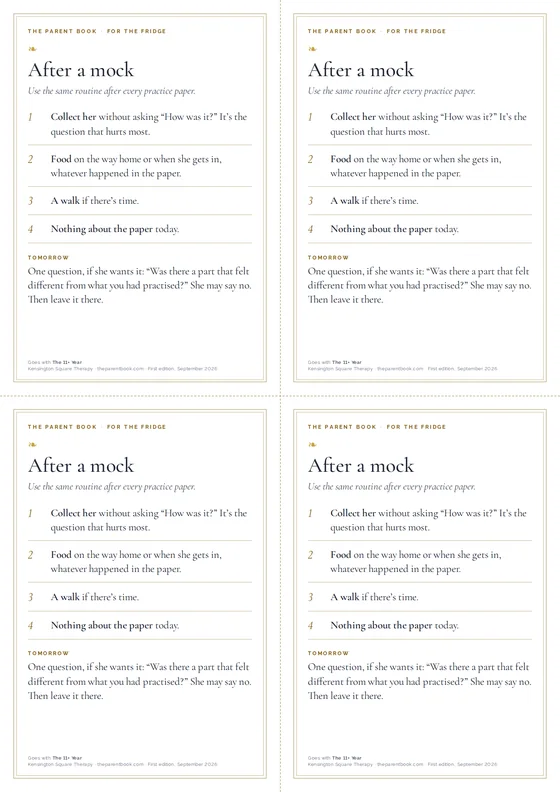
The quick tips and activities are for subscribers; the sheets that go with this chapter are yours to print. What a subscription includes.
Who else can help
YoungMinds
The UK’s young people’s mental health charity, with a free Parents Helpline, webchat and email, and a plain A to Z of the things parents worry about.
0808 802 5544 · Mon, Thu, Fri 9.30am-4pm; Tue, Wed 9.30am-6pm
Outside those hours the parents line is closed. The urgent routes on this page are open when it is not.
Anna Freud
The Anna Freud Centre’s family wellbeing resources: careful, research-led reading on children’s emotional development, separation, self-care for parents, and supporting a child through treatment.
Coram Family Lives
A free, confidential helpline for any parenting or family worry, by phone, live chat, WhatsApp or email, staffed by trained family support workers.
0808 800 2222 · Mon-Fri 9am-9pm; weekends 10am-3pm; closed bank holidays
Outside those hours the line is closed. Samaritans answer at any hour on 116 123, and Shout answer if you text the word SHOUT to 85258.
coramfamilylives.org.uk/how-we-can-help/confidential-helpline