
Behaviour
Behaviour
Behaviour is the visible part of what’s going on inside a child: the hitting, the tantrums, the slammed doors, the child who has stopped doing what she’s asked. We read it as communication, a four-year-old’s body saying what her words can’t yet, and these pages are for the parent trying to work out what lies behind it.
What the library says about this, on one page. It is also online at theparentbook.com/help/behaviour
What to do first
Behaviour is communication before it’s defiance. A child who has come undone has run out of the capacity to cope, not out of manners.
- In the moment, get lower than she is, slow your voice down, and name the feeling before you deal with the behaviour. She won’t be able to take in reasoning for a while.
- Repair things afterwards, an hour later, in three sentences: “That was hard for both of us; I was sharp; I love you.” The repair is the part she learns from.
- Look back over the week for what led up to it. Most explosions have a hungry, tired or overloaded hour behind them.
Some tips to try
Short pieces from the library, and a first thing to try from each.
-
The Meltdown in Public.
In the middle of it she can’t listen, so the next ten minutes are for getting her safe and calm, and the talking comes later.
- Get her somewhere safe with fewer people, stay close, and say very little.
- If they’re getting more frequent or worse, or she hurts herself or someone else, talk to your health visitor or GP, and take the notes with you.
-
When Mealtimes Are About Control.
A child’s relationship with food is almost always about control.
- You decide what, when and where. She decides whether to eat and how much.
- If restriction has been creeping rather than holding steady, ring the GP.
-
When She Hits Her Brother.
Stop it, go to the child who was hurt, and leave the talking until she has calmed down.
- Separate them and go to her brother first: “I won’t let you hurt him.”
- If the hitting is frequent, getting worse, or affecting how the family gets on over a longer period, talk to her school or your GP.
The rest of each tip, with more to try and why it works, is in the library.
Something to do together
First this, then that. A card with two pictures, the thing she does first and the thing that comes next, for a young child who finds it hard to stop one thing and start another.
What it is for. Moving from one thing to another is hard for many young children, and often harder for autistic children, who may prefer to know what is going to happen in advance. A card that shows the order in pictures means she doesn’t have to keep it in her head or hear it said again and again, and she can see that the next thing is on its way.
- The first step. Choose one moment in the day that often goes wrong: leaving the park, getting into the bath, the tablet going off. Start with that one, and add others later.
Safety. An adult cuts the cards out. If you stick on photographs or pictures, use glue or tape, not pins or anything small enough to swallow.
When to get help. If moving from one thing to another ends in long, intense upset on most days, it is getting worse over several weeks, or she hurts herself or others when it happens, talk to your health visitor if she is under five, or your GP, and to her nursery or school. If you have been wondering whether she might be autistic, the GP is where an assessment starts; for a child not yet at school, the health visitor may make the referral. If something she says suggests that someone is hurting her, or that she does not want to be alive, stay calm, thank her for telling you, do not promise to keep it secret, and act that day, using the routes under “If you need help right now”, at the foot of every page.
The other five steps, and your part in it, are in the library.
If you want to read further
- Big Feelings and Co-Regulation. For parents whose child has just had a meltdown, on how to help her through it. theparentbook.com/reader/big-feelings-and-co-regulation
Worth your time
- A book for you: The Kazdin Method for Parenting the Defiant Child, Alan E. Kazdin with Carlo Rotella. From the Yale Parenting Center, a structured programme built on decades of trials: praise the behaviour you want, practise it in play, use points charts and keep consequences mild and brief.
- A book to read together: Hands Are Not for Hitting, Martine Agassi. A sturdy board book for toddlers who hit, showing all the things hands can do instead, such as waving, hugging and building. Short enough to read in the moment and repeat often. uk.bookshop.org/p/books/hands-are-not-for-hitting-martine-agassi/09b2db4e36d0faa6
- Something to watch: How to handle toddler tantrums, NSPCC, YouTube. NSPCC advice on why toddlers have tantrums, how to stay calm yourself, and simple ways to prevent and ride out the hardest moments without shouting or smacking. www.youtube.com/watch?v=tT1cm7Eiv2I
- Something to listen to: Respectful Parenting: Janet Lansbury Unruffled, Janet Lansbury. Janet Lansbury answers listeners’ letters about toddlers and young children: hitting, bedtime, separation, a new sibling. Her calm, respectful approach helps parents hold limits without anger or long explanations. podcasts.apple.com/gb/podcast/respectful-parenting-janet-lansbury-unruffled/id1030050704
Who else can help
This usually starts at school rather than at the surgery. The adults who see your child every day are the first people to tell, and often the fastest route to a change. The GP is there if it persists or deepens.
- Your child’s school. The pastoral lead, the head of year, or the form tutor. Free, already knows your child, and often the quickest way to get something changed at school. Before or alongside anything else. A school cannot act on what it has not been told, and what you bring is often what it did not have.
- Your GP. The gateway to everything the NHS offers a child: paediatric assessment, a referral to CAMHS, and support for you as the parent. Ask for a double appointment. Describe the pattern over weeks rather than the worst single day, and say plainly what you are worried about. Bring a written list; the ten minutes go quickly. www.nhs.uk/service-search/find-a-gp
- Place2Be. Parenting Smart, written by the child mental health specialists who work in primary schools: short, practical articles and films on friendships, behaviour, worries and routines. For a child of five to eleven, when you want something you can read in ten minutes and try tonight. Place2Be’s counselling itself is only through partner schools. parentingsmart.place2be.org.uk
- Action for Children Parent Talk. A free one-to-one webchat with a trained parenting coach, and a library of articles by age on behaviour, sleep, neurodiversity and family life. When you want to talk it through with someone in writing, this week, without a referral. Free one-to-one webchat with a parenting coach, Mon-Fri, with evening slots on Mon and Thu; check the site for current times · Parent Talk+ by phone or video for parents of children with additional needs, up to eight free sessions parents.actionforchildren.org.uk
- Coram Family Lives. A free, confidential helpline for any parenting or family worry, by phone, live chat, WhatsApp or email, staffed by trained family support workers. When you need to talk it through with someone, about your child or about how you are managing, and you do not need a specialist to do it. Coram Family Lives helpline 0808 800 2222 · Mon-Fri 9am-9pm; weekends 10am-3pm; closed bank holidays · Live chat and WhatsApp 07441 444125 at the same hours; email askus@coramfamilylives.org.uk · Outside those hours the line is closed. Samaritans answer at any hour on 116 123, and Shout answer if you text the word SHOUT to 85258. www.coramfamilylives.org.uk/how-we-can-help/confidential-helpline
The full list for behaviour, with what each organisation does and when it is the right call, is at theparentbook.com/help/behaviour/services
Published by Kensington Square Therapy. Company No. 16707111. Written by therapists registered with the British Association for Counselling and Psychotherapy (BACP) and the National Counselling and Psychotherapy Society (NCPS). This page is not therapy, and not a substitute for professional support. The full library is at theparentbook.com.
Everything the library holds on behaviour
Go further
Quick tips
- The Meltdown in PublicIn the middle of it she can’t listen, so the next ten minutes are for getting her safe and calm, and the talking comes later.
- When Mealtimes Are About ControlA child’s relationship with food is almost always about control.
- When She Hits Her BrotherStop it, go to the child who was hurt, and leave the talking until she has calmed down.
- When She Is the One Doing the BullyingHear the facts first, then be clear with her that it stops and that she’ll help put it right.
- The Three-Year-Old Who HitsStop the hit first, then help her find words for what she was feeling.
- Making Home Easier on Her SensesBy bath time she has been processing sensory input for eleven hours, and a few changes at home help.
- The Tantrum Over the Broken BananaA broken banana is more than a tired three-year-old can take.
- Routines That Work for an ADHD ChildAn ADHD child needs a routine that’s more visual and more forgiving, with the prompts outside her head.
- The Supermarket That Is Too MuchPlan supermarket trips so you leave before the noise and lights become too much for her.
- The Two-Year-Old in TearsCrying is how a two-year-old tells you what she can’t yet put into words.
Quick tips open with a subscription.
Things to do together
- First this, then thatA card with two pictures, the thing she does first and the thing that comes next, for a young child who finds it hard to stop one thing and start another.
- Ten minutes where she leadsTen minutes most days when she chooses what you play and you follow her lead. You don’t teach, correct or ask questions, and she never has to earn it.
- A place to settle, with you nearbyA comfortable corner, chosen with her, for when a feeling gets too big. While she is small you go there together, and nobody is ever sent there.
Activities open with a subscription.
To print
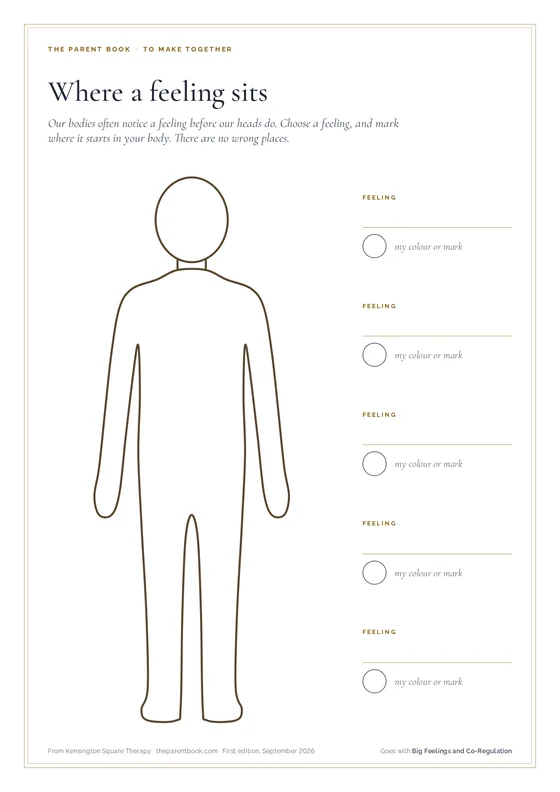 Where a feeling sits
To make together · A4, two sides · PDF, 62 KB · With a subscription
Where a feeling sits
To make together · A4, two sides · PDF, 62 KB · With a subscription
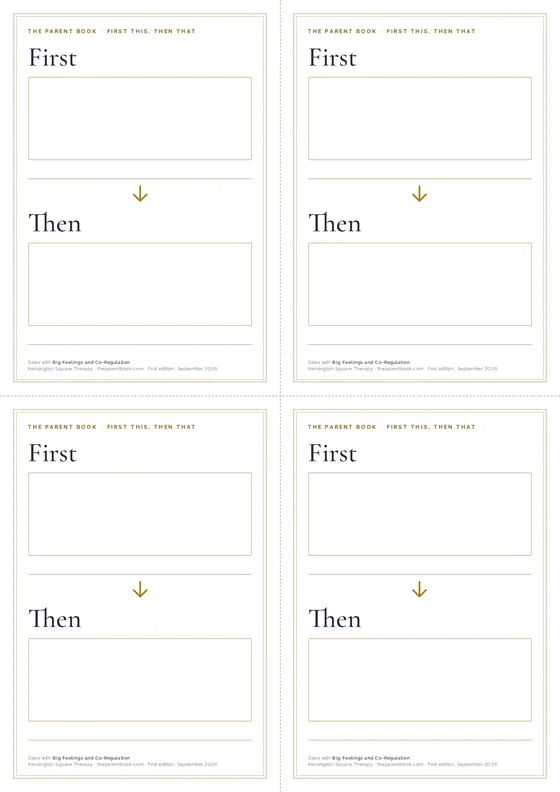 First this, then that
Cards to cut out · A4, four cards to cut, two sides · PDF, 64 KB · With a subscription
First this, then that
Cards to cut out · A4, four cards to cut, two sides · PDF, 64 KB · With a subscription
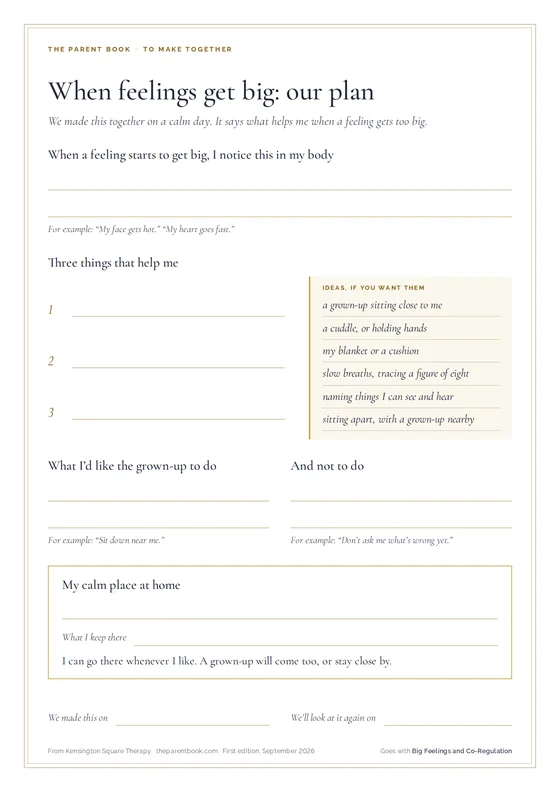 When feelings get big: our plan
To make together · A4, two sides · PDF, 66 KB · With a subscription
When feelings get big: our plan
To make together · A4, two sides · PDF, 66 KB · With a subscription
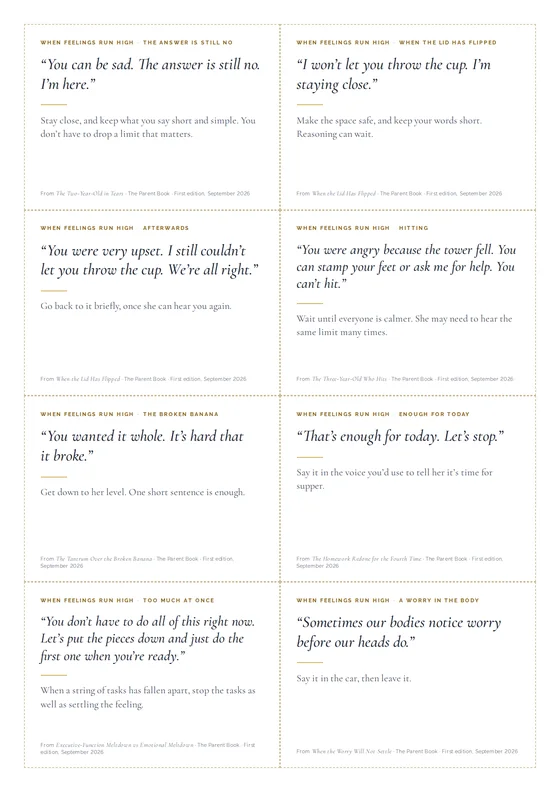 What to say: when feelings run high
Cards to cut out · A4, eight cards to cut · PDF, 61 KB · With a subscription
What to say: when feelings run high
Cards to cut out · A4, eight cards to cut · PDF, 61 KB · With a subscription
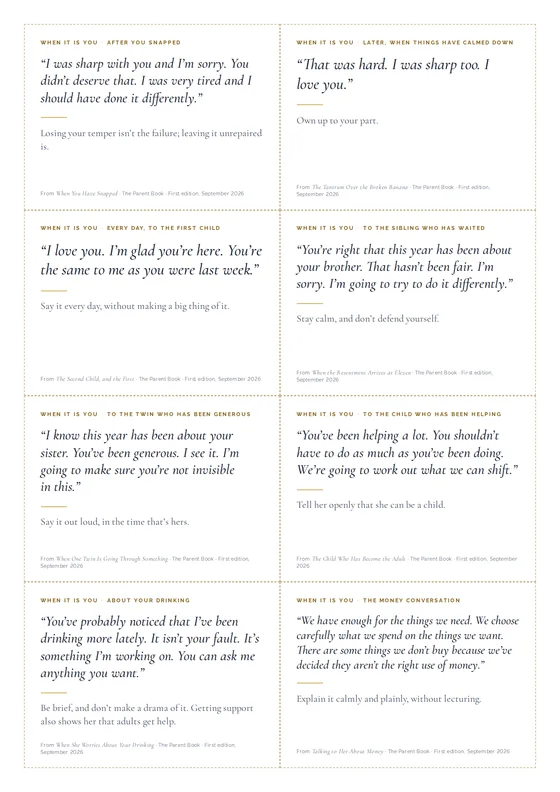 What to say: when it is you
Cards to cut out · A4, eight cards to cut · PDF, 62 KB · With a subscription
What to say: when it is you
Cards to cut out · A4, eight cards to cut · PDF, 62 KB · With a subscription
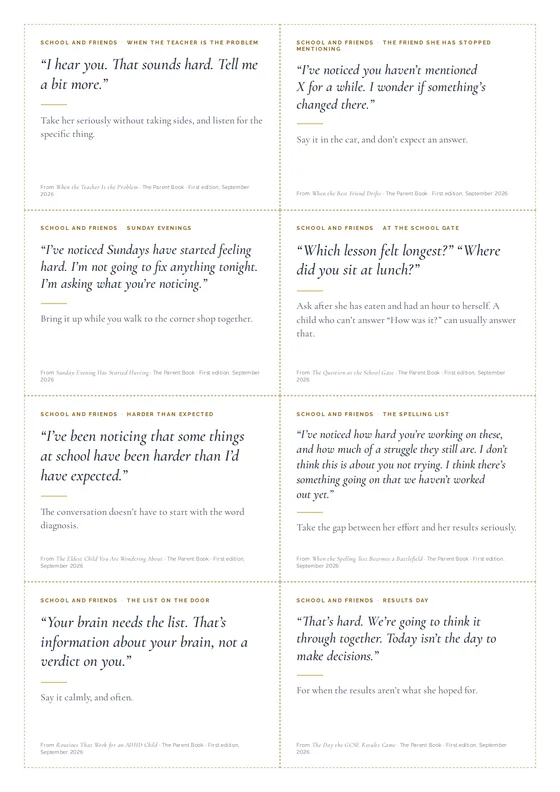 What to say: school and friends
Cards to cut out · A4, eight cards to cut · PDF, 63 KB · Free
What to say: school and friends
Cards to cut out · A4, eight cards to cut · PDF, 63 KB · Free
Family life and behaviour
Parenting strategySibling conflictDifficult conversationsFamily stress