
Family stress
Family stress
This is about what happens to a household under pressure: the morning that has gone wrong before breakfast, the week when everyone is short with everyone, the long Sunday when nothing works. Stress in a family doesn’t mean the love has failed. These pages are for the parent who wants home to feel less tense.
What the library says about this, on one page. It is also online at theparentbook.com/help/family-stress
What to do first
Children pick up on the mood of a household long before anyone explains it to them, and what frightens them is usually not knowing, more than the problem itself.
- Say one true, brief sentence about what’s happening, suited to their age, and say who is dealing with it. Children fill silence with something worse.
- Deal with the practical side. If money or housing is part of it, Citizens Advice will get more done this week than anything said at home.
- Choose one family routine and don’t let the stress touch it.
Some tips to try
Short pieces from the library, and a first thing to try from each.
-
Explaining Where Mum Is.
At six, she may ask out of the blue where her mum is; give her a short, honest answer.
- Prepare a short, true sentence in advance, pitched at her age.
-
Helping Her Answer Questions About You.
Other children will ask her about your disability or illness, and she’ll need words ready to answer.
- Give her a short script for when other children ask, and practise it together.
-
The Boundary With the Grandparent.
Set a boundary with your own parent calmly and briefly, before resentment builds up.
- Have the conversation before resentment builds up.
The rest of each tip, with more to try and why it works, is in the library.
Something to do together
One meal without phones, yours first. One regular meal where every phone in the house, starting with yours, stays in another room.
What it is for. A child learns what a phone is for by watching what the adults use theirs for. If every phone goes into another room at one meal, it becomes something the family does, and you do not have to police it.
- The first step. Pick the meal you can keep most often: supper for some families, Saturday lunch for others.
- Say it once, as something the family does: “At supper the phones live in the hall, mine too.” There is no need to police it; your phone in the hall is the reminder.
When to get help. If something said at the table suggests that someone is frightening or hurting her, online or off, stay calm, thank her for telling you, do not promise to keep it secret, and act that day, using the routes under “If you need help right now”, at the foot of every page. If she has stopped seeing friends in person, her sleep has collapsed, or her mood drops hard whenever the phone is away, talk to your GP or her school’s pastoral lead. If she is avoiding family meals, eating less and less, or hiding food, do not wait: ask your GP for an early appointment.
The other three steps, and your part in it, are in the library.
If you want to read further
- Siblings and the Fights That Aren’t Fair. For parents whose children keep finding new ways to fall out with each other. theparentbook.com/reader/siblings-and-the-fights-that-arent-fair
- When Parents Separate. For parents in the middle of a separation who are watching closely to see how their child is coping. theparentbook.com/reader/separating-what-your-child-is-doing-with-it
Worth your time
- A book for you: Families and How to Survive Them, Robin Skynner & John Cleese. A family psychiatrist and John Cleese in dialogue about how families work, from courtship and new babies to adolescence. Dated in places, but still a clear and often funny introduction to family systems thinking. uk.bookshop.org/p/books/families-and-how-to-survive-them-dr-robin-skynner/653a42e6e204b666
- A book to read together: Grandma, Jessica Shepherd. Oscar’s grandma has dementia and moves into a care home, and he finds new ways to be with her there. A kind, practical book for when a grandparent’s memory is changing. uk.bookshop.org/p/books/grandma-jessica-shepherd/d0a227c91642bb7e
- Something to watch: How does arguing in front of children affect them?, OnePlusOne, YouTube. Why arguing in front of children is not always harmful, what matters is how it is resolved, and how children read the difference between conflict and repair. www.youtube.com/watch?v=G2ssFwwMH0U
- Something to listen to: Emerging Minds Families, Emerging Minds (Australia). Australia’s national centre for child mental health makes calm half-hour conversations for families on separation, siblings, body image, loneliness and community, often a parent alongside a practitioner. podcasts.apple.com/gb/podcast/emerging-minds-families/id1658690877
Who else can help
Where money or housing is part of it, solving the practical problem does more for a child than anything said to them about it.
- Citizens Advice. Free, independent advice on the practical layer: housing, benefits, debt, employment, and your rights when a family separates. When the worry is partly a practical problem wearing an emotional coat. Solving the practical part often lowers the temperature at home more than anything else will. www.citizensadvice.org.uk
- MoneyHelper. The government-backed free money guidance service, including a debt advice locator. When money is part of what is happening at home. Children read household stress long before anyone explains it to them. www.moneyhelper.org.uk
- Coram Family Lives. A free, confidential helpline for any parenting or family worry, by phone, live chat, WhatsApp or email, staffed by trained family support workers. When you need to talk it through with someone, about your child or about how you are managing, and you do not need a specialist to do it. Coram Family Lives helpline 0808 800 2222 · Mon-Fri 9am-9pm; weekends 10am-3pm; closed bank holidays · Live chat and WhatsApp 07441 444125 at the same hours; email askus@coramfamilylives.org.uk · Outside those hours the line is closed. Samaritans answer at any hour on 116 123, and Shout answer if you text the word SHOUT to 85258. www.coramfamilylives.org.uk/how-we-can-help/confidential-helpline
- Family Action FamilyLine. A free helpline for adults on family relationships, conflict, parenting, caring and money, by phone, text, email or chat, with befriending or short counselling if it would help. When the strain is on you and there is no one to say it to. FamilyLine 0808 802 6666 · Mon-Fri 9am-5pm; closed bank holidays. Out of hours, text FAMILYACTION to 85258 family-action.org.uk/get-support/familyline
- Action for Children Parent Talk. A free one-to-one webchat with a trained parenting coach, and a library of articles by age on behaviour, sleep, neurodiversity and family life. When you want to talk it through with someone in writing, this week, without a referral. Free one-to-one webchat with a parenting coach, Mon-Fri, with evening slots on Mon and Thu; check the site for current times · Parent Talk+ by phone or video for parents of children with additional needs, up to eight free sessions parents.actionforchildren.org.uk
The full list for family stress, with what each organisation does and when it is the right call, is at theparentbook.com/help/family-stress/services
Published by Kensington Square Therapy. Company No. 16707111. Written by therapists registered with the British Association for Counselling and Psychotherapy (BACP) and the National Counselling and Psychotherapy Society (NCPS). This page is not therapy, and not a substitute for professional support. The full library is at theparentbook.com.
Everything the library holds on family stress
Go further
Chapters
- Siblings and the Fights That Aren’t FairFor parents whose children keep finding new ways to fall out with each other.
- When Parents SeparateFor parents in the middle of a separation who are watching closely to see how their child is coping.
- When You Are Not All RightFor parents whose own mental health is part of what’s going on at home.
- The Conversations Parents AvoidFor parents who need to tell their child something hard and don’t know how to start.
- Screen TimeFor parents who have lost the argument about screen hours, and suspect it was never quite the right argument to have.
- When Your Child Is Working Out Who They AreFor parents whose child has raised a question about who they are, and who weren’t prepared for it.
- Trauma in ChildhoodFor parents whose child has been through something hard, or whose family has.
Quick tips
- Explaining Where Mum IsAt six, she may ask out of the blue where her mum is; give her a short, honest answer.
- Helping Her Answer Questions About YouOther children will ask her about your disability or illness, and she’ll need words ready to answer.
- The Boundary With the GrandparentSet a boundary with your own parent calmly and briefly, before resentment builds up.
- The Extroverted Parent and the Introvert ChildAn extroverted parent often mistakes an introverted child’s temperament for shyness or low confidence.
- The Grandparent Who Disagrees With YouHer advice is given with love, but you still need to set it aside calmly.
- The Grandparent Whose View Does Not FitYou can be clear about how your own house runs without proving a grandparent wrong.
- When Medication Becomes Family RoutineBuild the medication into something the family already does, and give her ownership of the routine in stages.
- When the Grandparent Becomes IllThe grandparent who looked after the children now needs looking after.
- When the Job Has GoneChildren notice when a job or income is lost, so give them a short, honest explanation.
- When We Cannot Afford ItA calm “We can’t afford that” gives her a way to talk about money that she’ll keep.
All 75 quick tips on family stress
Quick tips open with a subscription.
Things to do together
- One meal without phones, yours firstOne regular meal where every phone in the house, starting with yours, stays in another room.
- A plan for a bad day, made in a good weekA one-page plan, made calmly with your children: who they can call, who does the school run, and what you say to each other on a hard day.
- The week on the fridgeHer week across two homes, drawn in colour with her and put up at her eye level, so that she does not have to keep it all in her head.
Activities open with a subscription.
To print
 A week across two homes
For the fridge · A4 landscape, two pages · PDF, 55 KB · With a subscription
A week across two homes
For the fridge · A4 landscape, two pages · PDF, 55 KB · With a subscription
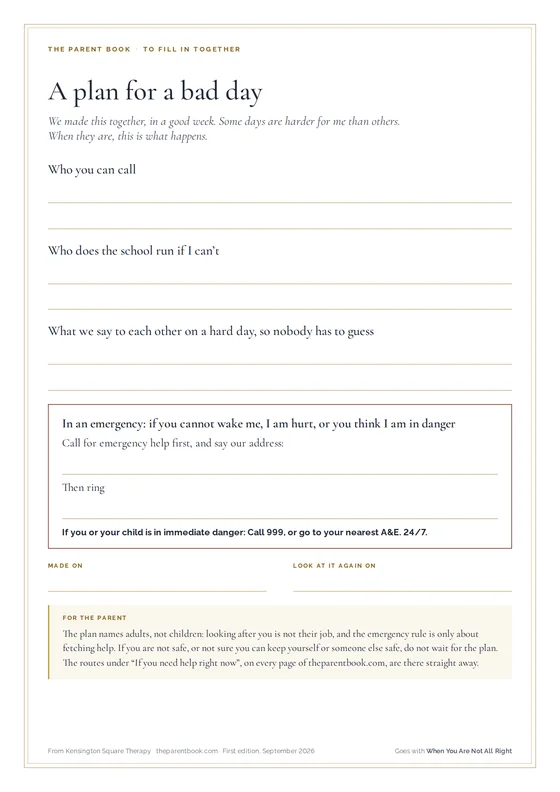 A plan for a bad day
To fill in together · A4 · PDF, 59 KB · Free
A plan for a bad day
To fill in together · A4 · PDF, 59 KB · Free
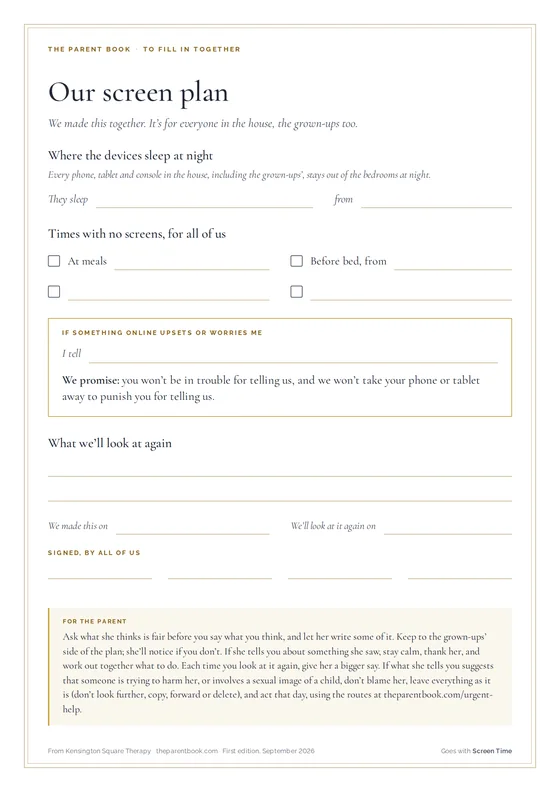 Our screen plan
To fill in together · A4 · PDF, 53 KB · With a subscription
Our screen plan
To fill in together · A4 · PDF, 53 KB · With a subscription
 What to say: loss and change
Cards to cut out · A4, eight cards to cut · PDF, 62 KB · With a subscription
What to say: loss and change
Cards to cut out · A4, eight cards to cut · PDF, 62 KB · With a subscription
 What to say: when it is you
Cards to cut out · A4, eight cards to cut · PDF, 62 KB · With a subscription
What to say: when it is you
Cards to cut out · A4, eight cards to cut · PDF, 62 KB · With a subscription
Family life and behaviour
BehaviourParenting strategySibling conflictDifficult conversations
Every subjectWho else can help with family stressUrgent help