
Difficult conversations
Difficult conversations
Parents put some conversations off, often for years, because the right moment never quite arrives: death, sex, divorce, their own diagnosis, or a family secret their child is starting to sense. If you’re dreading one of them, these pages suggest how to start, what to say first and what to do if it goes badly.
What the library says about this, on one page. It is also online at theparentbook.com/help/difficult-conversations
What to do first
The conversation you’re dreading almost always does less damage than the silence around it. Children already know something is happening; what they don’t have is the words for it.
- Decide on the one true sentence you need to say, and write it down. You’ll need it when your nerve goes.
- Say it early in the day, not at bedtime, and sit side by side if that’s easier than face to face.
- Answer what you’re asked, then stop. Say you’ll come back to it, and then make sure you do.
Some tips to try
Short pieces from the library, and a first thing to try from each.
-
The Day She Asked About Sex.
Give a brief, accurate answer when your child asks how babies are made, then stop.
- Answer at the level she asked it, and keep it brief, accurate and matter-of-fact.
-
The Talk Before It Is Needed.
Aim for eighteen short conversations about puberty over two or three years, starting early.
- Start talking about puberty early, briefly and in passing, before it’s urgent.
- Start talking about puberty early, briefly and in passing, long before anyone in the family has an urgent reason to. When a seven-year-old asks why her older cousin’s voice sounds different, answer her then and there. Do the same when an eight-year-old comments on the bra on the washing line: “Yes, that’s what bodies do as they get older. It happens to everyone. We can talk about it more if you want.” Then move on to something else. She has the information, and she knows it’s a subject the family doesn’t flinch at.
-
Answering Her Questions About Her Past.
When a fostered child asks about her past, take the question seriously and ask her social worker about it together.
- Tell her the question is real, without filling in the gaps.
The rest of each tip, with more to try and why it works, is in the library.
Something to do together
The walk with no agenda. Walk with her at the same time each week, side by side. Some weeks she will talk, and you still go on the weeks she does not.
What it is for. Many children say the hardest things when nobody is looking straight at them. A regular walk gives her a chance to say them, without any pressure to.
- The first step. Choose a time you can keep most weeks, and a route you both know. A familiar walk is easy to start.
Safety. For under-fives, hold hands near traffic; the looking walk is best on a quiet route.
When to get help. If she tells you that someone is hurting her, that she is hurting herself, or that she does not want to be alive, finish the walk calmly, thank her for telling you, do not promise to keep it secret, and act that day, using the routes under “If you need help right now”, at the foot of every page. If a change in her mood or behaviour lasts for several weeks, gets worse, or begins to affect sleep, eating or school, talk to her school and your GP.
The other four steps, and your part in it, are in the library.
If you want to read further
- The Conversations Parents Avoid. For parents who need to tell their child something hard and don’t know how to start. theparentbook.com/reader/the-conversations-parents-avoid
- When You Are Not All Right. For parents whose own mental health is part of what’s going on at home. theparentbook.com/reader/when-you-are-not-all-right
Worth your time
- A book for you: The Opposite of Spoiled, Ron Lieber. A financial journalist on talking openly with children about money, including pocket money, work, giving and what the family can afford. American in detail, but the principles translate. uk.bookshop.org/p/books/the-opposite-of-spoiled-raising-kids-who-are-grounded-generous-and-smart-about-money-ron-lieber/d8a0285e70c49777
- A book to read together: Something Bad Happened: A Kid’s Guide to Coping With Events in the News, Dawn Huebner. For children unsettled by frightening news, such as attacks, wars or disasters. It explains what happened in general terms, why adults react as they do, and how to feel safer, with space for questions. uk.bookshop.org/p/books/something-bad-happened-a-kid-s-guide-to-coping-with-events-in-the-news-dawn-phd-huebner/6e4bb9ebcef3bb37
- Something to watch: Brené Brown on Empathy, Brené Brown, YouTube. A three-minute animation on the difference between empathy and sympathy, why “at least” rarely helps, and what connection sounds like. Teenagers tend to enjoy it too. www.youtube.com/watch?v=1Evwgu369Jw
- Something to listen to: Episode 195 - Dr Cassie Rhodes Talks with Professor Louise Dalton: Talking to Children and Teens about Serious Illness, Get a Grip - Evidence-Based Conversations for Parents and Educators, 48 min. Oxford researcher Louise Dalton explains why being open and honest with children about a parent’s or relative’s serious illness protects their mental health, and how to begin those conversations, with advice for schools. podcasts.apple.com/gb/podcast/episode-195-dr-cassie-rhodes-talks-with-professor/id1450644258?i=1000705587764
Who else can help
This usually starts at school rather than at the surgery. The adults who see your child every day are the first people to tell, and often the fastest route to a change. The GP is there if it persists or deepens.
- Your child’s school. The pastoral lead, the head of year, or the form tutor. Free, already knows your child, and often the quickest way to get something changed at school. Before or alongside anything else. A school cannot act on what it has not been told, and what you bring is often what it did not have.
- Your GP. The gateway to everything the NHS offers a child: paediatric assessment, a referral to CAMHS, and support for you as the parent. Ask for a double appointment. Describe the pattern over weeks rather than the worst single day, and say plainly what you are worried about. Bring a written list; the ten minutes go quickly. www.nhs.uk/service-search/find-a-gp
- Coram Family Lives. A free, confidential helpline for any parenting or family worry, by phone, live chat, WhatsApp or email, staffed by trained family support workers. When you need to talk it through with someone, about your child or about how you are managing, and you do not need a specialist to do it. Coram Family Lives helpline 0808 800 2222 · Mon-Fri 9am-9pm; weekends 10am-3pm; closed bank holidays · Live chat and WhatsApp 07441 444125 at the same hours; email askus@coramfamilylives.org.uk · Outside those hours the line is closed. Samaritans answer at any hour on 116 123, and Shout answer if you text the word SHOUT to 85258. www.coramfamilylives.org.uk/how-we-can-help/confidential-helpline
- Action for Children Parent Talk. A free one-to-one webchat with a trained parenting coach, and a library of articles by age on behaviour, sleep, neurodiversity and family life. When you want to talk it through with someone in writing, this week, without a referral. Free one-to-one webchat with a parenting coach, Mon-Fri, with evening slots on Mon and Thu; check the site for current times · Parent Talk+ by phone or video for parents of children with additional needs, up to eight free sessions parents.actionforchildren.org.uk
The full list for difficult conversations, with what each organisation does and when it is the right call, is at theparentbook.com/help/difficult-conversations/services
Published by Kensington Square Therapy. Company No. 16707111. Written by therapists registered with the British Association for Counselling and Psychotherapy (BACP) and the National Counselling and Psychotherapy Society (NCPS). This page is not therapy, and not a substitute for professional support. The full library is at theparentbook.com.
Everything the library holds on difficult conversations
Go further
Chapters
Quick tips
- The Day She Asked About SexGive a brief, accurate answer when your child asks how babies are made, then stop.
- The Talk Before It Is NeededAim for eighteen short conversations about puberty over two or three years, starting early.
- Answering Her Questions About Her PastWhen a fostered child asks about her past, take the question seriously and ask her social worker about it together.
- The Conversation With the Children About Your IllnessFit what you tell the children to their age, and expect to come back to it over weeks.
- The Day Your Diagnosis CameAfter a serious diagnosis, let the children know something is happening; the full conversation can wait a few days.
- The Medication on Your Bedside TableFor the parent who has not named her own medication out loud.
- Answering a Grieving Child’s QuestionsA grieving child’s questions often come out of nowhere; answer them briefly, in your everyday voice.
- Explaining Where Mum IsAt six, she may ask out of the blue where her mum is; give her a short, honest answer.
- Faith in a Household Where Parents DifferIf you and your partner differ on faith, tell your child openly, in words that suit her age.
- The Boundary With the GrandparentSet a boundary with your own parent calmly and briefly, before resentment builds up.
All 51 quick tips on difficult conversations
Quick tips open with a subscription.
Things to do together
- The walk with no agendaWalk with her at the same time each week, side by side. Some weeks she will talk, and you still go on the weeks she does not.
- Cooking one thing togetherCook one dish together each week, side by side, and give her a real job. If she wants to talk, she can do it while she chops.
- A box for the memoriesAfter a death, make a box together for things that remind her of the person, and a page of what she remembers. She chooses what goes in, and the box is hers.
- A film, and the conversation you do not forceChoose a film with some care, watch it side by side, and do not ask questions afterwards. If she wants to talk, she will.
- Hands busy, side by sideColour, build or make things side by side, each of you on your own thing. Nothing is asked of her, and nothing she makes is marked.
- Play me somethingShe picks a song and plays it to you. You listen to the end, and ask one question about it.
- The interesting bit and the hard bitAsk her one question at the end of the day, at supper or on the way home: what was interesting, and what was hard. Then answer it yourself.
- You go to her thingShe chooses a film, a book, a song or a game she cares about. You watch it, read it or play it, and ask one curious question.
Activities open with a subscription.
To print
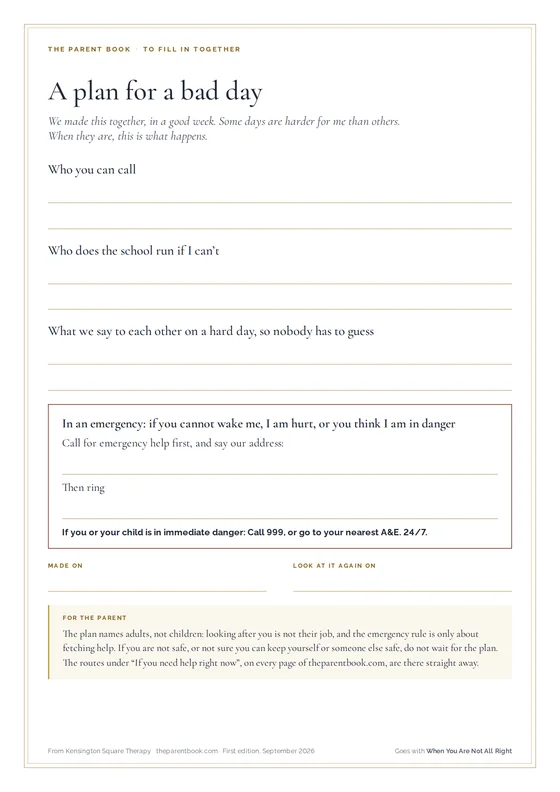 A plan for a bad day
To fill in together · A4 · PDF, 59 KB · Free
A plan for a bad day
To fill in together · A4 · PDF, 59 KB · Free
 What to say: growing up
Cards to cut out · A4, eight cards to cut · PDF, 62 KB · With a subscription
What to say: growing up
Cards to cut out · A4, eight cards to cut · PDF, 62 KB · With a subscription
 What to say: loss and change
Cards to cut out · A4, eight cards to cut · PDF, 62 KB · With a subscription
What to say: loss and change
Cards to cut out · A4, eight cards to cut · PDF, 62 KB · With a subscription
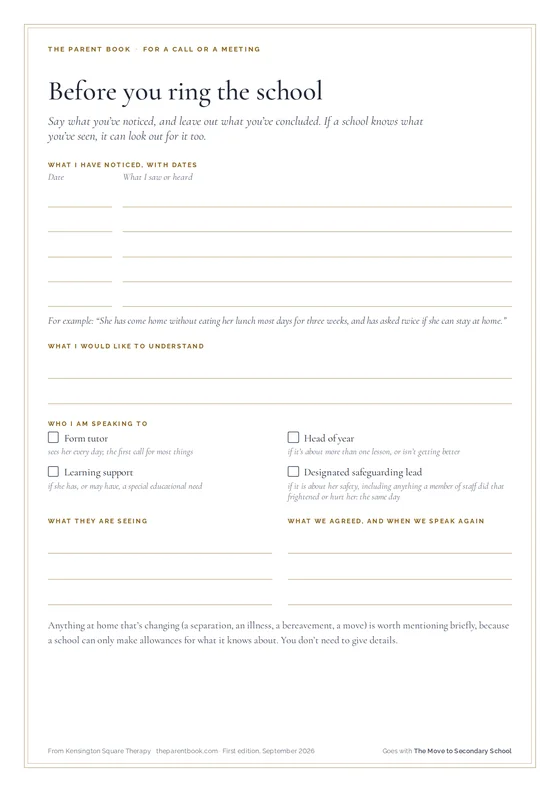 Before you ring the school
For a call or a meeting · A4 · PDF, 58 KB · Free
Before you ring the school
For a call or a meeting · A4 · PDF, 58 KB · Free
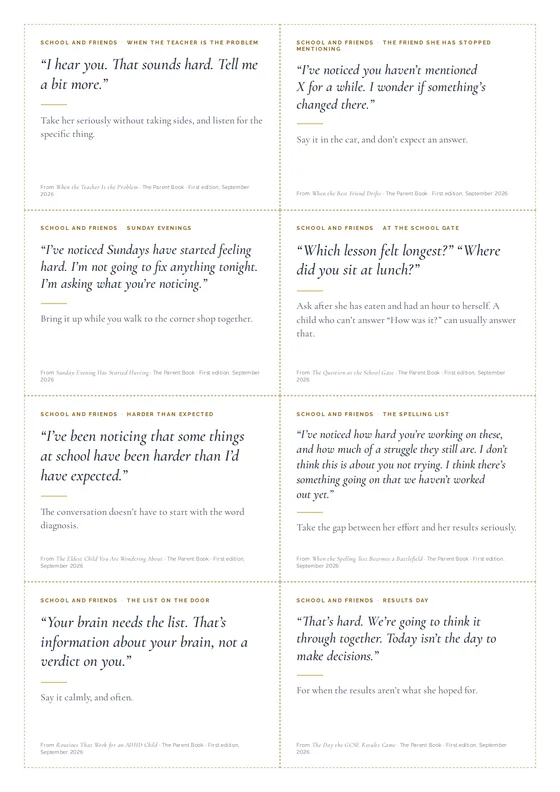 What to say: school and friends
Cards to cut out · A4, eight cards to cut · PDF, 63 KB · Free
What to say: school and friends
Cards to cut out · A4, eight cards to cut · PDF, 63 KB · Free
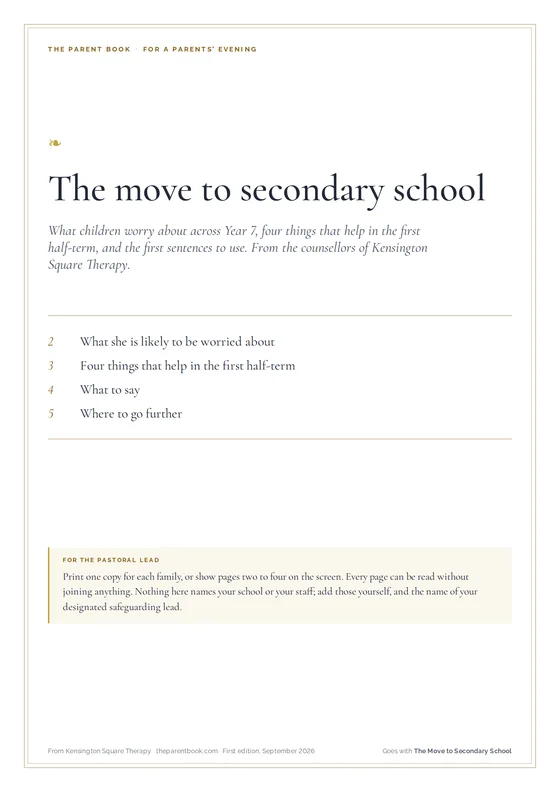 The move to secondary school, for a parents’ evening
For a parents’ evening · A4, five pages · PDF, 170 KB · Free
The move to secondary school, for a parents’ evening
For a parents’ evening · A4, five pages · PDF, 170 KB · Free
Family life and behaviour
Every subjectWho else can help with difficult conversationsUrgent help