
Parenting strategy
Parenting strategy
This section is for any parent thinking about how the family is run: boundaries, routines, how you talk to each other at home, and the decisions you make about phones, friends, money and faith. It describes the habits our practice has seen make a difference to families over the years.
What the library says about this, on one page. It is also online at theparentbook.com/help/parenting-strategy
What to do first
There’s no manual, and the parents who look certain usually aren’t. Doing one thing consistently works better than doing five things well for a fortnight.
- Pick the hour of the day that goes worst, and change one thing in it, leaving the rest of the day alone.
- Say what will happen instead of asking whether it can. You can be warm and clear at the same time.
- When you get it wrong, put it right out loud. It’s the most effective thing you can do, and it takes three sentences.
What helps
- Let home be where she can stop working. The school, the class teacher and the in-school enrichment that the year is built around will cover the academic preparation. Your job is to make home feel different from that, so she has somewhere to recover.
- Praise effort and behaviour. “You kept going when that question was hard.” “You were kind to your sister tonight.” Say exactly what you saw, without judging how good it was. Praise that depends on outcomes adds pressure.
- Stay calm first, talk later. Sit close and slow your own breathing. Being next to a calm adult helps a child’s body settle, and that does more than anything clever you could say. Save the words for when the worst has passed.
- Name the feeling out loud. Try “That sounds really hard” or “You look really worried.” Naming the feeling makes it seem less strange, and it shifts brain activity from the alarm centre towards the language centre.
Some tips to try
Short pieces from the library, and a first thing to try from each.
-
Before You Choose a Private Clinic.
Ask five questions before you pay, and be wary of any clinic that can’t answer them.
- Ask: who is doing it, what is their registration, and is it multidisciplinary.
-
Praise That Tells Her Something.
Describe what she did and how she did it, which tells her far more than a verdict on how clever she is.
- Describe what she did: “You kept going when it got hard, and you checked your answer.”
-
The Child Who Reads the World Differently.
She experiences the world differently from you, and it helps to find out how.
- Adjust to her differences gradually; don’t rush to correct them.
The rest of each tip, with more to try and why it works, is in the library.
Something to do together
Cooking one thing together. Cook one dish together each week, side by side, and give her a real job. If she wants to talk, she can do it while she chops.
What it is for. A child who will not sit down to talk will often stand next to you and chop. Cooking gives her a real job, and she can talk without anyone looking straight at her.
- The first step. Choose one dish and a time you can keep. A supper you were making anyway works better than a special project; she can pick it from two or three you suggest.
Safety. Raw flour and raw cake mixture should not be eaten, even from the bowl. Keep hot pans out of reach of the youngest, and check for allergies when a friend cooks too. Under eleven, if she helps at the hob, an adult stays beside her and handles the hot pan. From eleven, the hob is hers once she has done it beside you a few times, with an adult in the kitchen.
When to get help. If she tells you that someone is hurting her, that she is hurting herself, or that she does not want to be alive, turn off the hob, stay with her, thank her for telling you, do not promise to keep it secret, and act that day, using the routes under “If you need help right now”, at the foot of every page. If her eating narrows over several weeks, she is losing weight, or food talk turns to “clean” and “bad”, ask your GP for an early appointment and say plainly what you have seen.
The other four steps, and your part in it, are in the library.
If you want to read further
- Eating and Control. For parents whose family mealtimes have become about much more than food. theparentbook.com/reader/eating-and-control
- Siblings and the Fights That Aren’t Fair. For parents whose children keep finding new ways to fall out with each other. theparentbook.com/reader/siblings-and-the-fights-that-arent-fair
Worth your time
- A book for you: How to Talk So Kids Will Listen and Listen So Kids Will Talk, Adele Faber and Elaine Mazlish. A classic for good reason. Through cartoons, dialogues and exercises it teaches parents to acknowledge feelings, invite cooperation without nagging and find alternatives to punishment. uk.bookshop.org/p/books/how-to-talk-so-kids-will-listen-and-listen-so-kids-will-talk-adele-faber/6d559e16712802ce
- Something to watch: 9 Tips for Parenting Pre-Teens, Child Mind Institute, YouTube. Nine brief tips for the pre-teen years, from staying curious about their friendships to giving more independence while keeping clear boundaries. www.youtube.com/watch?v=MxBkXCTrh8s
- Something to listen to: Episode 199 - Dr Rhodes Talks with Dr Tara Porter: Being a Good Enough Parent, Get a Grip - Evidence-Based Conversations for Parents and Educators, 51 min. Clinical psychologist Tara Porter, drawing on more than thirty years of practice, explores what ‘good enough’ parenting means amid modern pressure and parenting ideals, from her book Good Enough. podcasts.apple.com/gb/podcast/episode-199-dr-rhodes-talks-with-dr-tara-porter-being/id1450644258?i=1000712102623
Who else can help
This usually starts at school rather than at the surgery. The adults who see your child every day are the first people to tell, and often the fastest route to a change. The GP is there if it persists or deepens.
- Your child’s school. The pastoral lead, the head of year, or the form tutor. Free, already knows your child, and often the quickest way to get something changed at school. Before or alongside anything else. A school cannot act on what it has not been told, and what you bring is often what it did not have.
- Your GP. The gateway to everything the NHS offers a child: paediatric assessment, a referral to CAMHS, and support for you as the parent. Ask for a double appointment. Describe the pattern over weeks rather than the worst single day, and say plainly what you are worried about. Bring a written list; the ten minutes go quickly. www.nhs.uk/service-search/find-a-gp
- Action for Children Parent Talk. A free one-to-one webchat with a trained parenting coach, and a library of articles by age on behaviour, sleep, neurodiversity and family life. When you want to talk it through with someone in writing, this week, without a referral. Free one-to-one webchat with a parenting coach, Mon-Fri, with evening slots on Mon and Thu; check the site for current times · Parent Talk+ by phone or video for parents of children with additional needs, up to eight free sessions parents.actionforchildren.org.uk
- Coram Family Lives. A free, confidential helpline for any parenting or family worry, by phone, live chat, WhatsApp or email, staffed by trained family support workers. When you need to talk it through with someone, about your child or about how you are managing, and you do not need a specialist to do it. Coram Family Lives helpline 0808 800 2222 · Mon-Fri 9am-9pm; weekends 10am-3pm; closed bank holidays · Live chat and WhatsApp 07441 444125 at the same hours; email askus@coramfamilylives.org.uk · Outside those hours the line is closed. Samaritans answer at any hour on 116 123, and Shout answer if you text the word SHOUT to 85258. www.coramfamilylives.org.uk/how-we-can-help/confidential-helpline
- Place2Be. Parenting Smart, written by the child mental health specialists who work in primary schools: short, practical articles and films on friendships, behaviour, worries and routines. For a child of five to eleven, when you want something you can read in ten minutes and try tonight. Place2Be’s counselling itself is only through partner schools. parentingsmart.place2be.org.uk
The full list for parenting strategy, with what each organisation does and when it is the right call, is at theparentbook.com/help/parenting-strategy/services
Published by Kensington Square Therapy. Company No. 16707111. Written by therapists registered with the British Association for Counselling and Psychotherapy (BACP) and the National Counselling and Psychotherapy Society (NCPS). This page is not therapy, and not a substitute for professional support. The full library is at theparentbook.com.
Everything the library holds on parenting strategy
Go further
Chapters
- Eating and ControlFor parents whose family mealtimes have become about much more than food.
- Siblings and the Fights That Aren’t FairFor parents whose children keep finding new ways to fall out with each other.
- Body ImageFor parents who want their child to grow up comfortable in their own body.
- Anxiety, by AgeFor parents whose child’s worry has started to make decisions for her, with what helps at each age and when to ask for help.
- What Screen Time Actually IsFor parents who feel they have lost the argument about screens.
- Big Feelings and Co-RegulationFor parents whose child has just had a meltdown, on how to help her through it.
- The Conversations Parents AvoidFor parents who need to tell their child something hard and don’t know how to start.
- Neurodiversity, and the Conversation with the SchoolFor parents whose child has been working harder and longer than other children to do things that come more easily to them.
Quick tips
- Before You Choose a Private ClinicAsk five questions before you pay, and be wary of any clinic that can’t answer them.
- Praise That Tells Her SomethingDescribe what she did and how she did it, which tells her far more than a verdict on how clever she is.
- The Child Who Reads the World DifferentlyShe experiences the world differently from you, and it helps to find out how.
- The Early RiserSome early waking can be changed and some can’t, and a two-week sleep diary will show you which you have.
- The Toddler Who Keeps Getting Out of BedGo back to her before she gets up, and when she does get up, take her back to bed without a conversation.
- Toilet Training as a Family ProjectToilet training works when her body and brain are ready, whatever the timetable says.
- When Medication Becomes Family RoutineBuild the medication into something the family already does, and give her ownership of the routine in stages.
- When We Cannot Afford ItA calm “We can’t afford that” gives her a way to talk about money that she’ll keep.
- When You Become the Everyday ParentYou agreed to look after her for a weekend, and the weekend has become a year.
- Talking to Her About MoneyMoney is something you can talk about with your child, though most families don’t.
All 53 quick tips on parenting strategy
Quick tips open with a subscription.
Things to do together
- Cooking one thing togetherCook one dish together each week, side by side, and give her a real job. If she wants to talk, she can do it while she chops.
- The walk with no agendaWalk with her at the same time each week, side by side. Some weeks she will talk, and you still go on the weeks she does not.
- You go to her thingShe chooses a film, a book, a song or a game she cares about. You watch it, read it or play it, and ask one curious question.
- Getting out of the doorA short list by the door, made with her, of the things that go with her each morning. She ticks them off as they go in the bag, and you point at the list instead of reminding her.
- Learning something new, badly, togetherEach of you takes up something none of you can do, and practises it where the others can see. There is no show at the end.
- One step at a timeFor an everyday fear, such as dogs, the dark or a new club: together you write the steps from easiest to hardest, and she practises each one until it feels easy before she moves up.
- Ten minutes where she leadsTen minutes most days when she chooses what you play and you follow her lead. You don’t teach, correct or ask questions, and she never has to earn it.
- The last half-hour before bedChoose the last half-hour before bed with her, write it down in order and put it on the fridge. Then do it in that order most nights, slowly.
- The thing she can teach youAsk her to teach you something she can do and you can’t. She runs the lesson, you get it wrong in front of her, and at the end you tell her what you learned.
- Time alone with each childA regular time with each of your children on her own, doing something she chooses. Keep it short enough to protect every week.
- What my body can doNow and then, each of you writes a few things your body did this week: something it managed, something it felt, something it mended. Nobody mentions how anyone looks.
- When a friend comes roundFor a visit she has asked for: one friend, one thing to do together, you within earshot, and a warm, clear ending.
Activities open with a subscription.
To print
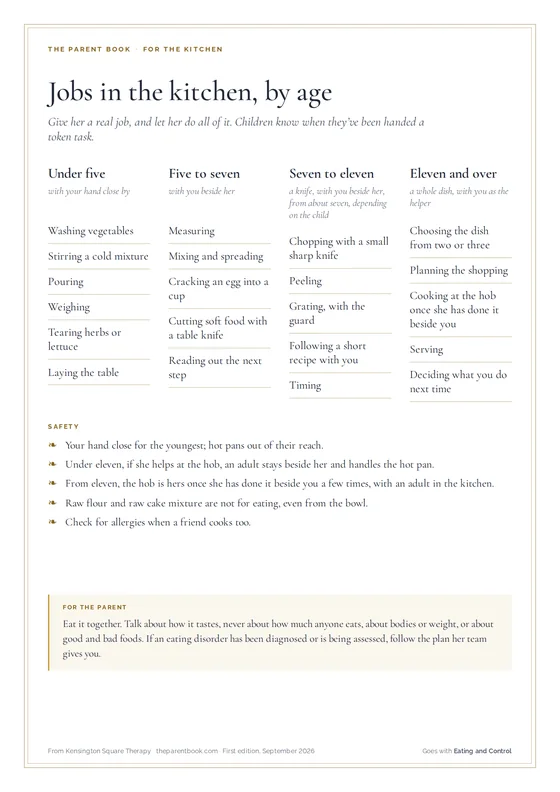 Jobs in the kitchen, by age
For the kitchen · A4 · PDF, 60 KB · With a subscription
Jobs in the kitchen, by age
For the kitchen · A4 · PDF, 60 KB · With a subscription
 Where a feeling sits
To make together · A4, two sides · PDF, 62 KB · With a subscription
Where a feeling sits
To make together · A4, two sides · PDF, 62 KB · With a subscription
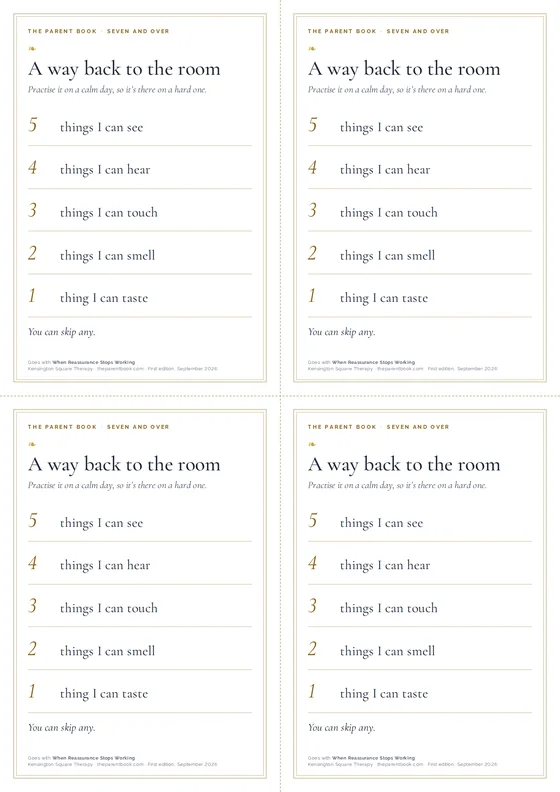 A way back to the room
Pocket card · A4, four cards to cut, two sides · PDF, 68 KB · With a subscription
A way back to the room
Pocket card · A4, four cards to cut, two sides · PDF, 68 KB · With a subscription
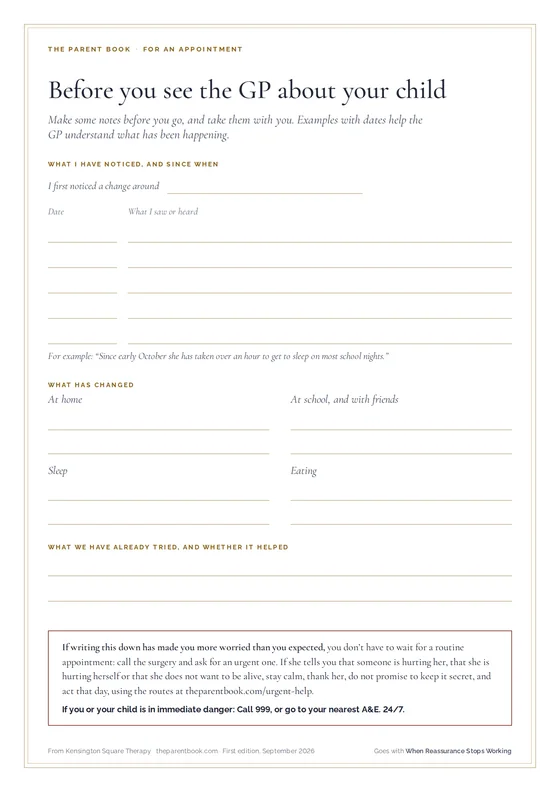 Before you see the GP about your child
For an appointment · A4, two sides · PDF, 72 KB · Free
Before you see the GP about your child
For an appointment · A4, two sides · PDF, 72 KB · Free
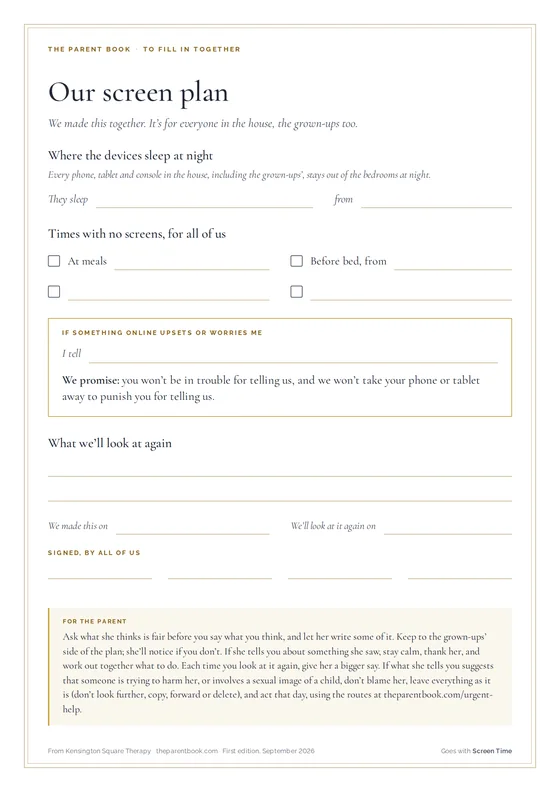 Our screen plan
To fill in together · A4 · PDF, 53 KB · With a subscription
Our screen plan
To fill in together · A4 · PDF, 53 KB · With a subscription
 First this, then that
Cards to cut out · A4, four cards to cut, two sides · PDF, 64 KB · With a subscription
First this, then that
Cards to cut out · A4, four cards to cut, two sides · PDF, 64 KB · With a subscription
Family life and behaviour
BehaviourSibling conflictDifficult conversationsFamily stress
Every subjectWho else can help with parenting strategyUrgent help