The Parent Book·From the library
What Screen Time Actually Is
For parents who feel they have lost the argument about screens.
A thirteen-minute read · Published 25 May 2026

By early evening you’ve already said the word phone in a tone of voice you never planned to use. Your twelve-year-old is at the table with her phone tilted just below the edge, the way they all hold it. You asked her to put it down for supper. She put it down, and then she picked it up again. The pasta is on the hob, and you can hear yourself saying, in a voice that belongs to someone older and crosser than you are, that this is the last time, that the phone will be confiscated, that you’ve had enough.
And you have had enough. You’ve been having enough for about two years. The device she had at nine isn’t the one she has at twelve, and at fifteen it will be different again. Every upgrade starts the argument over.
We hear some version of this from the great majority of parents we see with a child older than nine, and the pattern is consistent. The parent has started to feel she is losing an argument she didn’t choose to get into and isn’t allowed to leave, and that somehow it’s her fault.
It isn’t her fault, and the argument she’s in isn’t the one she thinks it is.
What is actually happening
For the child in front of you, the screen is doing three things at once, and it helps to name them.
The first is calming down. A child whose nervous system has spent the day coping with school, a change in her friendships or a piece of work she didn’t understand comes home in a low-level state of stress she has no words for. For the first thirty minutes, the screen is what brings that stress down. In effect, she’s using the device to do what a calm adult nearby would otherwise help her do. Take it away at minute three, and by minute five you’re in a conversation with a child who is behaving badly. What looks like bad behaviour is a child who was interrupted halfway through calming herself down.
The second is social. To her, the phone is where her friends are. The group chat is the friendship, happening right now. Take the phone away for an evening and you take her out of her friendships for that evening, and she knows exactly what she’s being asked to give up.
The third is escape. Like adults, children sometimes want to be somewhere other than where they are. A video game can be that place, or a Minecraft server where she plays with friends she hasn’t met in person. A child with a device has a way out of any room she’s in. It’s the same impulse that took an eight-year-old to the bottom of the garden with a book in 1985. The difference is that the way out is now in her pocket, and it lights up.
None of this makes screens harmless. But the conversation you’re having about screen time is almost always a conversation about calming down, belonging and escape.
The variable nobody wants to look at
In our experience, the biggest change in most households has been in the parent’s screen use, more than the child’s.
On the whole, the families we see aren’t failing in any obvious way. They’re families where two adults are running on tighter margins than they were five years ago, where work email follows them home, and where the phone stays on the counter while the pasta cooks because the parent is never quite off duty. Your child has seen all this. You’re the person she watches most closely, and she has noticed that you, the adult asking her to put her phone down, are the one who picks up your own phone at the dinner table, on the sofa and at red lights.
The word for this is modelling, not hypocrisy. A child learns what a phone is for by watching what her parent’s phone is for. If, in her house, the phone is what the adult turns to when she is bored, tired, lonely, anxious or trying not to feel something, then that is what a phone is.
The single most useful thing we’ve seen a parent do about screen time is to put her own phone in a drawer for an hour after work, and find six weeks later that she no longer needed the rule she had been going to introduce.
What actually works
Parents who come to us at the end of their tether usually want a rule that will finally stick. We don’t have one. Rules work for some weeks in some houses, and when you look closely, the houses where they work are usually ones where the rule has grown out of something else: a ritual.
A rule is no phones at the dinner table. A ritual is “we eat together on Sundays and the phones are on the side”. A rule has to be policed by the parent, as it happens, every time. A ritual is something the family does. The rule produces arguments; the ritual produces a Sunday together. Rituals work because being together is the point, and putting the phones away follows on its own.
The rituals that work are modest: a supper without screens, because the supper is what everyone is there for; a Saturday walk with the dog, a stop at the corner shop and a hot chocolate; a film on Sunday evening; a card game at half-term. The activity hardly matters. What matters is that the family has something that isn’t a screen, and the screens end up in another room without anyone having to say so.
A few specific moves come from families who have found something that works. When she gets home, her phone goes on the counter, not in her pocket and not in her room, because her room is where it disappears. Every phone in the family, the parents’ included, charges overnight in the hallway, not on a bedside table. There’s a basket by the front door where, the family has agreed, the phones go on Sunday afternoons. None of these is a rule a parent has to enforce minute by minute. They’re fixed arrangements the family has agreed to, and the arrangements do most of the work. Each one applies to the parents as well as the child: a rule only the child has to follow needs policing, while a habit everyone shares is just how the family lives.
The conversation parents most often skip is the one about what’s actually on the screen. Asking what apps are you using gets you the usual. Try “show me the one Mia is obsessed with”, and sit next to her on the sofa for five minutes while she shows you. Come to it out of curiosity; that works better than treating it as a safety check. She’ll tell you more about her life in those five minutes than in an hour of asking what she did at school. When parents want an age-by-age view of what’s on the platforms their children use, we send them to Common Sense Media. It’s American and the tone is occasionally off, but its platform-by-platform breakdowns are the clearest we know, and they still apply here.
By now, but everyone else has it is almost a formality. Ask the question she isn’t asking: “I hear that everyone has one. Tell me what you’d do with it that you can’t do at the moment.” A teenager who can give a real answer (“the group chat is on it and I’m the only one missing the plans for Saturday”) is asking for something real. A teenager who can’t is often just asking. The first might be solved with a basic phone, a watch with messaging or a borrowed family iPad after school. For the second, you can say, kindly, “not yet, and we’ll look at it again at the end of the summer”.
Putting your own phone down does more than any single rule, and you have to actually do it: put it in a drawer for the first hour after work, turn it face down at meals, and leave it at home when you go for a walk on Saturday. The NSPCC’s online safety pages are the right pointer when the question has tipped into safeguarding; the NHS Every Mind Matters pages on digital wellbeing are the right pointer when the question is the family’s wider relationship with screens.
Sometimes, behind the argument about devices, a parent is grieving the fact that her child no longer wants to do the things they used to do together. The screen is a sign that the child is growing up. The seven-year-old who would have played a board game with you for an hour is now twelve, and a twelve-year-old rightly has a social life of her own. The argument about the screen can be an argument about losing the seven-year-old, a loss the parent hasn’t let herself feel directly. You can call it a loss. Naming it as one, even just to yourself, takes some of the heat out of the arguments about rules.
At different ages
A screen is a different thing in a four-year-old’s hands than in a sixteen-year-old’s, and what helps at one age stops working at the next. The bands below are a rough guide; some nine-year-olds are already deep in the social world of group chats and some aren’t.
If your child is between four and seven. This is the only age at which parental-control software does most of what it claims to. In practice, the device is still yours: the iPad has the apps you’ve chosen, the timer you’ve set and the lock you’ve configured. Use a timer on the counter instead of the one in the app, so that the end of screen time is announced by something in the room. When the device itself ends the session, that’s almost always when the worst behaviour happens. At this age, make the screen an unremarkable part of the afternoon: twenty minutes after the snack, in the same chair, before tea. Keep it predictable and short, and don’t use it as a reward.
If your child is between seven and nine. The first device is appearing in Years 3 and 4: a hand-me-down phone, a borrowed iPad, a YouTube subscription. At this age you can still see, in practice, what she’s watching, so make use of that while you can. Sit next to her on the sofa for five minutes while she shows you a channel she likes, and ask her to explain what’s funny about it. What she tells you in those five minutes is more useful than any parental-control dashboard. Set the device up so that it lives on the counter at the end of the day, not in her room. At this age her bedroom isn’t yet the right place for a screen.
If your child is between nine and eleven. This is when the first phone arrives, the first WhatsApp group is set up and, for the first time, some of her standing with friends is earned online. What works changes more at this age than at any other. It’s now harder to talk to her casually about what she’s doing, because she has realised, with some embarrassment, that it’s hers. Have the conversation anyway, in passing, in the car, with neither of you looking at the other: “Show me the group chat that’s been making you laugh this week.” If the answer is no, don’t push; ask again next month. The one piece of household set-up that matters at this age is a family charging station in the hallway, put in place before the phone becomes a battleground.
If your child is in early secondary, eleven to thirteen. She is now fully on social media, whether or not she is officially allowed on the platforms: Snapchat, TikTok, or whatever has replaced them since we wrote this. Stop fighting the platforms and start being curious about her experience of them. “I read something about TikTok this week. What do you make of it?” Say it in passing, without looking straight at her. The rules that matter at this age are the household rituals from earlier in the chapter: supper without phones, overnight charging in the hallway, and you putting your own phone face down at the table. They apply to everyone in the house, you included.
If your child is in mid to late secondary, thirteen to sixteen. By now you can’t see her screen directly. The phone is hers, the passcode is hers and the platforms are hers, and the parental-control software that worked at seven is now something she can get round, and something that’s hard to justify. Make the kitchen the place where you talk about her online life, by being around without watching over her. Notice the platform she has stopped mentioning and the friend she has stopped replying to. If you notice she was on her phone until two in the morning, ask her at breakfast whether anything is going on. The NSPCC’s online safety pages are calibrated for parents in this band and have the right register for conversations that are not, any more, about parental controls.
If your child is in late secondary, sixteen to eighteen. Her screen and her online life are now entirely hers, and your job is mostly about how you behave around screens yourself. Put your own phone down at supper. Make the Sunday walk a walk without phones. Be a parent she’s comfortable sitting next to on the sofa without the room being lit by two screens. By now the rituals are part of the relationship you’re building with her as a young adult. The most useful conversation at this age is the one about your own phone use: ask her about it in good faith, and listen to the answer.
When the screen is the safeguarding question
There is a different conversation, and parents sometimes find themselves in it without warning. It follows the moment a parent finds something on a child’s phone, or hears about a contact the device has carried into the house. That conversation is about safeguarding, not rules.
The NSPCC’s online safety pages are calibrated for parents who are worried but not in crisis and need a step-by-step view of what to do next. The NSPCC adult helpline is the right line when the situation does not warrant the police but does warrant a clear head. That is a different chapter from the one we are in. It is worth knowing the line is there.
The longer arc
Every generation of parents has had this argument. Two generations ago it was the television. A generation later it was the Walkman, and then the PlayStation. In your house tonight it’s the phone, the iPad, the console and whatever the next thing will be called. The devices change, but the pattern stays the same: the child is reaching for a way to calm down, to belong and to escape, and the parent is looking for a way to stay connected to a child who is, right on schedule, becoming her own person.
You don’t have to win the argument. You have to stay in it: keep the rituals going, put your own phone down more often than you ask her to put hers down, and remember that her phone is, more than anything else, her way out to her friends and the world beyond your house. You can’t close that off. What you can do is make sure home is a place she wants to come back to.
The phone hasn’t beaten you for good. Like every parenting question worth its salt, it asks you to be present, in a particular way, for longer than feels reasonable. If you find that tiring, it’s because it is.
NOTES
- Livingstone, Sonia & Blum-Ross, Alicia. Parenting for a Digital Future: How Hopes and Fears about Technology Shape Children’s Lives. Oxford University Press, 2020. Their research with UK families on how parents actually manage digital technology at home.
Where to go further
Sonia Livingstone and Alicia Blum-Ross, Parenting for a Digital Future: How Hopes and Fears about Technology Shape Children’s Lives The standard UK academic book on children’s everyday digital lives, drawn from extensive research with UK parents. Read it if you want something more substantial than a charity’s guide and less alarmist than the trade press.
Pete Etchells, Unlocked: The Real Science of Screen Time A UK psychologist who studies screens sets out what the research does and does not show, and helps a family move from counting minutes to asking what the time is spent on. The calmest book we know on the subject.
What helps a family with screen time
The families who find something workable usually get there through rituals the whole household follows.
- Build family rituals around screens. A rule is “no phones at dinner”; a ritual is the Sunday supper where the phones sit on the side. Rules have to be policed as they happen, whereas rituals run themselves.
- Give the phones a fixed place. Charge all the family’s phones in the hallway overnight, yours included. When anyone comes in, their phone goes on the kitchen counter, not up to their room. A rule that applies only to her feels like policing.
- Sit next to her for five minutes. Say “Show me the one Mia is obsessed with.” She’ll respond to curiosity much better than to “What apps are you using?”, which sounds like surveillance.
- Keep one shared activity off-screen. It might be a Saturday walk, a film night or a card game at half-term. When the family has something else to do together, the screen ends up in another room without anyone having to say so.
Put it into practice
What this chapter looks like in practice: one-minute ideas for tonight, things to do together and sheets to print and keep.
Quick tipsOne minute each
- Ask What She Watches, Not How LongAsking what she watches online is harder than timing it, and more useful.
- The Room He Will Not LeaveTime on a headset is often time with friends, so start by asking about it.
- Her First Tablet at FourAt four, treat the tablet as yours, lent to her for short stretches with you nearby.
Five quick tips on this in the library
To do togetherActivities
- Reading in the same roomFor the last twenty minutes before bed, everyone reads in one room, you included. Keep reading aloud to her for longer than you think she needs it.About 20 minutes
- A film, and the conversation you do not forceChoose a film with some care, watch it side by side, and do not ask questions afterwards. If she wants to talk, she will.The length of a film
- Play me somethingShe picks a song and plays it to you. You listen to the end, and ask one question about it.About 10 minutes
Eight activities on this in the library
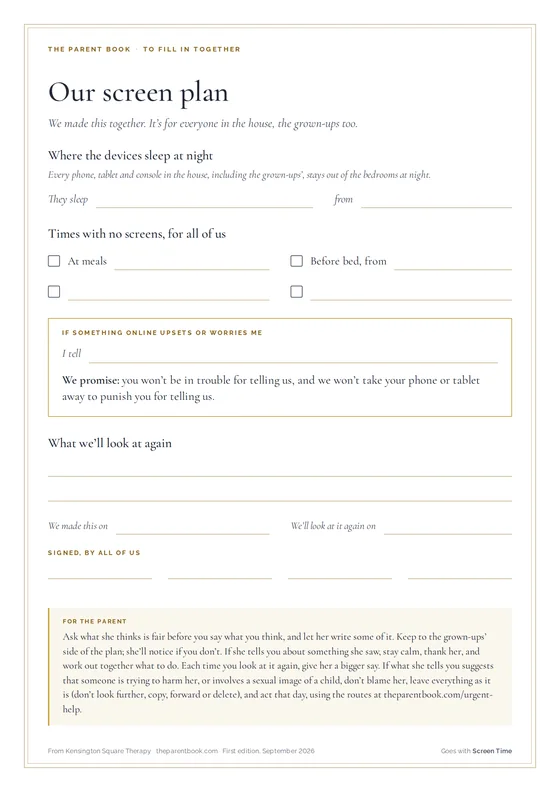
The quick tips and activities are for subscribers; the sheets that go with this chapter are yours to print. What a subscription includes.
Who else can help
NSPCC
The NSPCC helpline is for adults worried about a child.
0808 800 5000 · Mon-Fri 10am-4pm by phone; email 11am-4pm, seven days a week. An email sent when the service is closed is not received.
If the NSPCC service is closed and the concern cannot wait, call the police on 101. You can also contact the child’s local out-of-hours children’s social care, social work or social services team. If a child is in immediate danger, call 999.
nspcc.org.uk/keeping-children-safe/reporting-abuse/nspcc-helpline
NHS Every Mind Matters
The NHS self-help hub, with a page on children’s mental health and free programmes on sleep and anxiety for you.
nhs.uk/every-mind-matters/supporting-others/childrens-mental-health
Coram Family Lives
A free, confidential helpline for any parenting or family worry, by phone, live chat, WhatsApp or email, staffed by trained family support workers.
0808 800 2222 · Mon-Fri 9am-9pm; weekends 10am-3pm; closed bank holidays
Outside those hours the line is closed. Samaritans answer at any hour on 116 123, and Shout answer if you text the word SHOUT to 85258.
coramfamilylives.org.uk/how-we-can-help/confidential-helpline