The Parent Book·From the library
Eating and Control
For parents whose family mealtimes have become about much more than food.
A ten-minute read · Published 25 May 2026

For the third week running, you put down a plate of pasta, watch your child push it round with her fork for fifteen minutes, and then hear her say, quite calmly, that she isn’t hungry. You chopped the broccoli small, the way she once asked you to. You hear yourself start a sentence about children in the world who have nothing, and stop, because thirty years ago you heard your own mother say the same thing, and it didn’t work then either. The pasta gets covered with a side plate. The meal looks as if it’s about food, but it has become about something else.
This comes up often in our work with parents. In some houses it is the four-year-old who has stopped eating anything not beige; in others, the ten-year-old making rules about what touches what on the plate; in others, the fourteen-year-old who has, over a term, eaten less and less and is now making detailed comments about what is in things. Each is a different conversation, and your first job is to work out which one you’re in.
What is actually happening
A child’s relationship with food is very often, in part, a relationship with control. The parenting literature talks about food anxiety, fussy eating, pickiness, eating disorders and body image, and what links all of them is what a child gets to decide when most things are decided for her. Meals are one of the few times in her day when she has clear, immediate power. She can open her mouth or not, and in any practical sense, you can’t make her swallow. Her plate is a small part of the world that she controls completely.
Most childhood eating presentations are not eating disorders. Usually it’s a child working out what she can have a say in. If you take a hard line at the table and turn each meal into a negotiation you have to win, eating becomes the only area where she still has some control, and she’ll fight over it more, not less. The harder you press, the more reason she has to dig in.
The framework we find parents respond to is Ellyn Satter’s division of responsibility, the clearest piece of thinking in this whole field. The parent decides what food is offered, when, and where. The child decides whether to eat and how much. You don’t have to make her eat; you have to put a reasonable meal on the table at a reasonable time. She doesn’t have to be polite about the food, but she does have to decide what she does with it. Both roles are clear and both are respected, and in most households that have tried this, mealtimes become less heated straight away.
For younger children in the long beige stage, the approach we most often recommend is the one this chapter has already described: the parent decides what, when and where, and the child decides whether and how much. A child’s appetite varies more from day to day than adults expect, and a family that accepts this doesn’t end up with a long-running argument at the centre of every meal.
Knowing which conversation you are in
There are three rough categories.
Fussy eating. A child is suspicious of new foods, eats a narrow range and refuses things she ate happily last term. In most cases this is developmentally normal between two and seven, and it improves slowly with exposure and time. Keep offering the wider range, don’t turn the table into a battleground, and accept that her appetite will broaden over years, not weeks. The NHS guidance on fussy eating is the right place to start, and it’s reassuring.
Control-around-food. The child is using meals to have a different argument, usually about autonomy. Take the pressure off the food and give her more say elsewhere. If she has more control over the rest of her life, she has less need to grab it at the table.
Early warning signs. Restriction that is creeping rather than holding steady; sustained weight loss in a child previously stable; food hidden, thrown away, or moved around the plate to simulate eating; secrecy around meals; new sustained interest in solitary, rule-bound exercise; a developing moralistic vocabulary about food (clean, bad, safe); avoidance of family meals; preoccupation with what is in things; significant change in mood and social withdrawal alongside the food changes. None in isolation is diagnostic. The cluster, sustained over weeks, is the picture that has tipped from one conversation into another, and the right move is not to wait.
The third category is the one parents most often hesitate to act on, because they hope the change will reverse on its own. In our experience, the cluster does not reverse on its own. Early help changes the trajectory.
What to do, and what not to do
If you’re in the fussy-eating conversation, take the long view and keep putting the food on the table. Don’t let mealtimes become somewhere she has to put on a show of eating in order to be loved. Don’t use food as a reward or punishment: a child who learns that pudding is the reward for eating broccoli learns, with absolute clarity, that broccoli is the worse food. Sit down together when you can, eat what you’ve made yourself, and don’t comment on what’s on her plate.
If you’re in the control conversation, don’t try to settle it at the table. Find somewhere else in her life where she can have more say. A child who chooses her own clothes, her weekend activity, the order she does her homework in and the music in the car has already made plenty of decisions, and arrives at the table with less to fight about.
In both cases, some things rarely help: long conversations about the food itself, bribes, threats, hovering, asking “Did you eat your lunch?” on the way home from school, and cooking three separate meals, which teaches her that what’s for supper is open to negotiation. None of it is what you want her remembering when she’s twenty-two and cooking for herself.
What helps more is a family meal that goes on for forty-five minutes regardless of who eats what; snacks at regular times that don’t depend on her finishing what she was offered earlier; and no comments about her body, anyone else’s body, or what counts as a good food. A child whose parents don’t talk about food in moral terms has a better chance of an easy relationship with what she eats.
At different ages
Eating and control look very different at different ages.
If your child is between four and seven. At this age, food refusal is almost always normal, and her appetite will vary from day to day. Keep offering the plate, keep the meal calm, and refuse to turn the table into a stage. The most useful sentence is “That’s what’s for supper tonight, and you don’t have to eat it.” Keep yourself out of the argument: the fight she’s looking for needs two people.
If your child is between seven and nine. She’s starting to notice what other children eat, and the school lunch hall is now a social environment that shapes her relationship with food. Ask in passing what other children bring, what she eats and what she doesn’t. You’ll learn a lot from the answers.
If your child is between nine and eleven. She’s becoming self-conscious in the way children do before secondary school, and she looks at her body in the mirror in a way she didn’t last year. A new caution about food sometimes starts here, and is sometimes an early indication that something is shifting. Don’t comment on bodies of any kind, including your own. If you say something in passing about how your jeans fit, she’ll take it in and apply it to herself.
If your child is in early to mid secondary, eleven to fourteen. Her friends talk about food a lot, and now they do it online as well. She’s seeing more content about food and bodies than the previous generation did. There are two things to do. Keep food at home easy, shared and free of moral judgement, and talk about what she’s seeing on her phone in a general way, without aiming it at her: “I saw a thing about a girl who only eats one colour of food at a time. What do you make of that?”
If your child is mid to late secondary, fourteen and beyond. Her autonomy is real, and it isn’t yours to override. What you can offer is being around. Eat together when you can, and notice what’s going on without policing it. The teenager whose mood has gone flat alongside changes in eating is the one to take seriously, calmly, with the GP route in mind. For the wider conversation about how your family relates to food and bodies over time, the Mental Health Foundation’s family resources are the right place to look, particularly if you notice your own patterns turning up in your child.
Your own relationship with food
Parents reading this often have their own history at the table. Your child is watching what the adults in the house do with food. If they talk about diets, weigh themselves, complain about their bodies, use food to manage stress or talk about eating in moral terms, she learns that food is a moral subject. If they eat what’s in front of them and don’t talk about bodies at the table, she learns the opposite.
The most useful rule you can set yourself is not to comment on bodies, including your own, and not to pick up the conversation where your mother left it in 1991. These patterns get passed down the generations until somebody decides not to pass them on, and it may as well be you.
The longer arc
A child’s eating goes up and down over the years. Some weeks and months are difficult and some are easy. If you’ve stayed calm about it, kept the table from becoming the place where everything else gets fought over, and given her enough say elsewhere, you’ve given her eating its best chance of settling in its own time.
You’re not going to win tonight’s meal. What you can do is set a place, put something reasonable on the plate, sit down for as long as it takes, talk about something else, and let the rest of the evening go on around her. In the great majority of cases, the pasta will be eaten or not without becoming the defining event of the day. There will be another meal tomorrow.
NOTES
- Ockwell-Smith, Sarah. The Gentle Eating Book. Piatkus, 2017. Gentle parenting applied to younger children’s eating, and how much a child’s appetite varies from day to day.
- Satter, Ellyn. Child of Mine: Feeding with Love and Good Sense. Revised and updated edition. Bull Publishing, 2000. The source of the division of responsibility in feeding: the parent decides what, when and where; the child decides whether and how much.
Where to go further
Ellyn Satter, Child of Mine: Feeding with Love and Good Sense The original book on the division of responsibility, the framework described in this chapter. It’s decades old and still the clearest single book we know on how a family can run mealtimes without every meal becoming the place where everything else gets fought over.
Katja Rowell and Jenny McGlothlin, Helping Your Child with Extreme Picky Eating For the child whose eating has narrowed well beyond an ordinary fussy phase: a family doctor and a speech and language therapist build on Satter’s approach with a calm, low-pressure plan, and say when to ask for specialist help.
What helps at the table
Whichever conversation you’re in, the long-term aim is a table where food is just food and nobody has to eat a certain way to be loved.
- Take the morals out of food. Don’t sort food into good and bad, or comment on her plate or anyone’s body. A child whose parents don’t talk about food in moral terms finds it easier to see what she eats as neither right nor wrong.
- Give her choices away from the table. A child who chooses her own clothes, her weekend activity and the music in the car comes to the table with less to fight about.
- Keep mealtimes regular, and don’t bargain. The family meal goes ahead for forty-five minutes, whoever eats what. Give regular snacks, don’t bribe, and don’t cook three separate dinners to order.
- Act early if warning signs appear. If eating has become secrecy, rules, and fear, ask your GP for a face-to-face appointment and name the pattern plainly. Early intervention changes the trajectory.
Put it into practice
What this chapter looks like in practice: one-minute ideas for tonight, things to do together and sheets to print and keep.
Quick tipsOne minute each
To do togetherActivities
- Cooking one thing togetherCook one dish together each week, side by side, and give her a real job. If she wants to talk, she can do it while she chops.About 45 minutes · with a sheet to print
- One meal without phones, yours firstOne regular meal where every phone in the house, starting with yours, stays in another room.About 30 minutes
To printWith this chapter
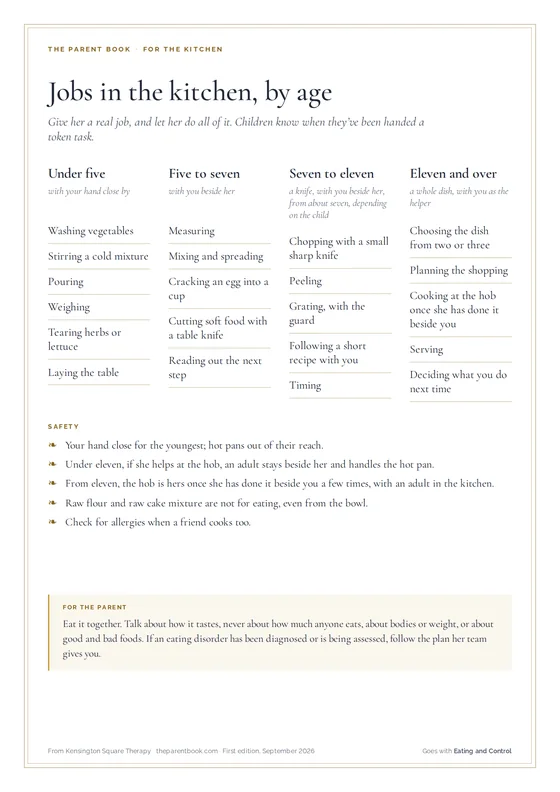
The quick tips and activities are for subscribers; the sheets that go with this chapter are yours to print. What a subscription includes.
Who else can help
Beat (the UK’s eating disorder charity)
The UK’s eating disorder charity.
England 0808 801 0677, Scotland 0808 801 0432, Wales 0808 801 0433, Northern Ireland 0808 801 0434 · Mon-Fri 3pm-8pm
Outside those hours the line is closed. If your child is physically unwell, use the urgent routes on this page, which are open when this line is not.
beateatingdisorders.org.uk/get-information-and-support/support-someone-else
Coram Family Lives
A free, confidential helpline for any parenting or family worry, by phone, live chat, WhatsApp or email, staffed by trained family support workers.
0808 800 2222 · Mon-Fri 9am-9pm; weekends 10am-3pm; closed bank holidays
Outside those hours the line is closed. Samaritans answer at any hour on 116 123, and Shout answer if you text the word SHOUT to 85258.
coramfamilylives.org.uk/how-we-can-help/confidential-helpline
Mental Health Foundation
Short, evidence-based explainers on children’s mental health and on parenting while looking after your own.
mentalhealth.org.uk/explore-mental-health/a-z-topics/children-and-young-people