
Sleep
Sleep
So much of a family’s day is decided in the hour around bedtime. These pages cover the toddler who won’t settle, the seven-year-old whose worries come out in the dark, and the teenager whose body clock has turned the wrong way round. They’re about bedtime routines, and the bedroom they happen in, at every age.
What the library says about this, on one page. It is also online at theparentbook.com/help/sleep
What to do first
Almost every family goes through a stretch when the evenings stop working. Sleep is a habit before it’s a problem, and habits can be rebuilt.
- Fix the wake-up time first. Everything else, bedtime included, adjusts to it.
- Tonight, move screens out of the bedroom, including yours if you’re the one settling her. Charge them in the kitchen, and tell her why.
- Make the hour before bed predictable: do things in the same order, and keep the lighting and the ending the same. The predictability is what settles her, not the length.
What helps
- Take devices out of the bedroom at night. A bright screen in a dark bedroom works against sleep. Charge devices in the kitchen overnight.
- Start winding down 30 to 45 minutes before bed. Go through bath, teeth, pyjamas, reading and low lights in the same order each night. The brain reads the sequence as “sleep is coming” and starts releasing melatonin, so it’s the predictability that makes it work.
Some tips to try
Short pieces from the library, and a first thing to try from each.
-
The Body Too Awake for Bedtime.
If your child is too wound up to sleep, slow yourself down at bedtime.
- Put your phone in the drawer in the hall before you go in.
-
The Early Riser.
Some early waking can be changed and some can’t, and a two-week sleep diary will show you which you have.
- Keep a two-week sleep diary and add up her sleep each day, naps included.
- If you’ve tried all this for a few weeks and nothing has changed, or you’re too tired to cope, talk to your health visitor or GP.
-
The Toddler Who Keeps Getting Out of Bed.
Go back to her before she gets up, and when she does get up, take her back to bed without a conversation.
- Go back with another kiss before she gets up, leaving longer gaps as she settles.
- If a fortnight has changed nothing, or you’re too tired to keep going, talk to your health visitor or GP.
The rest of each tip, with more to try and why it works, is in the library.
Something to do together
Reading in the same room. For the last twenty minutes before bed, everyone reads in one room, you included. Keep reading aloud to her for longer than you think she needs it.
What it is for. In our experience, slowing bedtime down helps more at the end of the day than starting a new routine. Reading beside her, or to her, slows the last half hour with you in the room.
- The first step. Slow down where you already are. Take the last twenty minutes before her bedtime, in the room you are in, with the light you already have.
Safety. A printed book, not a screen: screens off about an hour before bed. Small torches often take button batteries, which are dangerous if swallowed; with young children in the house, use ones whose compartment screws shut.
When to get help. If bedtime has stopped working for weeks, not just a few nights, or her sleep has changed along with a low or worried mood, talk to your GP. If something she says at bedtime tells you that someone is hurting her, that she is hurting herself, or that she does not want to be alive, stay calm, thank her for telling you, do not promise to keep it secret, and act that day, using the routes under “If you need help right now”, at the foot of every page.
The other four steps, and your part in it, are in the library.
If you want to read further
- The Hour Before Bed. For parents whose child’s bedtime has turned into an hour of worries, questions and meltdowns. theparentbook.com/reader/the-hour-before-bed
- Screen Time. For parents who have lost the argument about screen hours, and suspect it was never quite the right argument to have. theparentbook.com/reader/screen-time
Worth your time
- A book for you: Helping Your Child with Sleep Problems, Rachel Hiller and Michael Gradisar. Sleep researchers set out a CBT-based programme for school-age children, covering bedtime resistance, night waking, night-time fears and worries, with gradual methods parents can choose between. uk.bookshop.org/p/books/helping-your-child-with-sleep-problems-a-self-help-guide-for-parents-michael-gradisar/ffd16151003f621b
- A book to read together: Goodnight Moon, Margaret Wise Brown. A little rabbit says goodnight to everything in his room as the light fades. The slow, repetitive rhythm makes it an ideal part of a toddler’s bedtime routine. uk.bookshop.org/p/books/goodnight-moon-margaret-wise-brown/0071b9c0e7537a3b
- Something to watch: How to Encourage Good Sleep Habits in Kids | Child Mind Institute, Child Mind Institute, YouTube. A specialist explains the building blocks of good sleep for children, consistent bedtimes, wind-down routines and screens out of the bedroom, and what to do about night-time worries. www.youtube.com/watch?v=RyDiy_jXNBM
- Something to listen to: Helping Kids Build Healthy Habits for Better Sleep, Thriving Kids, 26 min. Clinical psychologist and sleep specialist Shelby Harris explains why sleep matters for children’s mood, learning and behaviour, and the small, compassionate changes that help a family sleep better. podcasts.apple.com/gb/podcast/helping-kids-build-healthy-habits-for-better-sleep/id1824322109?i=1000730973332
Who else can help
Most sleep problems are habits rather than illness. The GP is the right first call if snoring, pain or breathing are part of it, or if the pattern has changed suddenly.
- Your GP. The gateway to everything the NHS offers a child: paediatric assessment, a referral to CAMHS, and support for you as the parent. Ask for a double appointment. Describe the pattern over weeks rather than the worst single day, and say plainly what you are worried about. Bring a written list; the ten minutes go quickly. www.nhs.uk/service-search/find-a-gp
- Your child’s school. The pastoral lead, the head of year, or the form tutor. Free, already knows your child, and often the quickest way to get something changed at school. Before or alongside anything else. A school cannot act on what it has not been told, and what you bring is often what it did not have.
- The Sleep Charity. The UK’s only national sleep helpline, staffed by trained sleep advisers, covering children from a year old, including autistic and ADHD children, and teenagers. When nothing you have tried has worked and you want someone to look at the whole pattern with you. Charged at your standard call rate, not free. National Sleep Helpline 03303 530 541 · Mon-Thu 9am-11am; Mon, Tue and Thu 7pm-9pm; closed bank holidays thesleepcharity.org.uk/national-sleep-helpline
- NHS: mental health advice for parents and carers. The NHS’s pages for parents, in one place: anxiety, low mood, anger, bereavement, arguments with teenagers, exam stress, and how to talk about feelings. When you want the NHS’s own account before anyone else’s. www.nhs.uk/mental-health/children-and-young-adults/advice-for-parents
The full list for sleep, with what each organisation does and when it is the right call, is at theparentbook.com/help/sleep/services
Published by Kensington Square Therapy. Company No. 16707111. Written by therapists registered with the British Association for Counselling and Psychotherapy (BACP) and the National Counselling and Psychotherapy Society (NCPS). This page is not therapy, and not a substitute for professional support. The full library is at theparentbook.com.
Everything the library holds on sleep
Go further
Chapters
- The Hour Before BedFor parents whose child’s bedtime has turned into an hour of worries, questions and meltdowns.
- Screen TimeFor parents who have lost the argument about screen hours, and suspect it was never quite the right argument to have.
- When Reassurance Stops WorkingFor parents whose child is anxious and can’t be talked out of it, however often the adults around her try.
Quick tips
- The Body Too Awake for BedtimeIf your child is too wound up to sleep, slow yourself down at bedtime.
- The Early RiserSome early waking can be changed and some can’t, and a two-week sleep diary will show you which you have.
- The Toddler Who Keeps Getting Out of BedGo back to her before she gets up, and when she does get up, take her back to bed without a conversation.
- When She Is Frightened at NightAt this age a monster can feel real, so what settles her is a room that stays the same all night and a parent who comes back when promised.
- When You Are the One Not SleepingLying awake night after night is a sign of overload, and a reason to see your GP.
Quick tips open with a subscription.
Things to do together
- Reading in the same roomFor the last twenty minutes before bed, everyone reads in one room, you included. Keep reading aloud to her for longer than you think she needs it.
- The last half-hour before bedChoose the last half-hour before bed with her, write it down in order and put it on the fridge. Then do it in that order most nights, slowly.
- The interesting bit and the hard bitAsk her one question at the end of the day, at supper or on the way home: what was interesting, and what was hard. Then answer it yourself.
- Worry time, not at bedtimeTen minutes at the same time each afternoon for her worries. If one comes up at another time, you listen, write it down and save it for then.
Activities open with a subscription.
To print
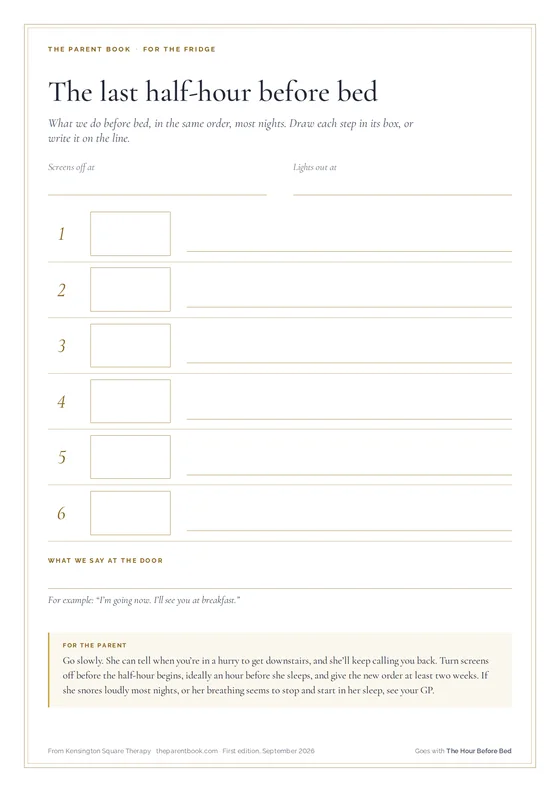 The last half-hour before bed
For the fridge · A4 · PDF, 53 KB · Free
The last half-hour before bed
For the fridge · A4 · PDF, 53 KB · Free
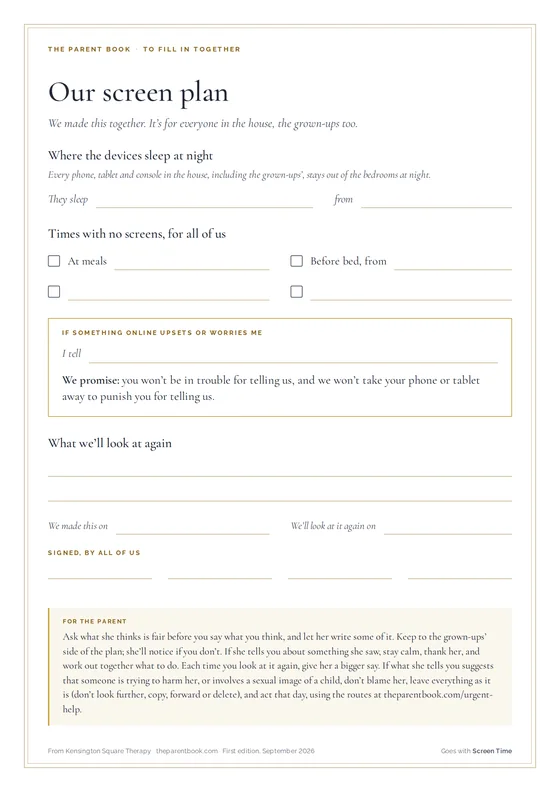 Our screen plan
To fill in together · A4 · PDF, 53 KB · With a subscription
Our screen plan
To fill in together · A4 · PDF, 53 KB · With a subscription
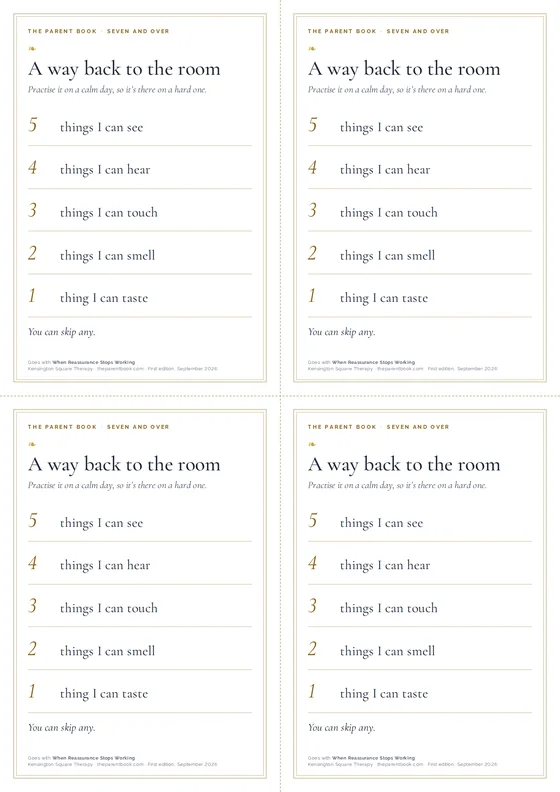 A way back to the room
Pocket card · A4, four cards to cut, two sides · PDF, 68 KB · With a subscription
A way back to the room
Pocket card · A4, four cards to cut, two sides · PDF, 68 KB · With a subscription
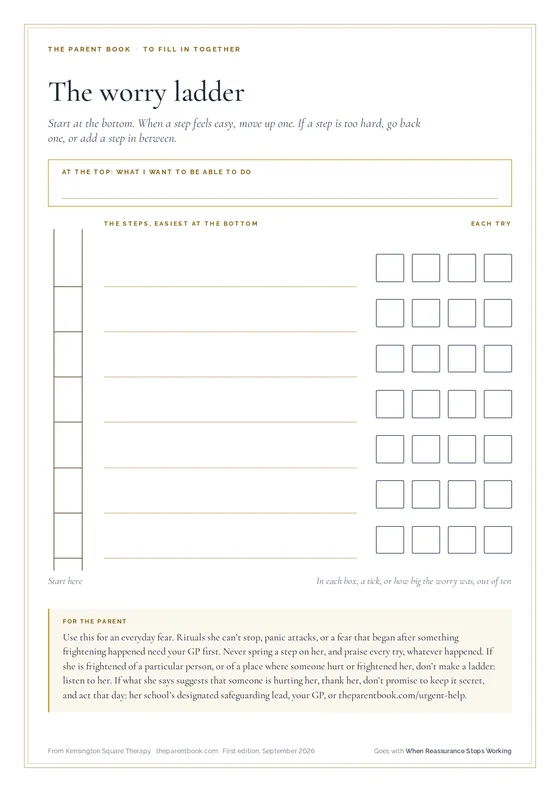 The worry ladder
To fill in together · A4 · PDF, 58 KB · Free
The worry ladder
To fill in together · A4 · PDF, 58 KB · Free
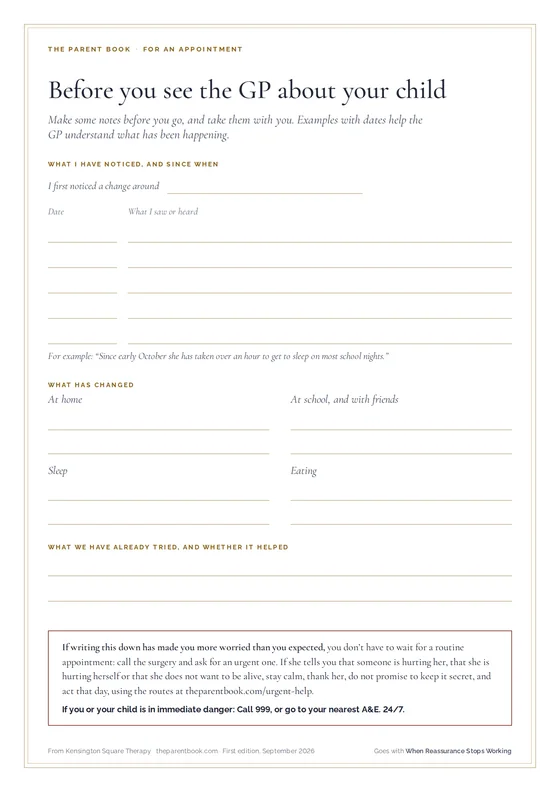 Before you see the GP about your child
For an appointment · A4, two sides · PDF, 72 KB · Free
Before you see the GP about your child
For an appointment · A4, two sides · PDF, 72 KB · Free