The Parent Book·From the library
When Reassurance Stops Working
For parents whose child is anxious and can’t be talked out of it, however often the adults around her try.
An eleven-minute read · Published 25 May 2026

Your ten-year-old stops on the front step and says her stomach hurts. You look at the clock, then at her face, then at the clock again. She says it’s a fluttery feeling and a sick feeling, and her chest feels tight. She didn’t do anything different last night, and she doesn’t know what’s wrong. All she knows is that she doesn’t want to walk to school this morning, and that her body has decided this for her.
You say the sensible things: “You’ll be fine when you get there. It’s just nerves. You had a good day yesterday.” She stands on the step, and you can see from her face that she has heard all this before and it didn’t help. You have a meeting at ten.
Some version of this morning comes up often in our work with parents. A child is anxious, her parent has tried with all the love she has to talk her out of it, and the talking hasn’t worked.
What is actually happening
In a child, anxiety is almost always the experience of not feeling in control. She is facing a world she can’t predict and can’t influence, and her nervous system keeps sounding the alarm. The alarm shows up in her body (her stomach, her chest, her sleep), in her behaviour (refusing, asking the same question again, a ritual at the front door) and, in older children, in her thinking (predicting disaster, going round and round the same worry). The fear is real, even when it’s out of proportion. Her body is responding accurately to a situation she doesn’t yet feel she has any control over.
This matters because a parent’s instinct is to reassure, and reassurance works on the wrong problem. It tells her “the thing you’re worried about won’t happen, and you’re safe”. Her nervous system has heard that and isn’t persuaded. She needs to feel that something in the situation is hers to influence, so the better response is to give her some control back.
Parents often take a wrong turn here. When a child’s anxiety has become disabling, the instinct is to remove whatever sets it off. If school is the trigger, she stops going to school; if it’s the lunch hall, she eats at home. Each of these changes is what a loving parent would do. Added together, though, they teach her nervous system that the world really is dangerous, because every time she gets close to it, the adults treat it as something to back away from. When anxiety is accommodated like this, it gets bigger.
No parent can remove uncertainty, so the realistic aim is to make it bearable. Karen Treisman’s writing on developmental trauma and felt-safety puts this well: a child can manage a world with risk in it, as long as she feels safe with the adults around her even when the world is uncertain. Daniel Siegel’s The Whole-Brain Child sets out the same idea, with the name it to tame it approach to helping a child put words to what her body is doing.
The two charities we most often send parents to are YoungMinds, whose A-Z parent pages on anxiety in children are the clearest single guide we know of in the UK, and Anxiety UK, a national charity that works only on anxiety. Calls to its Infoline, on 03444 775 774, cost the local rate and aren’t free. Anna Freud’s anxiety resources are the right place to go when a family wants something more clinical.
What anxiety is doing in the body
The signs of anxiety in children often aren’t labelled as anxiety, by the child or by the adults around her.
The body. She may get tummy aches that move around, headaches before something she knows is coming, a tight chest or nausea. She may struggle to get to sleep, or wake in the night. Her body is expressing what she can’t yet put into words.
The behaviour. She may ask the same question seven times, start a new ritual at the front door, refuse an activity she did happily last term, or suddenly need one particular parent. Anger is often anxiety in disguise, and the child whose anxiety has turned into irritability is the child no one reads as anxious.
The thought. Older children may predict disaster (“if I miss this homework I won’t get into the school I have to get into”), go round in circles with a worry, or have intrusive thoughts. Saying a thought out loud takes some of the force out of it.
Often the first practical step is to name what her body is doing: “I can see your stomach is hurting, and your body has noticed something the rest of you hasn’t had a chance to think about yet.” Say it on the front step, with a hand on her back. She doesn’t have to agree with what you say for it to help. It tells her that what she’s feeling has a name, and that it isn’t evidence that something is medically wrong.
What to do, and what not to do
Your job is to support her through what worries her, not to remove it. We call this scaffolding, and it takes four forms.
Predictability where you can give it. A child whose home life runs the same way on most days copes better with the unpredictability of school. Wake her the same way each morning, and keep after-school time and bedtime much the same too. Anxiety grows more easily in a house where every day is different than in one with a regular routine.
Some control of her own. An anxious child needs parts of her life where she decides: what she wears, the order she does her homework in, the weekend activity, the music on the school run. Over time, these are evidence to her nervous system that she does have power. Hand control back on purpose, and let her see you doing it, wherever it costs nothing.
Exposure, a step at a time. If she won’t go to ballet, don’t give up on ballet. Walk to the door of the building together, sit in the foyer for fifteen minutes while she watches the class, and try again next week, this time aiming for her to go in for the first ten minutes. Her distress doesn’t mean it’s the wrong activity. Sometimes it’s exactly the one she needs to learn she can do.
Staying calm yourself. A child who sees an anxious parent learns that uncertainty is frightening. If you’re anxious yourself, that often goes back to your own childhood, and it isn’t your fault. Where you have the resources, you can work on it in the background, alongside everything else, so that what she sees on the front step is an adult who, right then, isn’t scared.
Long conversations about whether the worry is realistic rarely help. An anxious mind is better at arguing with reassurance than a parent is at offering it. Keep the reassurance short and the next step small: “I know you’re worried about the maths test. I’m sorry it feels this big. We’re going to walk to school now and see what happens when you get there.”
It rarely helps, either, to tell her she’s anxious as a way of dismissing the feeling. She hears it’s just anxiety as a verdict, and next time she’ll keep the feeling to herself. Naming it with respect gives her useful information. It’s impatience that turns the name into a verdict.
At different ages
What anxiety looks like, and what helps, both change a great deal with age.
If your child is between four and seven. Anxiety shows up in the body: tummy aches, poor sleep, a fierce need for one particular cuddly toy, refusing to be alone in a room. What helps most is you being there, with predictable routines, the same words at bedtime and a hand on her back at the front door. Don’t try to talk the feeling away. Stay with her and let her see it doesn’t frighten you.
If your child is between seven and nine. Her worries start to be about particular things. Take the worry she names seriously, and find one simple thing she can do about it, because doing something is what helps: “You’re worried about Mrs G being away tomorrow. Let’s look at the timetable together and see who’s teaching.”
If your child is between nine and eleven. Before secondary school she grows more self-conscious, and her inner voice becomes more recognisable. Start naming what her body is doing, so she has words for it other than “I feel weird”. Some children take to the naming quickly. Others find it patronising; if she does, drop it and stay with the practical scaffolding.
If your child is in early secondary, eleven to thirteen. Anxiety at this age often shows up as school refusal, anger at home, or a flatness that looks like withdrawal. Stay easy to talk to without making her anxiety the family’s main topic: talk side by side in the car, or when she comes down for a glass of water late in the evening.
If your child is mid to late secondary, thirteen and beyond. In older teenagers anxiety can come with intrusive thoughts, panic, or the beginnings of more serious mental health concerns. Be available without pushing. Take what she tells you about her own experience at face value. If it has become more entrenched, start with your GP; the BACP and NCPS directories list counsellors who work with adolescents.
Your own anxiety, and the longer arc
An anxious child often has an anxious parent. In most cases the anxiety has been handed down through the family, and it isn’t a failure on your part. You may recognise, in her stomach ache, a morning you had yourself at the age of nine. If nobody properly helped you with your own anxiety back then, that’s the reason you have slightly less in the tank this morning than the situation needs.
Try to acknowledge this without blaming yourself. Becoming a calmer adult than the one who raised you is slow, unglamorous, and sometimes too much to do without help. Your own counselling, a friend and a moment to yourself in the garden are all part of that help.
The longer term is more reassuring than the morning suggests. An anxious child who is given patient support, the right amount of control and gradual exposure to what she fears almost always becomes a young adult whose anxiety no longer runs her. It doesn’t disappear, but it becomes part of her temperament that she has learned to work with, and often the root of an unusual perceptiveness.
Your ten-year-old on the front step doesn’t know any of this. All she knows is that her stomach hurts. You won’t talk her out of it this morning, and you don’t need to. Put a hand on her back, name what her body is doing, walk with her to school, and trust that, with you next to her, she’ll manage.
NOTES
- Siegel, Daniel J. & Bryson, Tina Payne. The Whole-Brain Child. Bantam, 2011. The “name it to tame it” move and the upstairs/downstairs brain model both originate here.
- Treisman, Karen. A Therapeutic Treasure Box for Working with Children and Adolescents with Developmental Trauma. Jessica Kingsley, 2018. Treisman’s felt-safety frame and the practical work with developmentally-traumatised children.
- Lebowitz, Eli R. Breaking Free of Child Anxiety and OCD: A Scientifically Proven Program for Parents. Oxford University Press, 2021. The SPACE programme developed at Yale: how a parent’s loving accommodation, from reassurance given at length to places and activities given up, keeps a child’s anxiety in place, and the supportive responses that replace it.
Where to go further
Eli R. Lebowitz, Breaking Free of Child Anxiety and OCD: A Scientifically Proven Program for Parents This sets out the SPACE programme, developed at Yale, for parents. It’s the best account we know of how a parent’s loving accommodation can keep a child’s anxious avoidance in place, and what supportive responses look like instead.
Daniel J. Siegel and Tina Payne Bryson, The Whole-Brain Child We mention this book above. It’s the clearest writing we know on the name it to tame it approach, and on the parent’s own calm, which any conversation with a child about anxiety depends on.
What helps an anxious child feel some control
Your job is to support her while she faces things, without taking them away. Five kinds of support cover most of it.
- Keep things predictable where you can. Use the same wake-up cue, the same after-school ritual and the same bedtime sequence. Anxiety has less room in a house with a regular rhythm.
- Hand back some control on purpose. Let her choose her clothes, the order she does her homework in, the weekend activity and the music in the car. Added together, these show her that she does have power.
- Build up to hard things in steps. Walk to the door of ballet together, sit in the foyer, and aim for the first ten minutes next week. Being upset about it doesn’t mean it’s the wrong activity for her, so don’t drop it.
- Keep reassurance short and the next step small. “I know you’re worried about the maths test. I’m sorry it feels this big. We’re going to walk to school now and see what happens when you get there.”
- Look after your own anxiety. A child who watches a frightened adult learns that uncertainty is frightening. Where you have the resources, work on your own anxiety at the same time, in the background.
Put it into practice
What this chapter looks like in practice: one-minute ideas for tonight, things to do together and sheets to print and keep.
Quick tipsOne minute each
- When the Worry Will Not SettleAn anxious child rarely tells you she’s worried; it comes out as stomach aches, refusals and repeated questions.
- The Party She Cannot Walk IntoHer stomach ache is real, and pushing her through party after party makes the next one harder.
- The Child Who Looks FineA teenager with good grades and teachers who say she’s fine can still be anxious and exhausted.
Seven quick tips on this in the library
To do togetherActivities
- Where a feeling sitsOn a plain outline of a body, she marks where she first notices anger, worry and sadness.About 20 minutes · with a sheet to print
- A way back to the roomA short noticing game, and for younger children a slow breath traced with a finger. Practise them together on calm days, so she already knows them on a hard one.About 5 minutes · with a sheet to print
- Worry time, not at bedtimeTen minutes at the same time each afternoon for her worries. If one comes up at another time, you listen, write it down and save it for then.About 10 minutes
Six activities on this in the library
To printWith this chapter
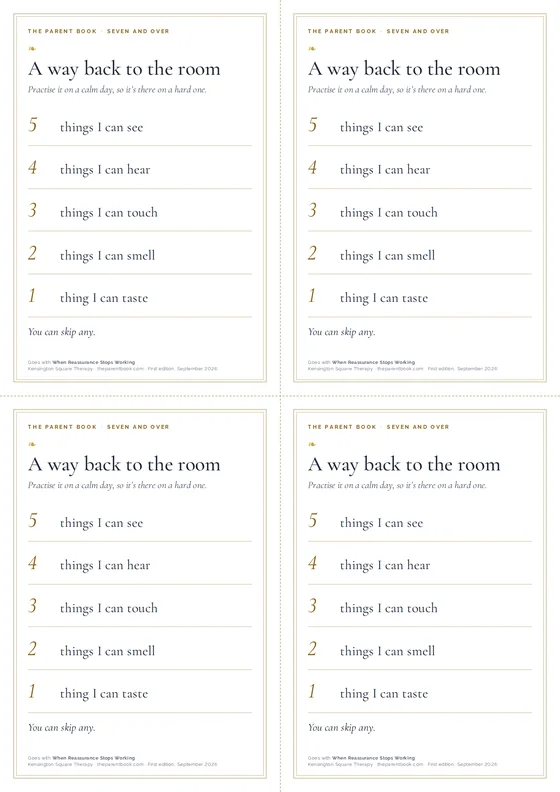
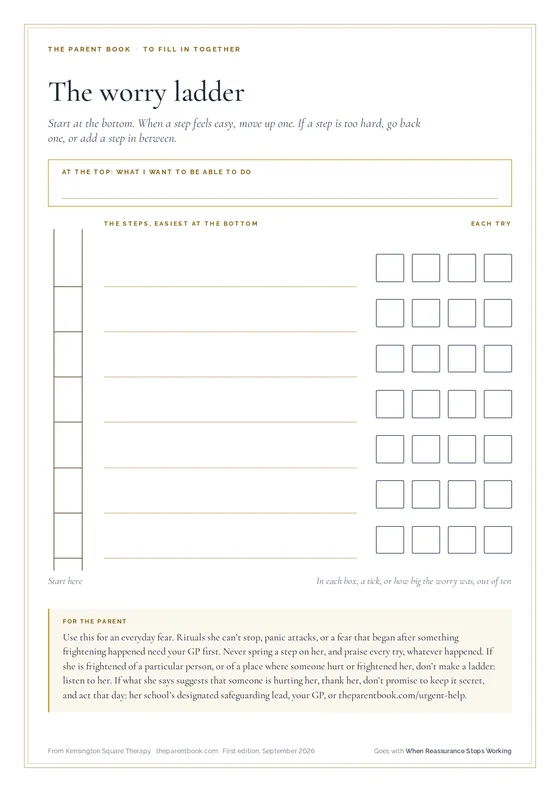
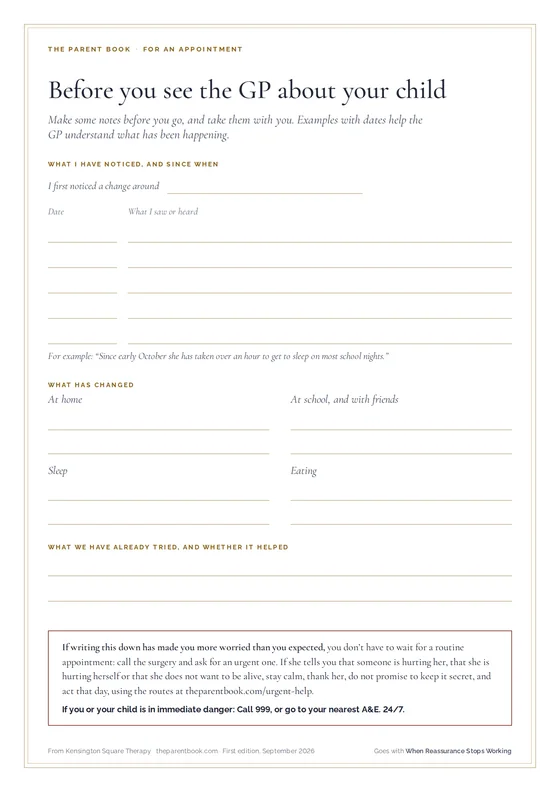
The quick tips and activities are for subscribers; the sheets that go with this chapter are yours to print. What a subscription includes.
Who else can help
YoungMinds
The UK’s young people’s mental health charity, with a free Parents Helpline, webchat and email, and a plain A to Z of the things parents worry about.
0808 802 5544 · Mon, Thu, Fri 9.30am-4pm; Tue, Wed 9.30am-6pm
Outside those hours the parents line is closed. The urgent routes on this page are open when it is not.
Anna Freud
The Anna Freud Centre’s family wellbeing resources: careful, research-led reading on children’s emotional development, separation, self-care for parents, and supporting a child through treatment.
Coram Family Lives
A free, confidential helpline for any parenting or family worry, by phone, live chat, WhatsApp or email, staffed by trained family support workers.
0808 800 2222 · Mon-Fri 9am-9pm; weekends 10am-3pm; closed bank holidays
Outside those hours the line is closed. Samaritans answer at any hour on 116 123, and Shout answer if you text the word SHOUT to 85258.
coramfamilylives.org.uk/how-we-can-help/confidential-helpline