Body image
Body image
These pages are about how a child sees herself in the mirror and where that view came from, including the conversations parents don’t realise they’re having, magazines and social media feeds, changing rooms and PE kits. We’ve written about it carefully, for parents of children at every age.
What the library says about this, on one page. It is also online at theparentbook.com/help/body-image
What to do first
A child learns how to talk about her body mostly from the adults around her, which means she can learn a different way. What you say about your own body does most of the teaching.
- Stop the commentary about bodies, starting with what you say about your own. Children pay more attention to what you say about your body than to anything you tell them about theirs.
- Praise what her body does, not how it looks: she climbed the thing, she swam further than last week.
- If eating has changed and not changed back, treat it as a medical question and see the GP.
Some tips to try
Short pieces from the library, and a first thing to try from each.
-
The Boy Whose Voice Is Changing.
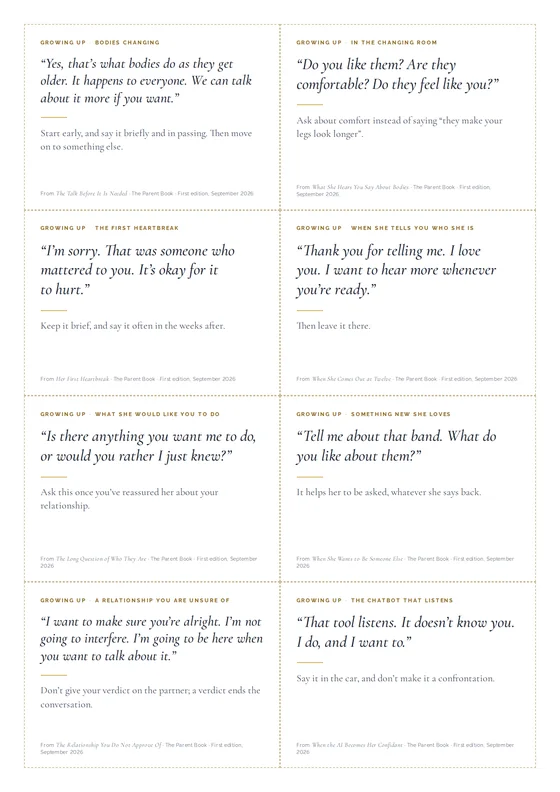
Once his voice starts to crack, have a short, matter-of-fact talk with him about puberty.
- Have the conversation on a walk, side by side.
-
The First Bra Conversation.
Take her question about a first bra seriously, and treat the shopping as an everyday errand.
- Take her seriously, and shop together at a department store that measures properly.
-
What She Hears You Say About Bodies.
In her first decade, a child’s body image is built almost entirely from what she hears adults say.
- Don’t run down your own body in front of her.
The rest of each tip, with more to try and why it works, is in the library.
Something to do together
What my body can do. Now and then, each of you writes a few things your body did this week: something it managed, something it felt, something it mended. Nobody mentions how anyone looks.
What it is for. What a child hears at home about bodies, including what adults say about their own, affects how she sees hers. Noticing what her body did this week, from running for the bus to healing a graze, gives her a way to think about it that has nothing to do with how it looks.
- The first step. Go first, with plain facts about your own body this week: “My legs got me up four flights of stairs when the lift broke. My body got over a cold.”
- Ask her to write or draw a few of hers. Anything counts: a cartwheel, a hug, laughing until it hurt, tasting something new, sleeping, growing, healing a graze.
When to get help. If she tells you that someone is hurting her, that she is hurting herself, or that she does not want to be alive, stay calm, thank her for telling you, do not promise to keep it secret, and act that day, using the routes under “If you need help right now”, at the foot of every page. If she seems to spend a lot of time worrying about her weight or shape, is eating very little, is exercising too much or has strict rules about food, tell her you’re worried and see your GP soon; don’t wait to be sure. If harsh talk about her body goes on for several weeks alongside a low or anxious mood, talk to her school and your GP.
The other three steps, and your part in it, are in the library.
If you want to read further
- Body Image. For parents who want their child to grow up comfortable in their own body. theparentbook.com/reader/body-image-and-the-conversations-we-do-not-realise-we-are-having
- Eating and Control. For parents whose family mealtimes have become about much more than food. theparentbook.com/reader/eating-and-control
Worth your time
- A book for you: Beauty Sick, Renee Engeln. Psychologist Renee Engeln, who runs a body image lab at Northwestern University, explains how appearance pressure drains girls’ time, money and mood, and what adults can say instead of commenting on bodies. uk.bookshop.org/p/books/beauty-sick-how-the-cultural-obsession-with-appearance-hurts-girls-and-women-renee-phd-engeln/f73a70befaf78dbb
- A book to read together: Being You: The Body Image Book for Boys, Charlotte Markey, Daniel Hart and Douglas Zacher. A rare book on body image written for boys, covering puberty, muscle ideals, social media, sport and self-talk. Plain, friendly and grounded in research. uk.bookshop.org/p/books/being-you-the-body-image-book-for-boys-charlotte-markey/7b845458dd97b737
- Something to watch: Navigating Teen Body Image: A Parent’s Guide with Anastassis Spiliadis, Dr Bettina Hohnen with Anastassis Spiliadis, YouTube. A UK clinical psychologist and a family therapist discuss how parents can support a teenager’s body image, including how to talk about food, weight and appearance at home. www.youtube.com/watch?v=q5WbJ7BawK0
- Something to listen to: 184: How Do I Support a Teen Who Hates Her Body?, Ask Lisa: Untangling Family Life, 33 min. Damour and Ninan answer a parent whose teenage daughter says she hates her body, looking at how to respond to body talk at home and how to support a teenager’s relationship with her appearance. podcasts.apple.com/gb/podcast/184-how-do-i-support-a-teen-who-hates-her-body/id1525689066?i=1000668983937
Who else can help
For almost everything, the NHS is the right first move, and it costs nothing.
- Your GP. The gateway to everything the NHS offers a child: paediatric assessment, a referral to CAMHS, and support for you as the parent. Ask for a double appointment. Describe the pattern over weeks rather than the worst single day, and say plainly what you are worried about. Bring a written list; the ten minutes go quickly. www.nhs.uk/service-search/find-a-gp
- Your child’s school. The pastoral lead, the head of year, or the form tutor. Free, already knows your child, and often the quickest way to get something changed at school. Before or alongside anything else. A school cannot act on what it has not been told, and what you bring is often what it did not have.
- Beat (the UK’s eating disorder charity). The UK’s eating disorder charity. A free helpline, webchat and email, and, for parents specifically, a free twelve-week one-to-one support programme and an online learning hub for families. As soon as eating has become a worry, and alongside the GP, not instead. You do not need a diagnosis to call. BEAT Helplines England 0808 801 0677, Scotland 0808 801 0432, Wales 0808 801 0433, Northern Ireland 0808 801 0434 · Mon-Fri 3pm-8pm · One-to-one webchat and email (help@, Scotlandhelp@, Waleshelp@ or NIhelp@beateatingdisorders.org.uk) at the same hours · Outside those hours the line is closed. If your child is physically unwell, use the urgent routes on this page, which are open when this line is not. www.beateatingdisorders.org.uk/get-information-and-support/support-someone-else
- Brook. The young people’s sexual health charity. Calm pages for parents on puberty, periods and talking about sex and relationships at home. When the question has arrived in the back of the car. Reading; the clinics are for young people themselves. www.brook.org.uk/parents-and-carers
- YoungMinds. The UK’s young people’s mental health charity, with a free Parents Helpline, webchat and email, and a plain A to Z of the things parents worry about. When you want to talk through a worry about your child with someone who has heard it before, or read a clear first explanation of a named concern. Not a crisis line. Parents Helpline 0808 802 5544 · Mon, Thu, Fri 9.30am-4pm; Tue, Wed 9.30am-6pm · Webchat Mon-Fri 9.30am-4pm; email parents@youngminds.org.uk · Outside those hours the parents line is closed. The urgent routes on this page are open when it is not. www.youngminds.org.uk/parent/parents-helpline
The full list for body image, with what each organisation does and when it is the right call, is at theparentbook.com/help/body-image/services
Published by Kensington Square Therapy. Company No. 16707111. Written by therapists registered with the British Association for Counselling and Psychotherapy (BACP) and the National Counselling and Psychotherapy Society (NCPS). This page is not therapy, and not a substitute for professional support. The full library is at theparentbook.com.
Everything the library holds on body image
Go further
Chapters
Quick tips
- The Boy Whose Voice Is ChangingOnce his voice starts to crack, have a short, matter-of-fact talk with him about puberty.
- The First Bra ConversationTake her question about a first bra seriously, and treat the shopping as an everyday errand.
- What She Hears You Say About BodiesIn her first decade, a child’s body image is built almost entirely from what she hears adults say.
- The First Period That Arrived at SchoolWhen her first period starts at school, take her home and treat the rest of the afternoon as normal.
- The Friends the Algorithm ChoseThe platform chooses what’s in her feed to keep her watching, and it can leave her feeling flat.
- The Feed Full of Diets and BodiesIf your daughter’s feed is full of diets and bodies, reset it with her and explain how it works.
Quick tips open with a subscription.
Things to do together
Activities open with a subscription.