
Parent wellbeing
Parent wellbeing
This section is about you, the adult. Parents tend to come to it last, though the rest of family life depends on how you are. It’s for the mother running on four hours of sleep, the father who can’t remember the last time he was alone in a room, and the parent who has stopped recognising her own life.
What the library says about this, on one page. It is also online at theparentbook.com/help/parent-wellbeing
What to do first
You’re the most reliable person in your child’s life, and nobody can keep that up for long when they’re exhausted. Looking after yourself is part of looking after her, and you don’t have to earn it.
- This week, say out loud to one adult what you’re dealing with. Your child shouldn’t be the one you tell.
- Take back one hour that’s yours and put it in the diary, so it doesn’t get given away without you noticing.
- If it has been going on for months, refer yourself to NHS Talking Therapies. You do not need your GP’s permission and you do not need to be in crisis to qualify.
What helps
- Take devices out of the bedroom at night. A bright screen in a dark bedroom works against sleep. Charge devices in the kitchen overnight.
- Start winding down 30 to 45 minutes before bed. Go through bath, teeth, pyjamas, reading and low lights in the same order each night. The brain reads the sequence as “sleep is coming” and starts releasing melatonin, so it’s the predictability that makes it work.
Some tips to try
Short pieces from the library, and a first thing to try from each.
-
A Plan Made in a Good Week.
Agree a plan with your children in a good week, so nobody has to guess on a bad day.
- Make the plan in a good week, not on the bad day.
- Agree one emergency rule: if they cannot wake you or think you are in danger, emergency help first, then a named adult.
- Coram Family Lives suggests agreeing a plan with your children for the bad times, and we’d add only that it’s best made in a good week, calmly, perhaps over a weekend breakfast. Agree who they can call, who will do the school run if you can’t, and what you’ll say to each other on a hard day, so that nobody has to guess. And one simple rule for an emergency: if they cannot wake you, you are hurt, or they think you are in danger, they call for emergency help first and ring a named adult second.
-
Asking for Help That Feels Like Failing.
A specific request for help gets a yes or a no; a general one gets sympathy.
- Ask for one specific thing: “Can you collect her on Thursday?”
- Contact your local branch first: Home-Start UK visits families across the country.
- “Can I drop her at yours on Saturday morning while I see the GP?”
-
The Fear That Stops You Asking.
Many parents fear that asking for help will cost them their children, but what usually follows asking is help.
- Name the fear to yourself: it is common, and what usually follows asking is help.
- Book the GP, or in England refer yourself to NHS Talking Therapies.
- If you are not safe, or not sure you can keep yourself or your children safe, do not wait for the GP: use the routes under “If you need help right now”, at the foot of this page. Say if your child is with you; it means the person helping can think about your child as well as you.
- For most people, the first step is the GP.
- In England you can also refer yourself to NHS Talking Therapies for anxiety and depression, without a GP appointment; the NHS website will find your local service.
The rest of each tip, with more to try and why it works, is in the library.
Something to do together
A plan for a bad day, made in a good week. A one-page plan, made calmly with your children: who they can call, who does the school run, and what you say to each other on a hard day.
What it is for. This is for a parent living with low mood, anxiety or another condition that comes and goes. A bad day is easier on everyone when the family has already thought about what happens on one.
- The first step. Choose a good week to do this, and a calm time within it.
- Agree one rule for an emergency, and keep it simple: if they cannot wake you, you are hurt, or they think you are in danger, they call for emergency help first and ring the adult named on the plan second. For anything else, they ring that adult. Say plainly that looking after you is not their job; the rule is only about fetching help.
Safety. The printable carries only the emergency route; the names and numbers of the adults who can help are for you to write in together.
When to get help. If you are not safe, or not sure you can keep yourself or someone else safe, do not wait for the plan: use the routes under “If you need help right now”, at the foot of every page, straight away. For everything else, the GP is the first step, and in England you can refer yourself to NHS Talking Therapies.
The other three steps, and your part in it, are in the library.
If you want to read further
- When You Are Not All Right. For parents whose own mental health is part of what’s going on at home. theparentbook.com/reader/when-you-are-not-all-right
- The Hour Before Bed. For parents whose child’s bedtime has turned into an hour of worries, questions and meltdowns. theparentbook.com/reader/the-hour-before-bed
Worth your time
- A book for you: Matrescence, Lucy Jones. A science writer explores the physical, psychological and social transformation of becoming a mother, drawing on research and her own experience. Validating for anyone changed by motherhood in ways no one mentioned. uk.bookshop.org/p/books/matrescence-on-the-metamorphosis-of-pregnancy-childbirth-and-motherhood-lucy-jones/94be607d43135365
- Something to watch: How do I know if I have postnatal depression? | NHS, NHS, YouTube. An NHS film on how postnatal depression differs from the baby blues, what the signs are, and why speaking to a GP or health visitor early matters. Calm and unfrightening. www.youtube.com/watch?v=KBlVBOP7TGc
- Something to listen to: The Therapy Edit, Anna Mathur. Therapist Anna Mathur’s listener-question show on anxiety, guilt, resentment and early motherhood. It has finished, but the archive remains good company for a parent who is struggling themselves. podcasts.apple.com/gb/podcast/the-therapy-edit/id1505968557
Who else can help
You can refer yourself. You do not need anyone’s permission, and you do not need to be in crisis to qualify.
- NHS Talking Therapies. Free NHS therapy for adults in England, for anxiety and low mood. You can refer yourself; you do not need to go through your GP first. For the parent. A great many of the parents we sit with are carrying something of their own, and waiting for someone to ask. www.nhs.uk/service-search/mental-health/find-an-NHS-talking-therapies-service
- Your GP. The gateway to everything the NHS offers a child: paediatric assessment, a referral to CAMHS, and support for you as the parent. Ask for a double appointment. Describe the pattern over weeks rather than the worst single day, and say plainly what you are worried about. Bring a written list; the ten minutes go quickly. www.nhs.uk/service-search/find-a-gp
- Mind. The UK’s mental health charity. Pages written for parents of a struggling young person, an Infoline that points you to the right service, and a Support Line that will simply listen. When your own reserves are running low and you want to talk to someone who is not the GP, your partner or a friend. Not for a crisis. Not a crisis line. If tonight is urgent, use the numbers at the top of this sheet. Charged at your standard call rate, not free. Mind Infoline 0300 123 3393 · Mon-Fri 9am-6pm (except bank holidays) · Mind Support Line 0300 102 1234, Mon-Fri 9am-6pm, for emotional support rather than signposting · Outside those hours the line is closed. Samaritans answer at any hour on 116 123, and Shout answer if you text the word SHOUT to 85258. www.mind.org.uk/for-young-people/information-for-parents
- Coram Family Lives. A free, confidential helpline for any parenting or family worry, by phone, live chat, WhatsApp or email, staffed by trained family support workers. When you need to talk it through with someone, about your child or about how you are managing, and you do not need a specialist to do it. Coram Family Lives helpline 0808 800 2222 · Mon-Fri 9am-9pm; weekends 10am-3pm; closed bank holidays · Live chat and WhatsApp 07441 444125 at the same hours; email askus@coramfamilylives.org.uk · Outside those hours the line is closed. Samaritans answer at any hour on 116 123, and Shout answer if you text the word SHOUT to 85258. www.coramfamilylives.org.uk/how-we-can-help/confidential-helpline
- Family Action FamilyLine. A free helpline for adults on family relationships, conflict, parenting, caring and money, by phone, text, email or chat, with befriending or short counselling if it would help. When the strain is on you and there is no one to say it to. FamilyLine 0808 802 6666 · Mon-Fri 9am-5pm; closed bank holidays. Out of hours, text FAMILYACTION to 85258 family-action.org.uk/get-support/familyline
The full list for parent wellbeing, with what each organisation does and when it is the right call, is at theparentbook.com/help/parent-wellbeing/services
Published by Kensington Square Therapy. Company No. 16707111. Written by therapists registered with the British Association for Counselling and Psychotherapy (BACP) and the National Counselling and Psychotherapy Society (NCPS). This page is not therapy, and not a substitute for professional support. The full library is at theparentbook.com.
Everything the library holds on parent wellbeing
Go further
Chapters
- When You Are Not All RightFor parents whose own mental health is part of what’s going on at home.
- The Hour Before BedFor parents whose child’s bedtime has turned into an hour of worries, questions and meltdowns.
- Body ImageFor parents who want their child to grow up comfortable in their own body.
- Anxiety, by AgeFor parents whose child’s worry has started to make decisions for her, with what helps at each age and when to ask for help.
- What to Do When School Is the ProblemFor parents whose child has started dreading school.
- When the Best Friend Moves OnFor parents whose child’s best friend has drifted away, with no falling-out to explain it.
- When They Stop Talking to YouFor parents whose teenager hardly talks to them any more.
- Screen TimeFor parents who have lost the argument about screen hours, and suspect it was never quite the right argument to have.
- The 11+ YearFor parents whose child is preparing for school entrance exams.
- What Screen Time Actually IsFor parents who feel they have lost the argument about screens.
- Eating and ControlFor parents whose family mealtimes have become about much more than food.
- PerfectionismFor parents whose child can’t bear to get anything wrong.
- Siblings and the Fights That Aren’t FairFor parents whose children keep finding new ways to fall out with each other.
- The Move to Secondary SchoolFor parents whose child is about to go from being one of the oldest in her school to one of the youngest.
- When a Child Is GrievingFor parents whose child has lost someone, or something, that was there last week.
- When Reassurance Stops WorkingFor parents whose child is anxious and can’t be talked out of it, however often the adults around her try.
- Big Feelings and Co-RegulationFor parents whose child has just had a meltdown, on how to help her through it.
- The Conversations Parents AvoidFor parents who need to tell their child something hard and don’t know how to start.
- When Parents SeparateFor parents in the middle of a separation who are watching closely to see how their child is coping.
- Your Child’s Online WorldFor parents who have seen something on their child’s phone that they can’t unsee.
- Neurodiversity, and the Conversation with the SchoolFor parents whose child has been working harder and longer than other children to do things that come more easily to them.
- When Your Child Is Working Out Who They AreFor parents whose child has raised a question about who they are, and who weren’t prepared for it.
- Trauma in ChildhoodFor parents whose child has been through something hard, or whose family has.
- When Your Child Is Being BulliedFor parents whose child has just told them she is being bullied.
Quick tips
- A Plan Made in a Good WeekAgree a plan with your children in a good week, so nobody has to guess on a bad day.
- Asking for Help That Feels Like FailingA specific request for help gets a yes or a no; a general one gets sympathy.
- The Fear That Stops You AskingMany parents fear that asking for help will cost them their children, but what usually follows asking is help.
- The Friend You Have Stopped CallingLosing touch with friends happens gradually, and the way back starts with a quick, low-stakes message.
- The Sunday Evening DreadSunday-evening dread is a sign that you’ve been doing more than you can recover from.
- What to Tell Her When You Are UnwellA child who is told nothing makes up her own explanation, and in it she is often to blame.
- When She Is Too Small for the WordsA child under five needs a short, calm explanation and care she can rely on.
- When You Are the One Not SleepingLying awake night after night is a sign of overload, and a reason to see your GP.
- When You Have SnappedAfter you’ve snapped at your child, go back, apologise and put it right.
- The First Phone Call BackA short, slightly distracted first call from university is a good sign that she’s settling in.
All 37 quick tips on parent wellbeing
Quick tips open with a subscription.
Things to do together
- A plan for a bad day, made in a good weekA one-page plan, made calmly with your children: who they can call, who does the school run, and what you say to each other on a hard day.
- A day with no 11+ in itOne day a week, and a few evenings, with no papers, no practice and no talk of the test. Keep it most weeks, and let it go when a week slips.
Activities open with a subscription.
To print
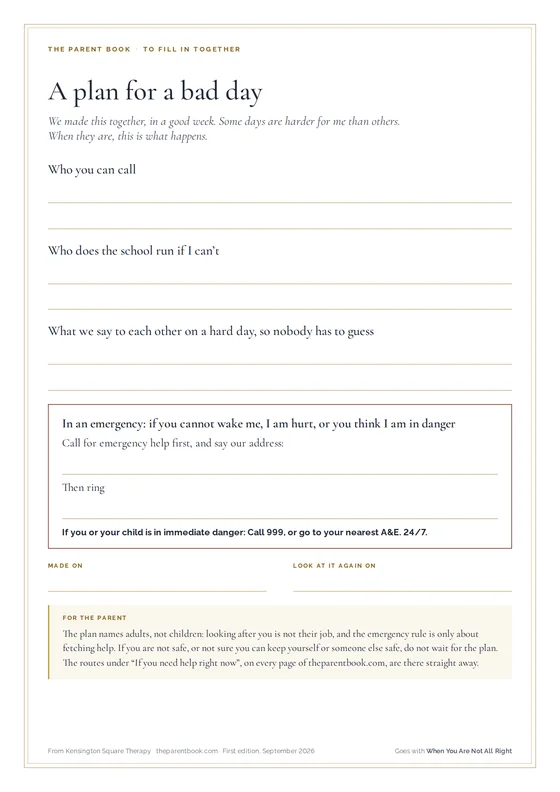 A plan for a bad day
To fill in together · A4 · PDF, 59 KB · Free
A plan for a bad day
To fill in together · A4 · PDF, 59 KB · Free
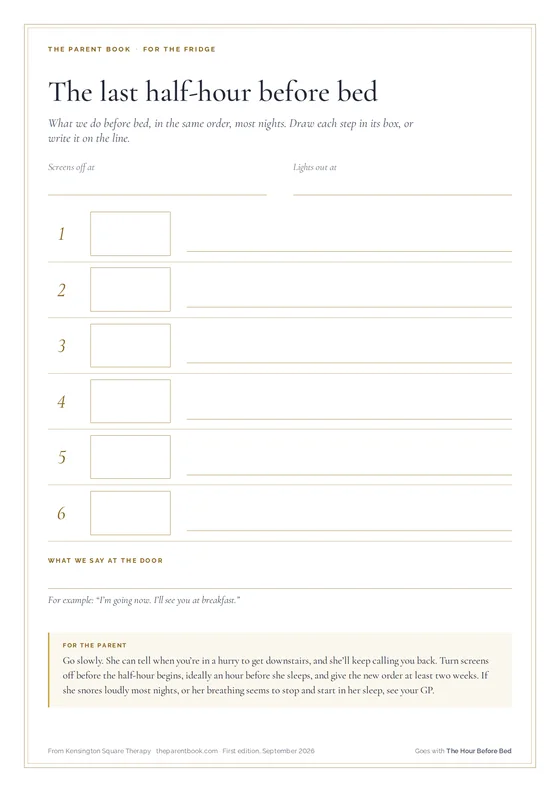 The last half-hour before bed
For the fridge · A4 · PDF, 53 KB · Free
The last half-hour before bed
For the fridge · A4 · PDF, 53 KB · Free
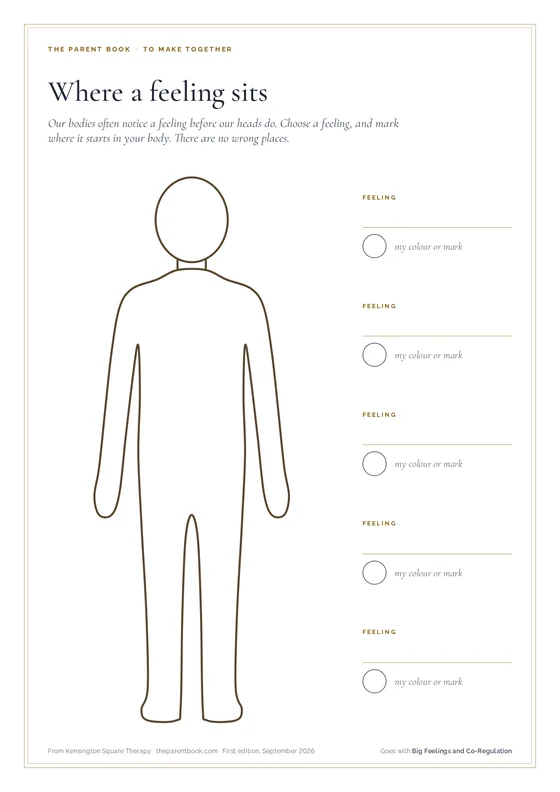 Where a feeling sits
To make together · A4, two sides · PDF, 62 KB · With a subscription
Where a feeling sits
To make together · A4, two sides · PDF, 62 KB · With a subscription
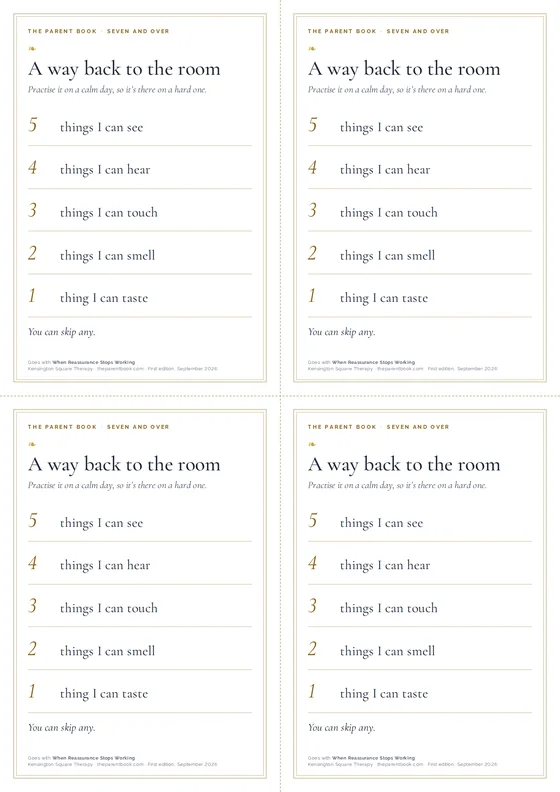 A way back to the room
Pocket card · A4, four cards to cut, two sides · PDF, 68 KB · With a subscription
A way back to the room
Pocket card · A4, four cards to cut, two sides · PDF, 68 KB · With a subscription
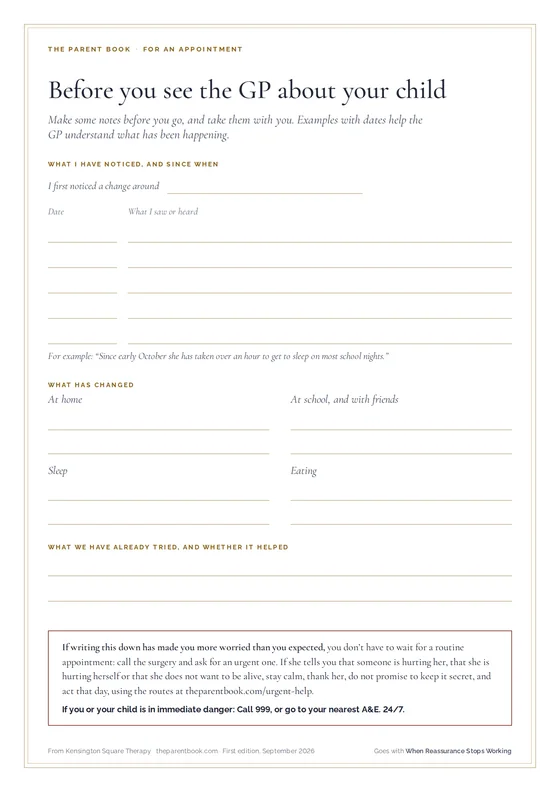 Before you see the GP about your child
For an appointment · A4, two sides · PDF, 72 KB · Free
Before you see the GP about your child
For an appointment · A4, two sides · PDF, 72 KB · Free
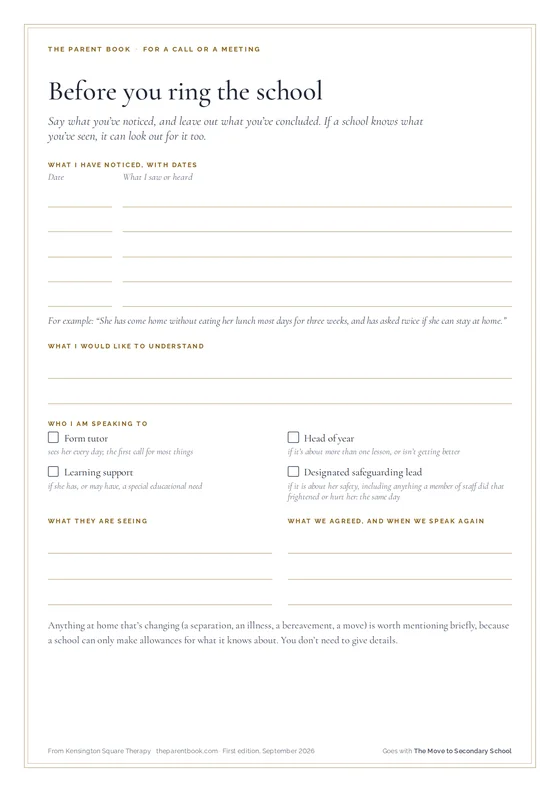 Before you ring the school
For a call or a meeting · A4 · PDF, 58 KB · Free
Before you ring the school
For a call or a meeting · A4 · PDF, 58 KB · Free
Looking after yourself
Every subjectWho else can help with parent wellbeingUrgent help