
Emotional regulation
Emotional regulation
Managing a strong feeling without being swept away by it is something children learn gradually as they grow. Helping a four-year-old calm down looks different from sitting beside a fourteen-year-old, and these pages follow that learning through childhood, whatever your child’s age.
What the library says about this, on one page. It is also online at theparentbook.com/help/emotional-regulation
What to do first
Children borrow calm from the adults around them before they can find it on their own. A child learns to calm herself by being calmed, several thousand times, by someone who wasn’t frightened by how upset she got.
- Start with your body, before any words: lower your voice, slow your breathing and get down to her level. The thinking part of her brain can’t hear you yet.
- Name the feeling in one short sentence, such as “That was so disappointing,” and then stop. Don’t add the lesson.
- Later, repair things briefly and warmly. The repair is where the learning happens.
What helps
- Settle yourself first. Young children can’t calm themselves down yet; they calm down by being near an adult who is calm. So before you say anything, slow your own breathing and lower your voice. That does more than the words.
- Name the feeling simply. Try “You’re really frustrated right now.” That’s all you need to say. Naming the feeling moves brain activity from the emotional centre towards the language centre, and that in itself is calming.
- Stay calm first, talk later. Sit close and slow your own breathing. Being next to a calm adult helps a child’s body settle, and that does more than anything clever you could say. Save the words for when the worst has passed.
- Name the feeling out loud. Try “That sounds really hard” or “You look really worried.” Naming the feeling makes it seem less strange, and it shifts brain activity from the alarm centre towards the language centre.
Some tips to try
Short pieces from the library, and a first thing to try from each.
-
When the Worry Will Not Settle.
An anxious child rarely tells you she’s worried; it comes out as stomach aches, refusals and repeated questions.
- Name what her body is doing, briefly, in plain language.
-
The Meltdown in Public.
In the middle of it she can’t listen, so the next ten minutes are for getting her safe and calm, and the talking comes later.
- Get her somewhere safe with fewer people, stay close, and say very little.
- If they’re getting more frequent or worse, or she hurts herself or someone else, talk to your health visitor or GP, and take the notes with you.
-
The Tantrum Over the Broken Banana.
A broken banana is more than a tired three-year-old can take.
- Get down lower than she is, and drop your voice.
The rest of each tip, with more to try and why it works, is in the library.
Something to do together
Play me something. She picks a song and plays it to you. You listen to the end, and ask one question about it.
What it is for. A teenager’s moods often show in the music she listens to. Asking her to play you something shows you are interested in what she listens to, and it can tell you something about her week.
- The first step. Ask when things are easy between you: “Play me something you’ve been listening to.”
Safety. Music services set minimum ages, often thirteen; a younger child belongs on a family account a parent manages. The phone that plays the music still charges in the kitchen overnight.
When to get help. If her mood has been flat for more than two weeks, or you’re worried at any point, talk to your GP and her school, and tell them about any change in her sleep, appetite or friendships. If a song leads her to tell you that someone is hurting her, that she is hurting herself, or that she does not want to be alive, stay calm, thank her for telling you, do not promise to keep it secret, and act that day, using the routes under “If you need help right now”, at the foot of every page.
The other four steps, and your part in it, are in the library.
If you want to read further
- When They Stop Talking to You. For parents whose teenager hardly talks to them any more. theparentbook.com/reader/when-they-stop-talking-to-you
- The Hour Before Bed. For parents whose child’s bedtime has turned into an hour of worries, questions and meltdowns. theparentbook.com/reader/the-hour-before-bed
Worth your time
- A book for you: Permission to Feel, Marc Brackett. The director of the Yale Center for Emotional Intelligence sets out his RULER approach: recognising, understanding, labelling, expressing and regulating emotions, for parents first and then with their children. uk.bookshop.org/p/books/permission-to-feel-unlock-the-power-of-emotions-to-help-yourself-and-your-children-thrive-marc-brackett/c8887740cb495774
- A book to read together: In My Heart: A Book of Feelings, Jo Witek. Die-cut hearts and short, physical descriptions help a toddler notice where a feeling lives in the body, such as anger that feels “hot and red”. A calm first feelings book for the youngest readers. uk.bookshop.org/p/books/in-my-heart-a-book-of-feelings-jo-witek/7fc45a4faf234526
- Something to watch: Sesame Street: Common and Colbie Caillat Sing “Belly Breathe” with Elmo, Sesame Street, YouTube. Elmo learns to slow down his ‘monster’ feelings with belly breathing in a catchy song. A gentle way to practise calming together before it is needed. www.youtube.com/watch?v=_mZbzDOpylA
- Something to listen to: Dr Sarah Mundy on Anger, Big Feelings & Resilience, Made by Mammas: The Podcast, 56 min. A clinical psychologist on anger, big feelings and resilience in children, in a longer conversation. open.spotify.com/episode/73N5hdUrwViEW9UoR25Md4
Who else can help
Big feelings are ordinary, and the school sees more of them than you do. Tell them what you are seeing at home; see the GP if the storms are getting longer, more frequent, or frightening.
- Your child’s school. The pastoral lead, the head of year, or the form tutor. Free, already knows your child, and often the quickest way to get something changed at school. Before or alongside anything else. A school cannot act on what it has not been told, and what you bring is often what it did not have.
- Your GP. The gateway to everything the NHS offers a child: paediatric assessment, a referral to CAMHS, and support for you as the parent. Ask for a double appointment. Describe the pattern over weeks rather than the worst single day, and say plainly what you are worried about. Bring a written list; the ten minutes go quickly. www.nhs.uk/service-search/find-a-gp
- Place2Be. Parenting Smart, written by the child mental health specialists who work in primary schools: short, practical articles and films on friendships, behaviour, worries and routines. For a child of five to eleven, when you want something you can read in ten minutes and try tonight. Place2Be’s counselling itself is only through partner schools. parentingsmart.place2be.org.uk
- YoungMinds. The UK’s young people’s mental health charity, with a free Parents Helpline, webchat and email, and a plain A to Z of the things parents worry about. When you want to talk through a worry about your child with someone who has heard it before, or read a clear first explanation of a named concern. Not a crisis line. Parents Helpline 0808 802 5544 · Mon, Thu, Fri 9.30am-4pm; Tue, Wed 9.30am-6pm · Webchat Mon-Fri 9.30am-4pm; email parents@youngminds.org.uk · Outside those hours the parents line is closed. The urgent routes on this page are open when it is not. www.youngminds.org.uk/parent/parents-helpline
- Anna Freud. The Anna Freud Centre’s family wellbeing resources: careful, research-led reading on children’s emotional development, separation, self-care for parents, and supporting a child through treatment. When you want depth from a clinical source rather than a quick explainer. Reading only; there is no helpline. www.annafreud.org/resources/family-wellbeing
The full list for emotional regulation, with what each organisation does and when it is the right call, is at theparentbook.com/help/emotional-regulation/services
Published by Kensington Square Therapy. Company No. 16707111. Written by therapists registered with the British Association for Counselling and Psychotherapy (BACP) and the National Counselling and Psychotherapy Society (NCPS). This page is not therapy, and not a substitute for professional support. The full library is at theparentbook.com.
Everything the library holds on emotional regulation
Go further
Chapters
- When They Stop Talking to YouFor parents whose teenager hardly talks to them any more.
- The Hour Before BedFor parents whose child’s bedtime has turned into an hour of worries, questions and meltdowns.
- When a Child Is GrievingFor parents whose child has lost someone, or something, that was there last week.
- When Reassurance Stops WorkingFor parents whose child is anxious and can’t be talked out of it, however often the adults around her try.
- Big Feelings and Co-RegulationFor parents whose child has just had a meltdown, on how to help her through it.
- When the Best Friend Moves OnFor parents whose child’s best friend has drifted away, with no falling-out to explain it.
- Eating and ControlFor parents whose family mealtimes have become about much more than food.
- Siblings and the Fights That Aren’t FairFor parents whose children keep finding new ways to fall out with each other.
- When Parents SeparateFor parents in the middle of a separation who are watching closely to see how their child is coping.
- PerfectionismFor parents whose child can’t bear to get anything wrong.
- Trauma in ChildhoodFor parents whose child has been through something hard, or whose family has.
- When Your Child Is Working Out Who They AreFor parents whose child has raised a question about who they are, and who weren’t prepared for it.
- Body ImageFor parents who want their child to grow up comfortable in their own body.
Quick tips
- When the Worry Will Not SettleAn anxious child rarely tells you she’s worried; it comes out as stomach aches, refusals and repeated questions.
- The Meltdown in PublicIn the middle of it she can’t listen, so the next ten minutes are for getting her safe and calm, and the talking comes later.
- The Tantrum Over the Broken BananaA broken banana is more than a tired three-year-old can take.
- When the Best Friend DriftsWhen a best friendship slowly fades, it’s usually part of growing up, and it helps to say you’ve noticed.
- When the Cat DiesFor many children, a pet’s death is their first significant bereavement, and the grief is real.
- When the Lid Has FlippedWhen a child is overwhelmed, a few words usually reach her better than a lot.
- Why Trauma Shows Up in the Body FirstYoung children usually show trauma in their bodies and behaviour before they can put it into words.
- The Two-Year-Old in TearsCrying is how a two-year-old tells you what she can’t yet put into words.
- Giving Her Words for the Hard ThingA young child rarely has words for something hard; give her a simple phrase for what her body feels.
- The Handover Cancelled at SixDon’t rush to fill the evening when the other parent cancels a handover at the last minute.
All 22 quick tips on emotional regulation
Quick tips open with a subscription.
Things to do together
- Play me somethingShe picks a song and plays it to you. You listen to the end, and ask one question about it.
- Where a feeling sitsOn a plain outline of a body, she marks where she first notices anger, worry and sadness.
- A place to settle, with you nearbyA comfortable corner, chosen with her, for when a feeling gets too big. While she is small you go there together, and nobody is ever sent there.
- A way back to the roomA short noticing game, and for younger children a slow breath traced with a finger. Practise them together on calm days, so she already knows them on a hard one.
- Hands busy, side by sideColour, build or make things side by side, each of you on your own thing. Nothing is asked of her, and nothing she makes is marked.
- One step at a timeFor an everyday fear, such as dogs, the dark or a new club: together you write the steps from easiest to hardest, and she practises each one until it feels easy before she moves up.
- An hour off after schoolFor the child who holds it together at school and comes apart at home. The first hour back asks nothing of her: something to eat, somewhere to recover, and no questions yet.
- First this, then thatA card with two pictures, the thing she does first and the thing that comes next, for a young child who finds it hard to stop one thing and start another.
- Losing at the kitchen tableA game now and then, where everyone loses sometimes, you included, and it is all right to be upset about losing.
- The walk with no agendaWalk with her at the same time each week, side by side. Some weeks she will talk, and you still go on the weeks she does not.
- Worry time, not at bedtimeTen minutes at the same time each afternoon for her worries. If one comes up at another time, you listen, write it down and save it for then.
Activities open with a subscription.
To print
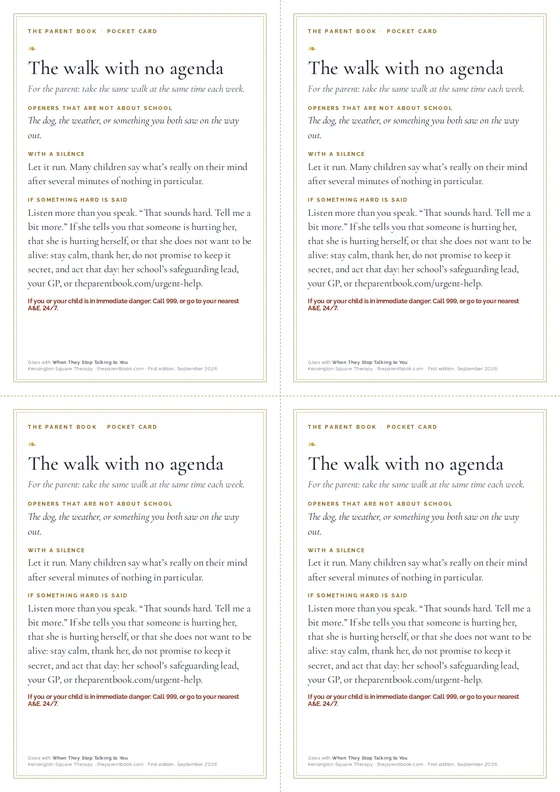 The walk with no agenda
Pocket card · A4, four cards to cut · PDF, 62 KB · With a subscription
The walk with no agenda
Pocket card · A4, four cards to cut · PDF, 62 KB · With a subscription
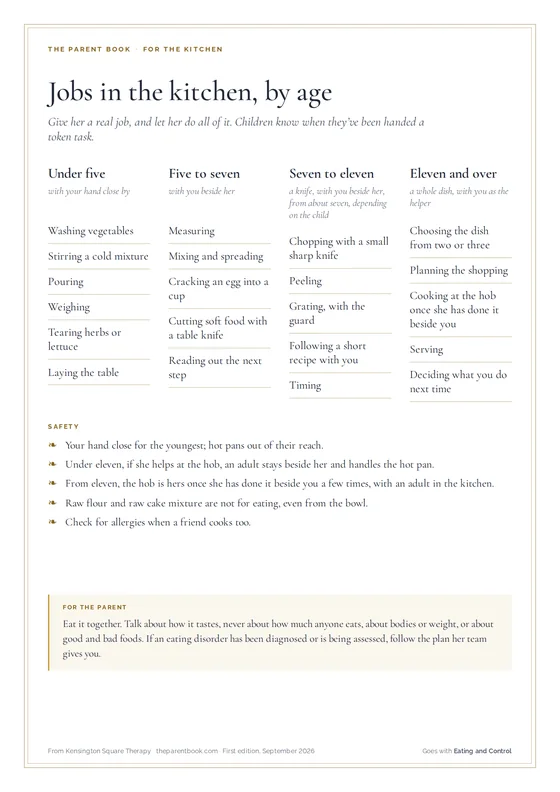 Jobs in the kitchen, by age
For the kitchen · A4 · PDF, 60 KB · With a subscription
Jobs in the kitchen, by age
For the kitchen · A4 · PDF, 60 KB · With a subscription
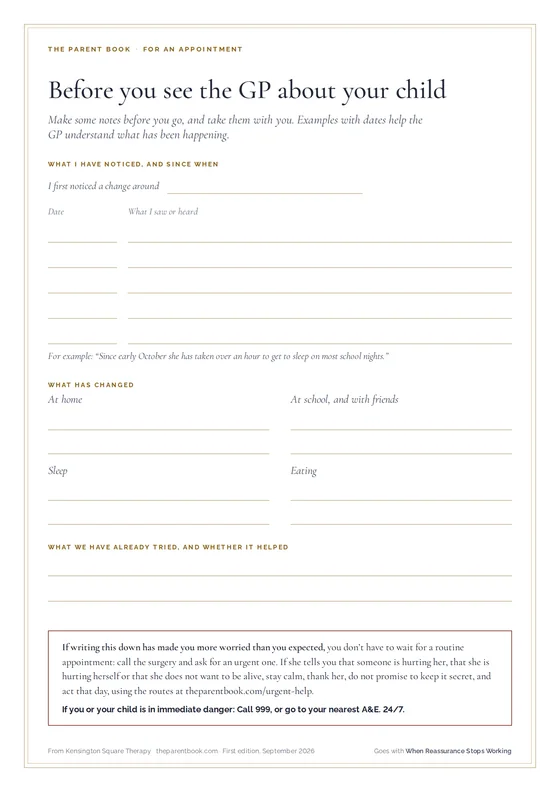 Before you see the GP about your child
For an appointment · A4, two sides · PDF, 72 KB · Free
Before you see the GP about your child
For an appointment · A4, two sides · PDF, 72 KB · Free
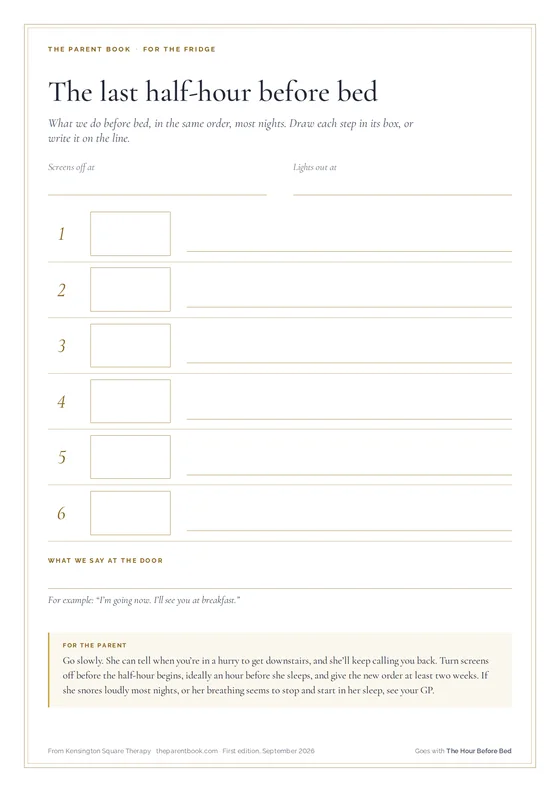 The last half-hour before bed
For the fridge · A4 · PDF, 53 KB · Free
The last half-hour before bed
For the fridge · A4 · PDF, 53 KB · Free
 What I will miss
To keep · A4, two pages · PDF, 41 KB · With a subscription
What I will miss
To keep · A4, two pages · PDF, 41 KB · With a subscription
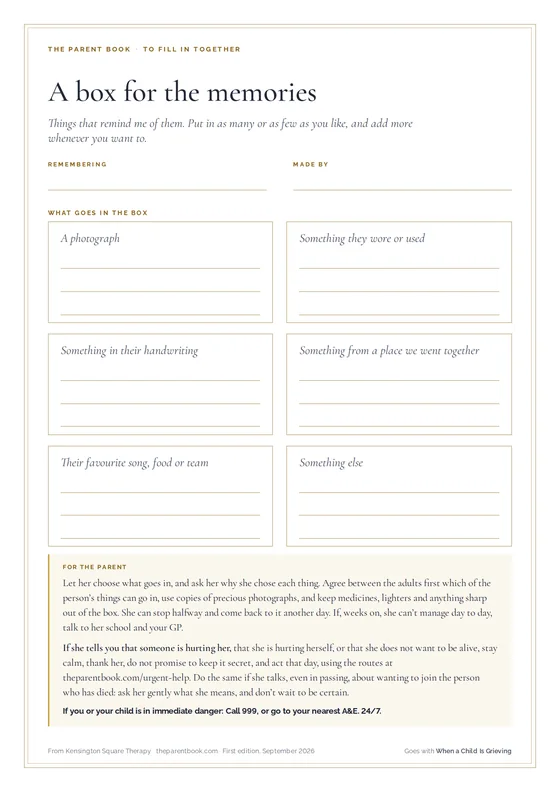 A box for the memories
To fill in together · A4, two pages · PDF, 66 KB · With a subscription
A box for the memories
To fill in together · A4, two pages · PDF, 66 KB · With a subscription
Worry, mood and big feelings
Every subjectWho else can help with emotional regulationUrgent help