
Trauma
Trauma
These pages are for parents whose child has been through something difficult. They cover how it can affect her nervous system, and the long process of helping her live with it. We’ve written them carefully; they don’t replace clinical help where it’s needed, and we show clearly where to find it.
What the library says about this, on one page. It is also online at theparentbook.com/help/trauma
What to do first
Most children who go through something frightening don’t develop lasting trauma, particularly when there’s an adult who stays calm, lets them talk and doesn’t press them. Being that adult does more than you can see.
- Get the usual routines back in place: meals, bedtimes, school, the same route home. In the first weeks, predictability is the treatment.
- Let her be the one to raise it, answer plainly, and don’t make her talk about it.
- If the sleep problems, the flashbacks or the avoidance are still there after a month, ask the GP for a referral. Do not wait it out beyond that.
Some tips to try
Short pieces from the library, and a first thing to try from each.
-
When to Seek Specialist Help for Trauma.
Early help shortens recovery, so don’t wait until she seems sick enough to need it.
- Ask whether early input would help, not whether she is sick enough.
- Take sustained changes over six to eight weeks to your GP.
- Go through your GP for community paediatrics, CAMHS and play therapy.
- Any of these, sustained, is worth bringing to your GP.
- The GP is the way into NHS services, including community paediatrics and CAMHS.
-
Giving Her Words for the Hard Thing.
A young child rarely has words for something hard; give her a simple phrase for what her body feels.
- Offer a simple phrase in the car: “Our bodies remember before our heads do.”
-
She Follows You From Room to Room.
After something hard, a young child needs adults who are predictable, calm and in the room with her.
- Slow the household down while she recovers.
The rest of each tip, with more to try and why it works, is in the library.
Something to do together
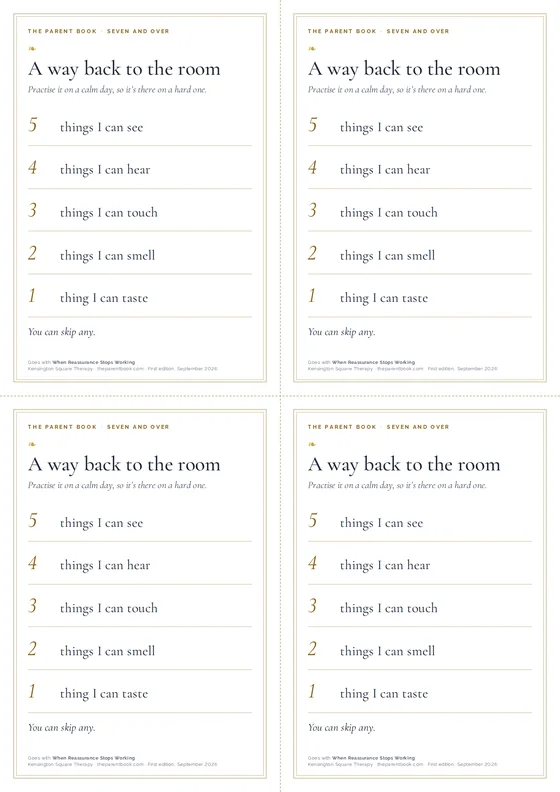
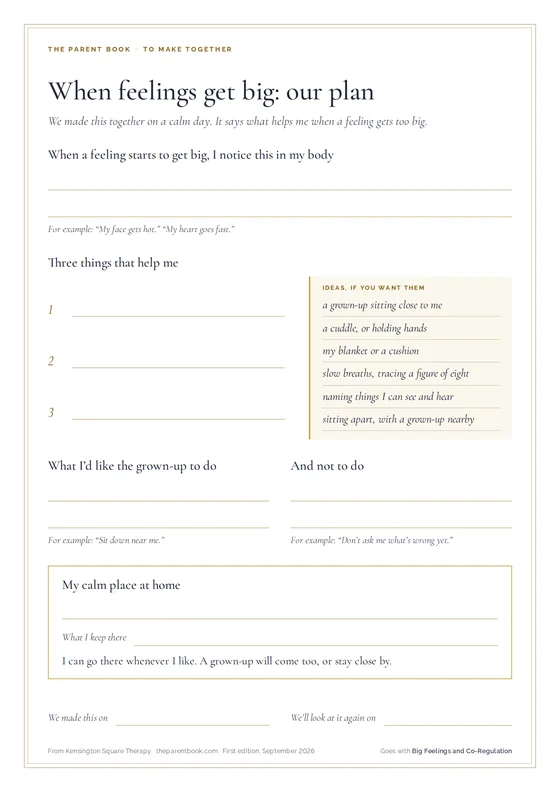
A way back to the room. A short noticing game, and for younger children a slow breath traced with a finger. Practise them together on calm days, so she already knows them on a hard one.
What it is for. In our experience, an anxious child is helped more by something she can do herself than by reassurance. If she learns this when nothing is wrong, she will already know it on a harder day.
- The first step. Choose a calm day and tell her what it is: “This is something people do when a worry gets loud. Let’s try it now, while nothing’s wrong.”
Safety. After something frightening, let her choose her senses, and do not ask her to close her eyes.
When to get help. This is practice, not a treatment. Talk to your GP about recurring panic, worry that stops her going to school, sleeping or eating, frightening intrusive thoughts, or several weeks of waking in fear. If she tells you that someone is hurting her, that she is hurting herself, or that she does not want to be alive, stay calm, thank her for telling you, do not promise to keep it secret, and act that day, using the routes under “If you need help right now”, at the foot of every page.
The other five steps, and your part in it, are in the library.
If you want to read further
- Trauma in Childhood. For parents whose child has been through something hard, or whose family has. theparentbook.com/reader/the-shape-of-trauma-in-childhood
Worth your time
- A book for you: Supporting Traumatized Children and Teenagers, Atle Dyregrov. A Norwegian psychologist’s guide to how children react after frightening events such as accidents, violence or disasters, what parents and schools can do in the first days, and when to seek specialist help.
- A book to read together: A Terrible Thing Happened, Margaret M. Holmes. Sherman saw something terrible, tried to forget it, and found that he got stomach aches and angry. Talking to a helper made things better. The event is never named, so it fits many situations. uk.bookshop.org/p/books/a-terrible-thing-happened-a-story-for-children-who-have-witnessed-violence-or-trauma-margaret-m-holmes/dc3c837eedb042cf
- Something to watch: Childhood Trauma and the Brain | UK Trauma Council, UK Trauma Council, YouTube. An animation explaining how abuse and neglect can change the way a child’s brain processes threat, reward and memory, and how supportive relationships help. Clear and not sensational. www.youtube.com/watch?v=xYBUY1kZpf8
- Something to listen to: How to support children after traumatic events, with Robin Gurwitch, PhD, Speaking of Psychology, 31 min. Psychologist Robin Gurwitch explains how disasters and frightening events affect children, how to support them in the weeks afterwards, and how to talk with them about traumatic news. podcasts.apple.com/gb/podcast/how-to-support-children-after-traumatic-events-with/id705934263?i=1000727163280
Who else can help
For almost everything, the NHS is the right first move, and it costs nothing.
- Your GP. The gateway to everything the NHS offers a child: paediatric assessment, a referral to CAMHS, and support for you as the parent. Ask for a double appointment. Describe the pattern over weeks rather than the worst single day, and say plainly what you are worried about. Bring a written list; the ten minutes go quickly. www.nhs.uk/service-search/find-a-gp
- Your child’s school. The pastoral lead, the head of year, or the form tutor. Free, already knows your child, and often the quickest way to get something changed at school. Before or alongside anything else. A school cannot act on what it has not been told, and what you bring is often what it did not have.
- Anna Freud. The Anna Freud Centre’s family wellbeing resources: careful, research-led reading on children’s emotional development, separation, self-care for parents, and supporting a child through treatment. When you want depth from a clinical source rather than a quick explainer. Reading only; there is no helpline. www.annafreud.org/resources/family-wellbeing
- NSPCC. The NSPCC helpline is for adults worried about a child. You do not have to be sure, you can call anonymously, and they will tell you whether it needs to go further and help you take that step. When something has been said or seen and you do not know what to do with it. Childline, 0800 1111, is the line for a child to call themselves. NSPCC Helpline (for adults) 0808 800 5000 · Mon-Fri 10am-4pm by phone; email 11am-4pm, seven days a week. An email sent when the service is closed is not received. · If the NSPCC service is closed and the concern cannot wait, call the police on 101. You can also contact the child’s local out-of-hours children’s social care, social work or social services team. If a child is in immediate danger, call 999. www.nspcc.org.uk/keeping-children-safe/reporting-abuse/nspcc-helpline
- YoungMinds. The UK’s young people’s mental health charity, with a free Parents Helpline, webchat and email, and a plain A to Z of the things parents worry about. When you want to talk through a worry about your child with someone who has heard it before, or read a clear first explanation of a named concern. Not a crisis line. Parents Helpline 0808 802 5544 · Mon, Thu, Fri 9.30am-4pm; Tue, Wed 9.30am-6pm · Webchat Mon-Fri 9.30am-4pm; email parents@youngminds.org.uk · Outside those hours the parents line is closed. The urgent routes on this page are open when it is not. www.youngminds.org.uk/parent/parents-helpline
The full list for trauma, with what each organisation does and when it is the right call, is at theparentbook.com/help/trauma/services
Published by Kensington Square Therapy. Company No. 16707111. Written by therapists registered with the British Association for Counselling and Psychotherapy (BACP) and the National Counselling and Psychotherapy Society (NCPS). This page is not therapy, and not a substitute for professional support. The full library is at theparentbook.com.
Everything the library holds on trauma
Go further
Chapters
Quick tips
- When to Seek Specialist Help for TraumaEarly help shortens recovery, so don’t wait until she seems sick enough to need it.
- Giving Her Words for the Hard ThingA young child rarely has words for something hard; give her a simple phrase for what her body feels.
- She Follows You From Room to RoomAfter something hard, a young child needs adults who are predictable, calm and in the room with her.
- Why Trauma Shows Up in the Body FirstYoung children usually show trauma in their bodies and behaviour before they can put it into words.
- Answering Her Questions About Her PastWhen a fostered child asks about her past, take the question seriously and ask her social worker about it together.
Quick tips open with a subscription.
Things to do together
Activities open with a subscription.
Worry, mood and big feelings
AnxietyLow moodEmotional regulationCo-regulationGeneral mental health