
Low mood
Low mood
Low mood is a flatness that isn’t quite depression and isn’t nothing either: a child who talks less than she did, a teenager who has stopped wanting things, a friendship group that has thinned, a bed that’s harder to get out of. These pages are for the parent learning to recognise it without labelling it too quickly.
What the library says about this, on one page. It is also online at theparentbook.com/help/low-mood
What to do first
Low mood in a child rarely looks like sadness. More often it’s flatness, irritability, a dropped hobby or a longer lie-in. Noticing it is the hard part, and you’ve done that.
- Make sure one thing happens every day that gets her out of her room and next to another person: a walk to the shop, the dog, the washing up alongside you. It isn’t meant to be a conversation.
- Say it out loud, without a solution attached: “You’ve seemed flat for a few weeks, and I’ve been thinking about you.” Then wait for her.
- See the GP within the fortnight. Persistent low mood in a young person is treatable and the waiting is the part that does harm.
Some tips to try
Short pieces from the library, and a first thing to try from each.
-
When Nothing Makes Her Laugh Any More.
A child with low mood often keeps going to school and doing her homework, but stops enjoying things.
- Sit on her bed for five minutes with no agenda.
- If she’s been this flat for more than a fortnight, or you’re worried, ring the GP.
- If she has been this flat for more than a fortnight, or you’re worried at any point, the next step is to see the GP, and to tell the doctor about any change in her sleep or appetite. If she tells you that she is hurting herself, or that she does not want to be alive, don’t wait for an appointment: act that day. England, Scotland and Wales: call 111 and choose the mental-health option. Northern Ireland: call Lifeline on 0808 808 8000. Help is free, confidential and available at any hour. Whoever answers may share information to arrange care or keep someone safe. YoungMinds’ A-Z page on low mood and depression is the clearest introduction for parents that we know of in the UK.
-
No One to Sit With at Lunch.
A lonely child generally seems fine, which is why loneliness is so easy to miss.
- Ask yourself whether any child has sought her out this week.
-
The Child Who Looks Fine.
A teenager with good grades and teachers who say she’s fine can still be anxious and exhausted.
- Take the tiredness and irritability seriously alongside the good marks.
The rest of each tip, with more to try and why it works, is in the library.
Something to do together
A plan for a bad day, made in a good week. A one-page plan, made calmly with your children: who they can call, who does the school run, and what you say to each other on a hard day.
What it is for. This is for a parent living with low mood, anxiety or another condition that comes and goes. A bad day is easier on everyone when the family has already thought about what happens on one.
- The first step. Choose a good week to do this, and a calm time within it.
- Agree one rule for an emergency, and keep it simple: if they cannot wake you, you are hurt, or they think you are in danger, they call for emergency help first and ring the adult named on the plan second. For anything else, they ring that adult. Say plainly that looking after you is not their job; the rule is only about fetching help.
Safety. The printable carries only the emergency route; the names and numbers of the adults who can help are for you to write in together.
When to get help. If you are not safe, or not sure you can keep yourself or someone else safe, do not wait for the plan: use the routes under “If you need help right now”, at the foot of every page, straight away. For everything else, the GP is the first step, and in England you can refer yourself to NHS Talking Therapies.
The other three steps, and your part in it, are in the library.
If you want to read further
- When You Are Not All Right. For parents whose own mental health is part of what’s going on at home. theparentbook.com/reader/when-you-are-not-all-right
- When Your Child Is Being Bullied. For parents whose child has just told them she is being bullied. theparentbook.com/reader/when-your-child-is-being-bullied
Worth your time
- A book for you: Can I Tell You About Depression?, Christopher Dowrick and Susan Martin. A short illustrated book in which a young person explains what depression feels like and what helps, a gentle way to open a conversation with a child, or to help friends and relatives understand. uk.bookshop.org/p/books/can-i-tell-you-about-depression-a-guide-for-friends-family-and-professionals-christopher-dowrick/33d162a2546f76b9
- A book to read together: Am I Depressed and What Can I Do About It? A CBT Self-Help Guide for Teenagers Experiencing Low Mood and Depression, Shirley Reynolds and Monika Parkinson. Written by two clinical psychologists from the University of Reading, this CBT-based guide helps a young person recognise low mood and try proven steps, such as scheduling rewarding activity, alongside professional help where needed. uk.bookshop.org/p/books/am-i-depressed-and-what-can-i-do-about-it-a-cbt-self-help-guide-for-teenagers-experiencing-low-mood-and-depression-monika-parkinson/f0eda3709ebe9b1f
- Something to watch: CAMHS | Fighting back depression and low mood | Part 2: How parents can help, Oxford Health NHS Foundation Trust, YouTube. NHS CAMHS guidance for parents of a young person with low mood, covering routine, activity, sleep and how to encourage without nagging. Measured, practical and clinically grounded. www.youtube.com/watch?v=iMfrpVCZOL8
- Something to listen to: 190: How Can I Help My Depressed Teen?, Ask Lisa: Untangling Family Life, 30 min. Damour and Ninan take a parent’s question about a teenager who seems depressed: how to understand what is happening, how to stay connected, and how to find the right help. podcasts.apple.com/gb/podcast/190-how-can-i-help-my-depressed-teen/id1525689066?i=1000673961167
Who else can help
For almost everything, the NHS is the right first move, and it costs nothing.
- Your GP. The gateway to everything the NHS offers a child: paediatric assessment, a referral to CAMHS, and support for you as the parent. Ask for a double appointment. Describe the pattern over weeks rather than the worst single day, and say plainly what you are worried about. Bring a written list; the ten minutes go quickly. www.nhs.uk/service-search/find-a-gp
- NHS 111, and Lifeline in Northern Ireland. The mental health crisis line for your area. Free, confidential and answered twenty-four hours a day, every day of the year. When you or your child is in mental health crisis and it will not wait for a GP appointment. England, Scotland and Wales: call 111 and choose the mental-health optionNorthern Ireland: call Lifeline on 0808 808 8000
- YoungMinds. The UK’s young people’s mental health charity, with a free Parents Helpline, webchat and email, and a plain A to Z of the things parents worry about. When you want to talk through a worry about your child with someone who has heard it before, or read a clear first explanation of a named concern. Not a crisis line. Parents Helpline 0808 802 5544 · Mon, Thu, Fri 9.30am-4pm; Tue, Wed 9.30am-6pm · Webchat Mon-Fri 9.30am-4pm; email parents@youngminds.org.uk · Outside those hours the parents line is closed. The urgent routes on this page are open when it is not. www.youngminds.org.uk/parent/parents-helpline
- NHS: mental health advice for parents and carers. The NHS’s pages for parents, in one place: anxiety, low mood, anger, bereavement, arguments with teenagers, exam stress, and how to talk about feelings. When you want the NHS’s own account before anyone else’s. www.nhs.uk/mental-health/children-and-young-adults/advice-for-parents
- Kooth. Free, anonymous online support for young people, commissioned by the NHS in many areas: articles, moderated forums and drop-in text chat with a qualified practitioner. For a teenager who will not talk to you but might talk to someone. Whether it is available depends on where you live; they check at sign-up. Whether it is available where you live depends on your local authority, so it is worth checking first. explore.kooth.com/families
The full list for low mood, with what each organisation does and when it is the right call, is at theparentbook.com/help/low-mood/services
Published by Kensington Square Therapy. Company No. 16707111. Written by therapists registered with the British Association for Counselling and Psychotherapy (BACP) and the National Counselling and Psychotherapy Society (NCPS). This page is not therapy, and not a substitute for professional support. The full library is at theparentbook.com.
Everything the library holds on low mood
Go further
Chapters
Quick tips
- When Nothing Makes Her Laugh Any MoreA child with low mood often keeps going to school and doing her homework, but stops enjoying things.
- No One to Sit With at LunchA lonely child generally seems fine, which is why loneliness is so easy to miss.
- The Child Who Looks FineA teenager with good grades and teachers who say she’s fine can still be anxious and exhausted.
- The Fear That Stops You AskingMany parents fear that asking for help will cost them their children, but what usually follows asking is help.
- Her First HeartbreakA first heartbreak is real grief, so take it seriously.
- The Friend You Have Stopped CallingLosing touch with friends happens gradually, and the way back starts with a quick, low-stakes message.
- The Sunday Evening DreadSunday-evening dread is a sign that you’ve been doing more than you can recover from.
- What to Tell Her When You Are UnwellA child who is told nothing makes up her own explanation, and in it she is often to blame.
- The Day She Gets a Mental Health DiagnosisA diagnosis puts a name to what she has been going through.
- The Friends the Algorithm ChoseThe platform chooses what’s in her feed to keep her watching, and it can leave her feeling flat.
Quick tips open with a subscription.
Things to do together
Activities open with a subscription.
To print
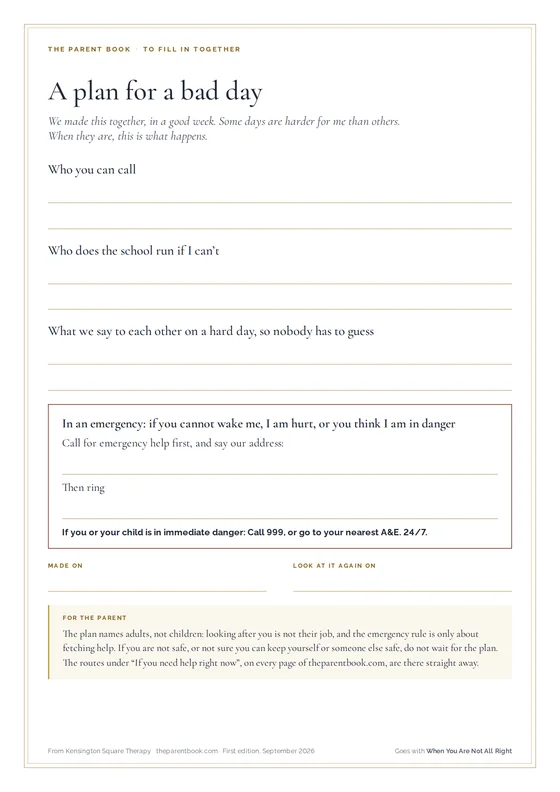 A plan for a bad day
To fill in together · A4 · PDF, 59 KB · Free
A plan for a bad day
To fill in together · A4 · PDF, 59 KB · Free
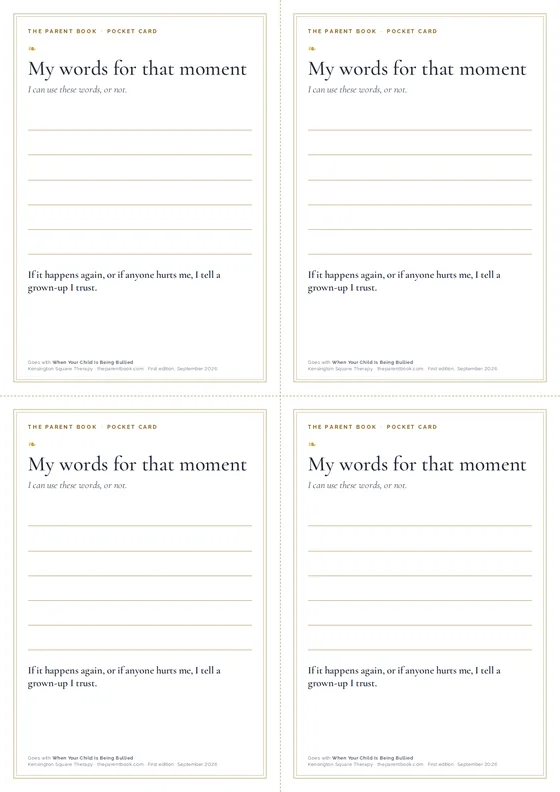 My words for that moment
Pocket card · A4, four cards to cut · PDF, 46 KB · With a subscription
My words for that moment
Pocket card · A4, four cards to cut · PDF, 46 KB · With a subscription
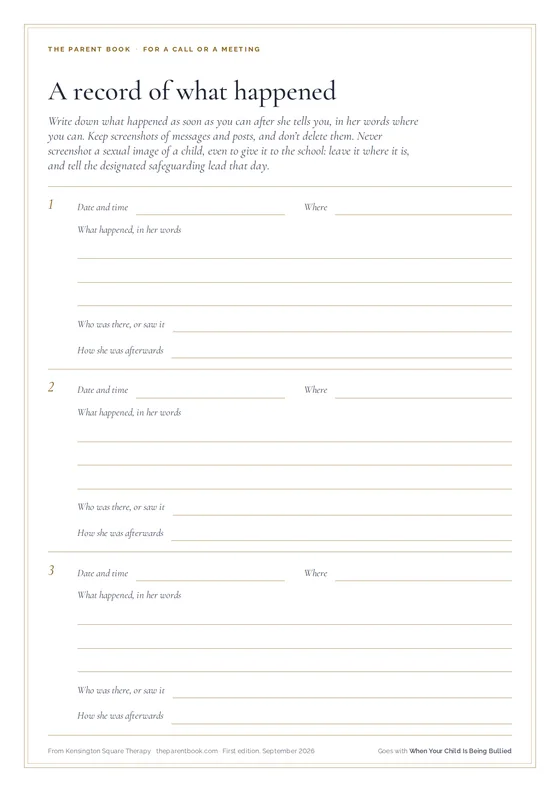 A record of what happened
For a call or a meeting · A4, two pages · PDF, 57 KB · Free
A record of what happened
For a call or a meeting · A4, two pages · PDF, 57 KB · Free
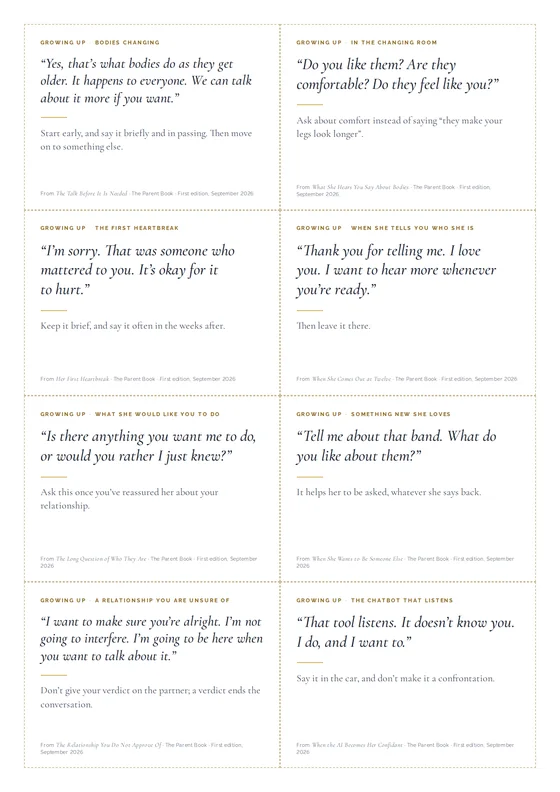 What to say: growing up
Cards to cut out · A4, eight cards to cut · PDF, 62 KB · With a subscription
What to say: growing up
Cards to cut out · A4, eight cards to cut · PDF, 62 KB · With a subscription
Worry, mood and big feelings
AnxietyEmotional regulationCo-regulationGeneral mental healthTrauma