
Co-regulation
Co-regulation
Co-regulation is the basic mechanism behind most of the advice in this library: a child’s nervous system takes its lead from yours. There’s no script for it. What helps is a slower breath, a lower voice, your feet on the floor, and learning to settle yourself first so the people around you can settle too.
What the library says about this, on one page. It is also online at theparentbook.com/help/co-regulation
What to do first
The instruction to stay calm is true but useless. What actually works is smaller and more physical than that, and you can do it while feeling anything but calm.
- Sit down: being lower than a distressed child does more to settle things than anything you say.
- Before you speak, breathe out slowly once. Her nervous system is responding to yours more than to your argument.
- Stay with her: what she learns from this is whether the adult next to her left.
Some tips to try
Short pieces from the library, and a first thing to try from each.
-
The Tantrum Over the Broken Banana.
A broken banana is more than a tired three-year-old can take.
- Get down lower than she is, and drop your voice.
-
When the Lid Has Flipped.
When a child is overwhelmed, a few words usually reach her better than a lot.
- Make the space safe, and move anything that can hurt.
-
The Three-Year-Old Who Hits.
Stop the hit first, then help her find words for what she was feeling.
- Stop the hit calmly: “I won’t let you hit. Hitting hurts.”
- Notice when and where it happens; ask for help if it is persistent or unsafe.
- If it is frequent, severe, causing injury, happening in more than one place, or leaving you unable to keep everyone safe, ask for help: the nursery, your health visitor or your GP.
The rest of each tip, with more to try and why it works, is in the library.
Something to do together
A place to settle, with you nearby. A comfortable corner, chosen with her, for when a feeling gets too big. While she is small you go there together, and nobody is ever sent there.
What it is for. When a young child has a feeling too big for her to manage yet, she settles by being close to a calmer adult. A familiar place makes that easier to reach for, and in time it can become hers.
- The first step. Choose the place with her on a calm day, somewhere you usually are.
Safety. Nothing that runs on button batteries, no hot lamps or trailing flexes, and nothing small enough to swallow where there are children under three.
When to get help. If the meltdowns are becoming more frequent, longer or harder to come back from over several weeks, or she hurts herself or others in them, talk to your GP and her school. If something she says while settling suggests that someone is hurting her, that she is hurting herself, or that she does not want to be alive, stay calm, thank her for telling you, do not promise to keep it secret, and act that day, using the routes under “If you need help right now”, at the foot of every page.
The other four steps, and your part in it, are in the library.
If you want to read further
- Big Feelings and Co-Regulation. For parents whose child has just had a meltdown, on how to help her through it. theparentbook.com/reader/big-feelings-and-co-regulation
Worth your time
- A book for you: Brain-Body Parenting, Mona Delahooke. A child psychologist explains how a child’s nervous system drives much of what looks like misbehaviour, and how a parent’s own calm helps a child settle. Especially useful for sensitive or neurodivergent children. uk.bookshop.org/p/books/brain-body-parenting-how-to-stop-managing-behaviour-and-start-raising-joyful-resilient-kids-mona-delahooke/ce1cfa4681c610cd
- A book to read together: I Am Peace: A Book of Mindfulness, Susan Verde. A child whose thoughts race ahead learns to slow down by breathing, noticing and feeling the ground underfoot. Short, calm pages that can double as a wind-down routine you do together. uk.bookshop.org/p/books/i-am-peace-a-book-of-mindfulness-susan-verde/29c1f0c3f62e487f
- Something to watch: What is Self Reg? Dr. Stuart Shanker Explains, Dr Stuart Shanker, YouTube. Stuart Shanker explains the difference between self-regulation and self-control, and why a child who ‘misbehaves’ may be overwhelmed by stress rather than wilful. The core idea behind Self-Reg. www.youtube.com/watch?v=hOlV_kNYAYA
- Something to listen to: Dr Sarah Mundy on Anger, Big Feelings & Resilience, Made by Mammas: The Podcast, 56 min. A clinical psychologist on anger, big feelings and resilience in children, in a longer conversation. open.spotify.com/episode/73N5hdUrwViEW9UoR25Md4
Who else can help
This usually starts at school rather than at the surgery. The adults who see your child every day are the first people to tell, and often the fastest route to a change. The GP is there if it persists or deepens.
- Your child’s school. The pastoral lead, the head of year, or the form tutor. Free, already knows your child, and often the quickest way to get something changed at school. Before or alongside anything else. A school cannot act on what it has not been told, and what you bring is often what it did not have.
- Your GP. The gateway to everything the NHS offers a child: paediatric assessment, a referral to CAMHS, and support for you as the parent. Ask for a double appointment. Describe the pattern over weeks rather than the worst single day, and say plainly what you are worried about. Bring a written list; the ten minutes go quickly. www.nhs.uk/service-search/find-a-gp
- Anna Freud. The Anna Freud Centre’s family wellbeing resources: careful, research-led reading on children’s emotional development, separation, self-care for parents, and supporting a child through treatment. When you want depth from a clinical source rather than a quick explainer. Reading only; there is no helpline. www.annafreud.org/resources/family-wellbeing
- Place2Be. Parenting Smart, written by the child mental health specialists who work in primary schools: short, practical articles and films on friendships, behaviour, worries and routines. For a child of five to eleven, when you want something you can read in ten minutes and try tonight. Place2Be’s counselling itself is only through partner schools. parentingsmart.place2be.org.uk
- Action for Children Parent Talk. A free one-to-one webchat with a trained parenting coach, and a library of articles by age on behaviour, sleep, neurodiversity and family life. When you want to talk it through with someone in writing, this week, without a referral. Free one-to-one webchat with a parenting coach, Mon-Fri, with evening slots on Mon and Thu; check the site for current times · Parent Talk+ by phone or video for parents of children with additional needs, up to eight free sessions parents.actionforchildren.org.uk
The full list for co-regulation, with what each organisation does and when it is the right call, is at theparentbook.com/help/co-regulation/services
Published by Kensington Square Therapy. Company No. 16707111. Written by therapists registered with the British Association for Counselling and Psychotherapy (BACP) and the National Counselling and Psychotherapy Society (NCPS). This page is not therapy, and not a substitute for professional support. The full library is at theparentbook.com.
Everything the library holds on co-regulation
Go further
Quick tips
- The Tantrum Over the Broken BananaA broken banana is more than a tired three-year-old can take.
- When the Lid Has FlippedWhen a child is overwhelmed, a few words usually reach her better than a lot.
- The Three-Year-Old Who HitsStop the hit first, then help her find words for what she was feeling.
- The Two-Year-Old in TearsCrying is how a two-year-old tells you what she can’t yet put into words.
- Making Home Easier on Her SensesBy bath time she has been processing sensory input for eleven hours, and a few changes at home help.
- The Body Too Awake for BedtimeIf your child is too wound up to sleep, slow yourself down at bedtime.
- When You Have SnappedAfter you’ve snapped at your child, go back, apologise and put it right.
- She Follows You From Room to RoomAfter something hard, a young child needs adults who are predictable, calm and in the room with her.
- The Meltdown in PublicIn the middle of it she can’t listen, so the next ten minutes are for getting her safe and calm, and the talking comes later.
- When She Is Frightened at NightAt this age a monster can feel real, so what settles her is a room that stays the same all night and a parent who comes back when promised.
All 14 quick tips on co-regulation
Quick tips open with a subscription.
Things to do together
- A place to settle, with you nearbyA comfortable corner, chosen with her, for when a feeling gets too big. While she is small you go there together, and nobody is ever sent there.
- Hands busy, side by sideColour, build or make things side by side, each of you on your own thing. Nothing is asked of her, and nothing she makes is marked.
- The last half-hour before bedChoose the last half-hour before bed with her, write it down in order and put it on the fridge. Then do it in that order most nights, slowly.
- Where a feeling sitsOn a plain outline of a body, she marks where she first notices anger, worry and sadness.
Activities open with a subscription.
To print
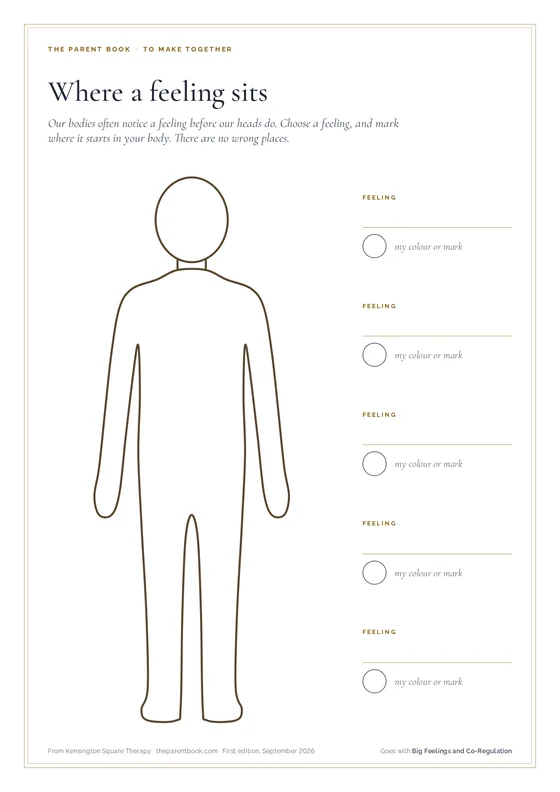 Where a feeling sits
To make together · A4, two sides · PDF, 62 KB · With a subscription
Where a feeling sits
To make together · A4, two sides · PDF, 62 KB · With a subscription
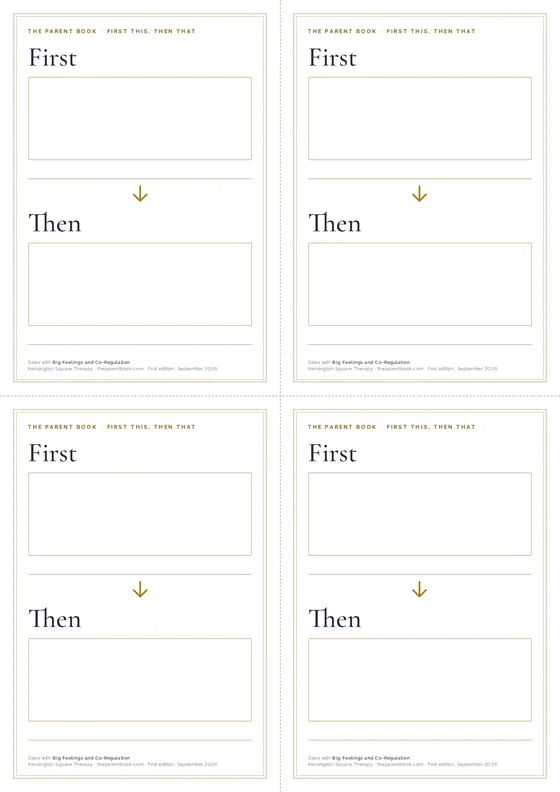 First this, then that
Cards to cut out · A4, four cards to cut, two sides · PDF, 64 KB · With a subscription
First this, then that
Cards to cut out · A4, four cards to cut, two sides · PDF, 64 KB · With a subscription
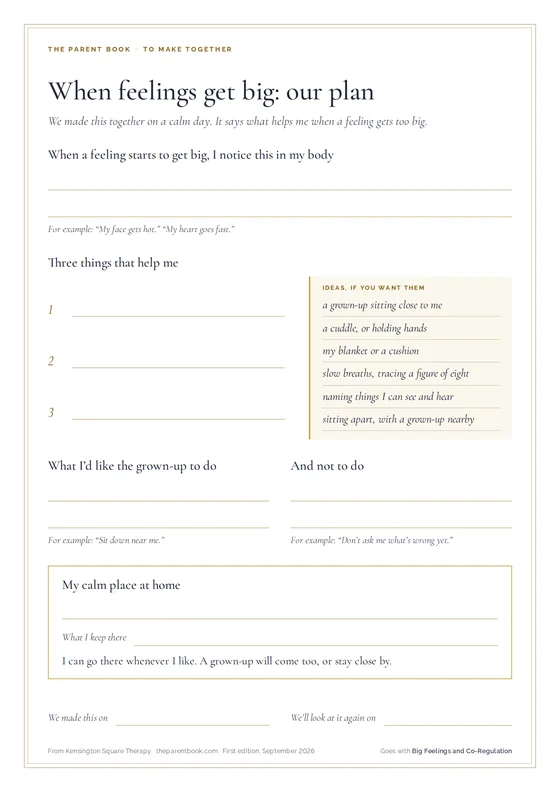 When feelings get big: our plan
To make together · A4, two sides · PDF, 66 KB · With a subscription
When feelings get big: our plan
To make together · A4, two sides · PDF, 66 KB · With a subscription
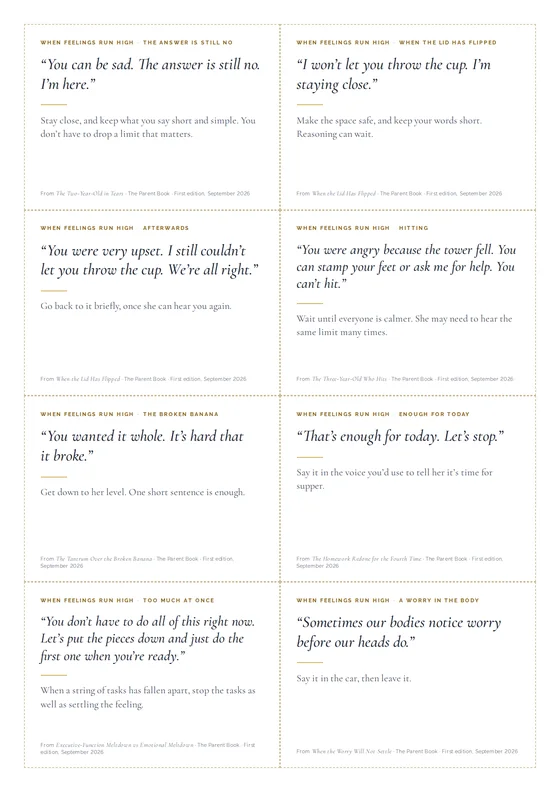 What to say: when feelings run high
Cards to cut out · A4, eight cards to cut · PDF, 61 KB · With a subscription
What to say: when feelings run high
Cards to cut out · A4, eight cards to cut · PDF, 61 KB · With a subscription
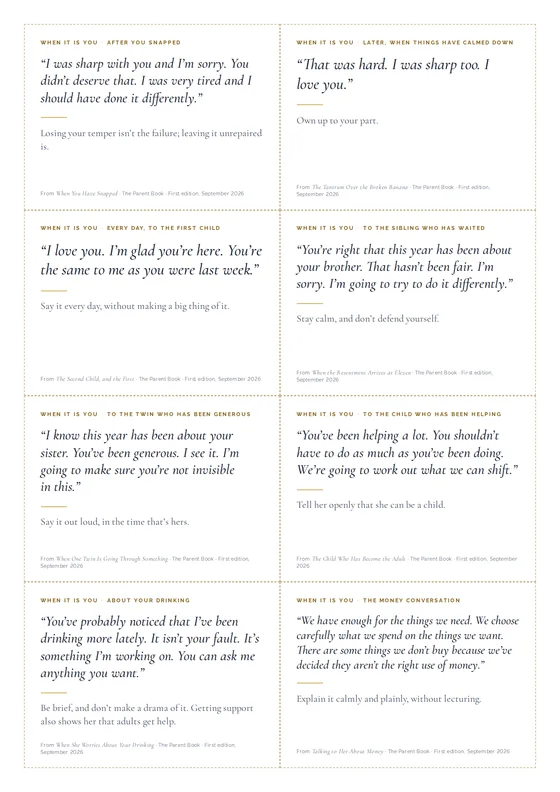 What to say: when it is you
Cards to cut out · A4, eight cards to cut · PDF, 62 KB · With a subscription
What to say: when it is you
Cards to cut out · A4, eight cards to cut · PDF, 62 KB · With a subscription
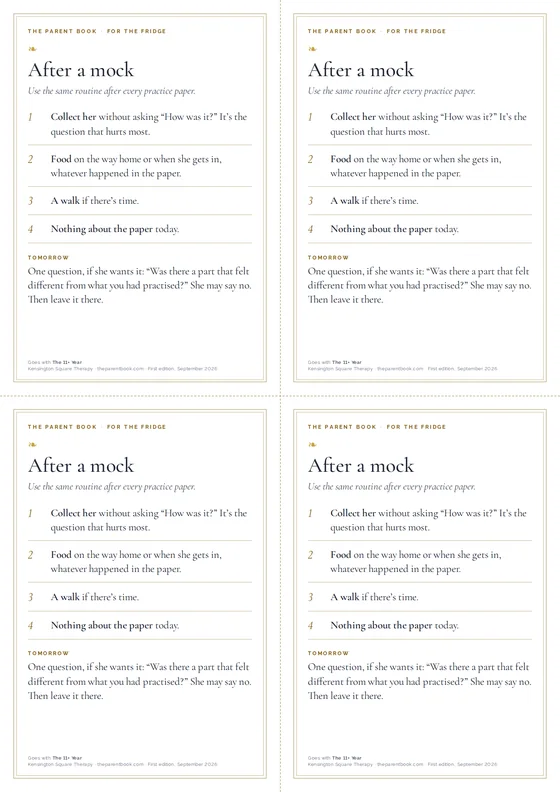 After a mock
For the fridge · A4, four cards to cut · PDF, 55 KB · With a subscription
After a mock
For the fridge · A4, four cards to cut · PDF, 55 KB · With a subscription
Worry, mood and big feelings
AnxietyLow moodEmotional regulationGeneral mental healthTrauma
Every subjectWho else can help with co-regulationUrgent help