
School stress
School stress
This covers homework, exams and the teacher who doesn’t seem to notice her. Outside the home, school is the biggest part of most children’s lives, and these pages are for the parent trying to work out when to push, when to back off and when to pick up the phone.
What the library says about this, on one page. It is also online at theparentbook.com/help/school-stress
What to do first
A child who is struggling at school is very rarely a child who isn’t trying. Something has become harder than she can manage right now, and that’s information you can use.
- Take the physical symptoms seriously. The Sunday stomach ache is real, and it’s telling you something before she can.
- For a fortnight, take the pressure off at home: ask fewer questions about homework at the table, and spend more time on things that have nothing to do with school.
- Email the form tutor and ask a specific question: what does the day actually look like for her, and what has the school already tried?
What helps
- Let home be where she can stop working. The school, the class teacher and the in-school enrichment that the year is built around will cover the academic preparation. Your job is to make home feel different from that, so she has somewhere to recover.
- Praise effort and behaviour. “You kept going when that question was hard.” “You were kind to your sister tonight.” Say exactly what you saw, without judging how good it was. Praise that depends on outcomes adds pressure.
- Listen first, advise second. Sit down, and don’t argue with the feeling: “That sounds really hard. Tell me what happened.” Let them finish before you offer a single suggestion.
- Make home a secure base. Children with a stable home are very good, in time, at finding friends they fit with. Time you put into home life helps them socially too.
Some tips to try
Short pieces from the library, and a first thing to try from each.
-
Say What You Have Noticed.
When you ring the school, describe what you’ve seen, with dates, so staff know what to look for.
- Before you ring, write down what you’ve noticed, with dates.
- Start with the form tutor, and go to the head of year if it’s wider or isn’t improving.
- For most things, start with her form tutor, who sees her every day. If it’s about more than one lesson, or isn’t getting better, go to the head of year. If she has, or may have, a special educational need, go to whoever leads learning support. If it is about her safety, or about how a member of staff has treated her, do not start with the form tutor: ask for the designated safeguarding lead that day. And tell the school, briefly, about anything that’s changing at home, because a school can only allow for what it knows.
-
When the School Gets Your Role Wrong.
The school may still treat you as the grandparent, even though you’re now the parent as well.
- Send the school a written introduction with the legal documents attached.
- Update all contact information; meet the class teacher before term begins.
- Forms go to the absent parent, requests for permission go through the wrong channel, and the school nurse rings a mobile number that hasn’t been updated.
-
When the Teacher Is the Problem.
Take her seriously without taking sides, and listen for specific incidents you can act on.
- Listen for the specific incident, not the general feeling.
- Talk to the teacher in person, with curiosity, not accusation.
- Treat the teacher as a colleague, not an opponent.
The rest of each tip, with more to try and why it works, is in the library.
Something to do together
A day with no 11+ in it. One day a week, and a few evenings, with no papers, no practice and no talk of the test. Keep it most weeks, and let it go when a week slips.
What it is for. A child preparing for an entrance test needs regular evidence that there is more to her than the test. A day off from it each week helps keep the test in proportion, for her and for you.
- The first step. Choose the day, and three evenings, when the preparation stops. Tell her once, calmly: “On Saturdays there’s no 11+: no work, and no talking about it.”
Safety. If she helps at the hob, an adult stays beside her and handles the hot pan.
When to get help. If she is sick or sleeping badly before tests, the worry is getting worse, or it is affecting her eating or her wish to go to school, talk to her school and your GP. The routes under “If you need help right now”, at the foot of every page, are for when it cannot wait.
The other four steps, and your part in it, are in the library.
If you want to read further
- What to Do When School Is the Problem. For parents whose child has started dreading school. theparentbook.com/reader/what-to-do-when-school-is-the-problem
- The 11+ Year. For parents whose child is preparing for school entrance exams. theparentbook.com/reader/eleven-plus-and-the-pressure-of-the-thing-ahead
Worth your time
- A book for you: Never Enough, Jennifer Breheny Wallace. Journalist Jennifer Breheny Wallace, drawing on Suniya Luthar’s research, shows why children in high-achieving schools are at raised risk of distress, and why feeling that they matter at home protects them.
- A book to read together: Starving the Stress Gremlin, Kate Collins-Donnelly. A CBT workbook for ages 10 and up on what stress is, how it shows in body and mind, and how to manage it. Useful in the run-up to exams or a school move. uk.bookshop.org/p/books/starving-the-stress-gremlin-a-cognitive-behavioural-therapy-workbook-on-stress-management-for-young-people-kate-collins-donnelly/986f1a08e841272a
- Something to watch: When Kids Refuse To Go To School | Child Mind Institute, Child Mind Institute, YouTube. A specialist explains why children refuse school, usually anxiety rather than defiance, and why a gradual, planned return with the school works better than waiting it out. www.youtube.com/watch?v=UC_SIxCx1U8
- Something to listen to: “She loved school until she didn’t”: the complex reality of school avoidance, Kooth Podcast, 29 min. Maddie describes how anxiety gradually stopped her going to school despite loving learning, what school felt like, and what she would tell her younger self. A young person’s view parents rarely hear. podcasts.apple.com/gb/podcast/she-loved-school-until-she-didnt-the-complex-reality/id1547256556?i=1000703585948
Who else can help
This usually starts at school rather than at the surgery. The adults who see your child every day are the first people to tell, and often the fastest route to a change. The GP is there if it persists or deepens.
- Your child’s school. The pastoral lead, the head of year, or the form tutor. Free, already knows your child, and often the quickest way to get something changed at school. Before or alongside anything else. A school cannot act on what it has not been told, and what you bring is often what it did not have.
- The SENCo at your child’s school. The member of staff responsible for special educational needs. They hold the assessment routes, the in-school support, and the paperwork an EHCP needs. Ask for a meeting in writing, and ask what is already being tried under the graduated approach. This conversation usually has to happen before anything statutory can.
- Place2Be. Parenting Smart, written by the child mental health specialists who work in primary schools: short, practical articles and films on friendships, behaviour, worries and routines. For a child of five to eleven, when you want something you can read in ten minutes and try tonight. Place2Be’s counselling itself is only through partner schools. parentingsmart.place2be.org.uk
- YoungMinds. The UK’s young people’s mental health charity, with a free Parents Helpline, webchat and email, and a plain A to Z of the things parents worry about. When you want to talk through a worry about your child with someone who has heard it before, or read a clear first explanation of a named concern. Not a crisis line. Parents Helpline 0808 802 5544 · Mon, Thu, Fri 9.30am-4pm; Tue, Wed 9.30am-6pm · Webchat Mon-Fri 9.30am-4pm; email parents@youngminds.org.uk · Outside those hours the parents line is closed. The urgent routes on this page are open when it is not. www.youngminds.org.uk/parent/parents-helpline
- NHS: mental health advice for parents and carers. The NHS’s pages for parents, in one place: anxiety, low mood, anger, bereavement, arguments with teenagers, exam stress, and how to talk about feelings. When you want the NHS’s own account before anyone else’s. www.nhs.uk/mental-health/children-and-young-adults/advice-for-parents
The full list for school stress, with what each organisation does and when it is the right call, is at theparentbook.com/help/school-stress/services
Published by Kensington Square Therapy. Company No. 16707111. Written by therapists registered with the British Association for Counselling and Psychotherapy (BACP) and the National Counselling and Psychotherapy Society (NCPS). This page is not therapy, and not a substitute for professional support. The full library is at theparentbook.com.
Everything the library holds on school stress
Go further
Chapters
- What to Do When School Is the ProblemFor parents whose child has started dreading school.
- The 11+ YearFor parents whose child is preparing for school entrance exams.
- The Move to Secondary SchoolFor parents whose child is about to go from being one of the oldest in her school to one of the youngest.
- When Your Child Is Being BulliedFor parents whose child has just told them she is being bullied.
- When Reassurance Stops WorkingFor parents whose child is anxious and can’t be talked out of it, however often the adults around her try.
- Neurodiversity, and the Conversation with the SchoolFor parents whose child has been working harder and longer than other children to do things that come more easily to them.
- Anxiety, by AgeFor parents whose child’s worry has started to make decisions for her, with what helps at each age and when to ask for help.
Quick tips
- Say What You Have NoticedWhen you ring the school, describe what you’ve seen, with dates, so staff know what to look for.
- When the School Gets Your Role WrongThe school may still treat you as the grandparent, even though you’re now the parent as well.
- When the Teacher Is the ProblemTake her seriously without taking sides, and listen for specific incidents you can act on.
- When the School Does Not See HerIf a school misreads your child’s culture, specific examples usually help it adjust.
- School Re-entry After a Long AbsenceAfter a long absence, her place at school is still there, but stepping back into it takes planning.
- She Has Just Told You About the BullyingWhat you do in the first ten minutes decides whether she tells you the next thing.
- Sunday Evening Has Started HurtingWhen Sunday evenings start to hurt, there is usually more than one reason, so slow down before deciding which conversation to have.
- Talking About the Apprenticeship RouteAn apprenticeship deserves the same care you’d give to choosing a university.
- The Homework Redone for the Fourth TimeIf your child keeps redoing her homework because it isn’t perfect, end the session for her.
- The PE Kit Left on the BusPack the bag together for a few weeks, then hand the job to her on a date you’ve set.
All 37 quick tips on school stress
Quick tips open with a subscription.
Things to do together
- A day with no 11+ in itOne day a week, and a few evenings, with no papers, no practice and no talk of the test. Keep it most weeks, and let it go when a week slips.
- After a mockThe same routine after every practice paper: collect her, give her something to eat, walk home, and ask nothing about the paper that day.
- The school day, drawn as a lineShe draws her day from gate to gate and marks where it feels heavy. You take the one moment she marks, not a conclusion, to the school.
- An hour off after schoolFor the child who holds it together at school and comes apart at home. The first hour back asks nothing of her: something to eat, somewhere to recover, and no questions yet.
- The route, twice, and the mapBefore term, do the route once together and once with her leading, and draw the few rooms that matter.
- A mistake each, at a weekly mealOnce a week, at one meal, everyone says one thing they got wrong, starting with you. Nobody comments on anyone else’s.
- A page about me, for a new teacherBefore a new class or a new school, she tells her teacher, in her own words, what she enjoys, what she finds hard and what helps. You write it down together and hand it in.
- Running the moment throughOn a calm day, you play the other child and she tries out what she might say. Keep it short and light, and do it once or twice at most.
Activities open with a subscription.
To print
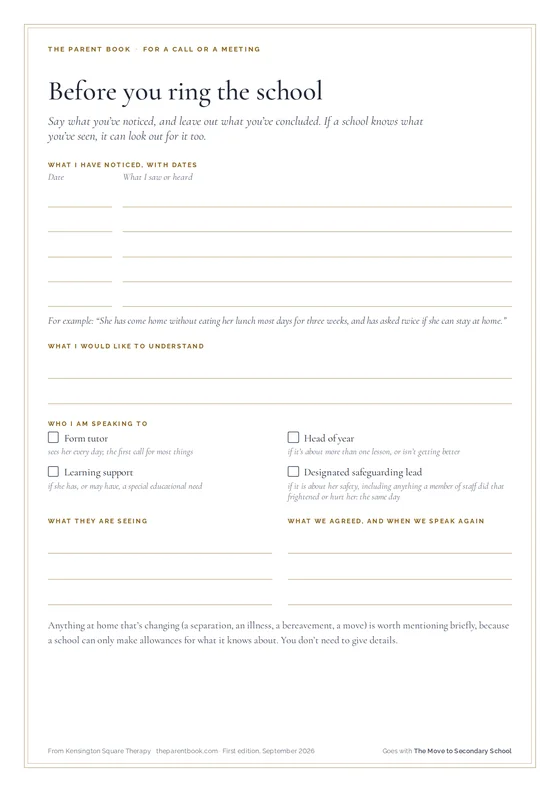 Before you ring the school
For a call or a meeting · A4 · PDF, 58 KB · Free
Before you ring the school
For a call or a meeting · A4 · PDF, 58 KB · Free
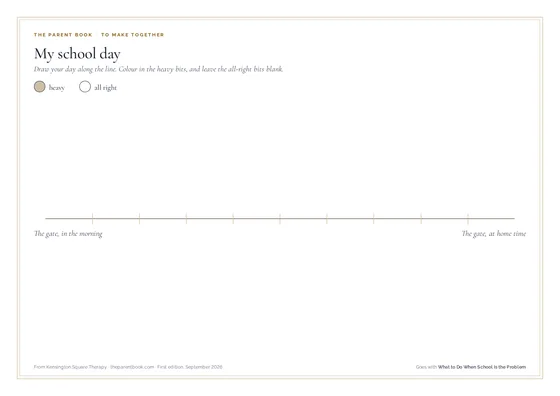 The school day, drawn as a line
To make together · A4 landscape, two pages · PDF, 63 KB · With a subscription
The school day, drawn as a line
To make together · A4 landscape, two pages · PDF, 63 KB · With a subscription
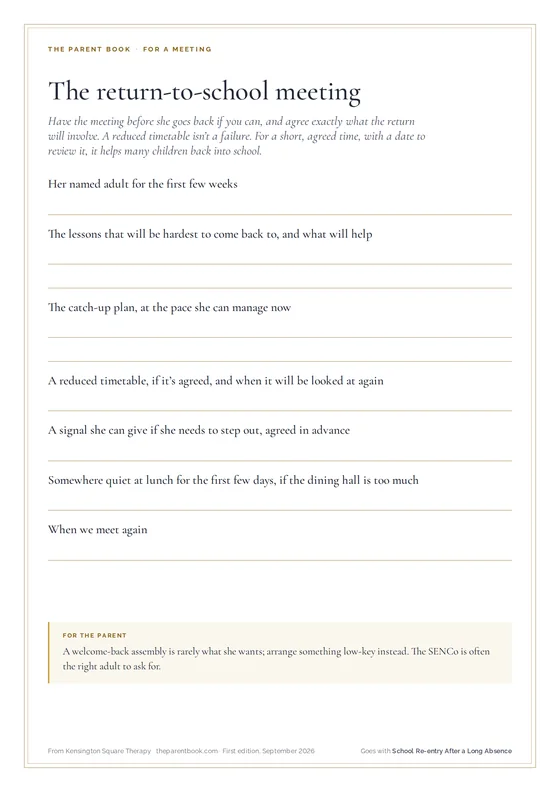 The return-to-school meeting
For a meeting · A4 · PDF, 49 KB · Free
The return-to-school meeting
For a meeting · A4 · PDF, 49 KB · Free
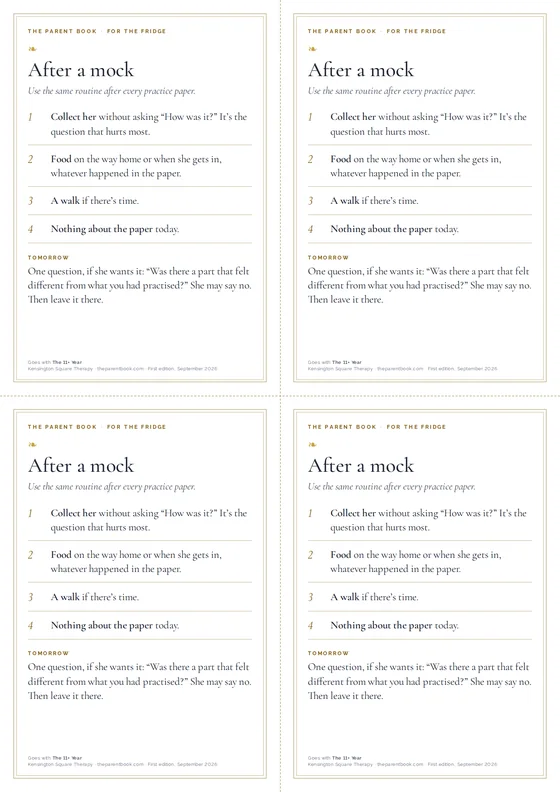 After a mock
For the fridge · A4, four cards to cut · PDF, 55 KB · With a subscription
After a mock
For the fridge · A4, four cards to cut · PDF, 55 KB · With a subscription
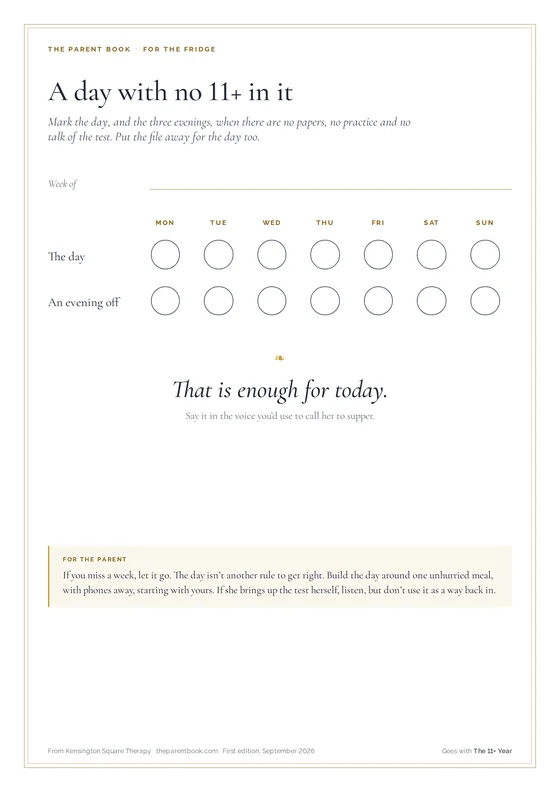 A day with no 11+ in it
For the fridge · A4 · PDF, 66 KB · With a subscription
A day with no 11+ in it
For the fridge · A4 · PDF, 66 KB · With a subscription
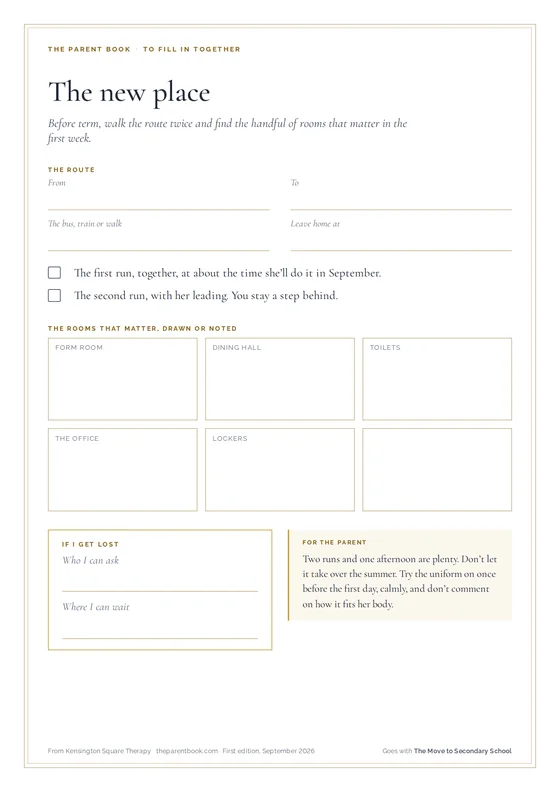 The new place
To fill in together · A4 · PDF, 52 KB · With a subscription
The new place
To fill in together · A4 · PDF, 52 KB · With a subscription
School and pressure
Every subjectWho else can help with school stressUrgent help