Transitions
Transitions
This covers the moves a child makes through childhood: from nursery to reception, from primary to secondary, and from sixth form to whatever comes next. Each change asks something of the whole family as well as the child. These pages are for parents in the weeks before and after, while the new routine settles.
What the library says about this, on one page. It is also online at theparentbook.com/help/transitions
What to do first
Children handle change better when the adults around them are honest about it and aren’t relentlessly upbeat. A wobble at a transition is normal; it’s what a real change costs.
- Go through the timetable out loud, in plain terms, including what you don’t know yet. Uncertainty a child can put into words is easier for her than uncertainty she can only feel.
- Keep two or three family routines exactly as they are through the change: the bedtime book, Saturday mornings, the same supper on the same night each week.
- Tell the new school, or the old one, what’s happening, so that someone other than you is keeping an eye on her.
What helps
- Keep the last week before the change predictable. Don’t fill it with new things. A child accepts a change more easily when the days leading up to it are familiar, and routine is comforting in itself.
- Get to know what’s coming. Walk past the new school, find the classroom on the website and lay out the uniform together. Children settle as the unknown becomes a little more familiar.
Some tips to try
Short pieces from the library, and a first thing to try from each.
-
The First Phone Call Back.
A short, slightly distracted first call from university is a good sign that she’s settling in.
- Take the call at face value; a brief call is a good sign.
-
The Week Before She Leaves.
The week before she leaves for university is one of the hardest; do less than you think it needs.
- Do less than you think the week needs.
-
Leaving the House She Loved.
Give her time to say goodbye to the places she loved before the boxes go.
- Photograph the doorframe, the garden corner and the view from her window.
The rest of each tip, with more to try and why it works, is in the library.
Something to do together
A page about me, for a new teacher. Before a new class or a new school, she tells her teacher, in her own words, what she enjoys, what she finds hard and what helps. You write it down together and hand it in.
What it is for. A new teacher starts the year not knowing what helped her last year. YoungMinds advises parents to tell school staff early what their child finds difficult and what helps. A page in her own words does that before term starts, and gives her a say in what her new teacher is told about her.
- The first step. Choose a calm afternoon a week or two before the new class or school starts, and ask: “Your new teacher doesn’t know you yet. Shall we make a page for them about what helps you?”
Safety. Medical needs, such as allergies, asthma or medicines, go to the school from you directly and not on her page, so that the right people have them. The page has her name and perhaps her photograph on it. Hand it in or send it by school email, and don’t post it anywhere public.
When to get help. If, several weeks into the year, she is dreading school, has stomach aches on school mornings or says the teacher doesn’t understand her, talk to her class teacher and, if she has or may have special educational needs, the SENCo. If the stomach aches keep coming back, or her sleep, eating or mood have changed and not changed back, talk to your GP as well. If what she writes or says suggests that someone is hurting her, that she is hurting herself, or that she does not want to be alive, stay calm, thank her for telling you, do not promise to keep it secret, and act that day, using the routes under “If you need help right now”, at the foot of every page.
The other five steps, and your part in it, are in the library.
If you want to read further
- The 11+ Year. For parents whose child is preparing for school entrance exams. theparentbook.com/reader/eleven-plus-and-the-pressure-of-the-thing-ahead
- The Move to Secondary School. For parents whose child is about to go from being one of the oldest in her school to one of the youngest. theparentbook.com/reader/the-move-to-secondary-school
Worth your time
- A book for you: Middle School Matters, Phyllis L. Fagell. Drawing on years of work in schools, Phyllis Fagell guides parents through ages 10 to 14, including the move to secondary school, friendship upheaval, good decision-making and learning from failure.
- A book to read together: I Am Too Absolutely Small for School, Lauren Child. Lola is sure she is too small for school, and her big brother Charlie answers each worry with patience and humour. A funny, reassuring book for the months before a child starts Reception. uk.bookshop.org/p/books/charlie-and-lola-i-am-too-absolutely-small-for-school-lauren-child/c69f29470a1f135c
- Something to watch: Moving Up! The transition to secondary school, Anna Freud, YouTube. An animation for Year 6 and 7 pupils about the move to secondary school, the worries that are normal and what helps. Good to watch together in the summer before. www.youtube.com/watch?v=kFpVOIpeksk
- Something to listen to: Let’s Talk Back-to-School, Good Inside with Dr. Becky, 29 min. Why a new school year unsettles children and parents alike, why younger behaviour can come back, and routines that keep things steady. podcasts.apple.com/gb/podcast/lets-talk-back-to-school/id1561689671?i=1000722610833
Who else can help
Most transitions are handled best by the two institutions on either side of them. Tell both schools what you are seeing; they will have seen it before.
- Your child’s school. The pastoral lead, the head of year, or the form tutor. Free, already knows your child, and often the quickest way to get something changed at school. Before or alongside anything else. A school cannot act on what it has not been told, and what you bring is often what it did not have.
- Your GP. The gateway to everything the NHS offers a child: paediatric assessment, a referral to CAMHS, and support for you as the parent. Ask for a double appointment. Describe the pattern over weeks rather than the worst single day, and say plainly what you are worried about. Bring a written list; the ten minutes go quickly. www.nhs.uk/service-search/find-a-gp
- Place2Be. Parenting Smart, written by the child mental health specialists who work in primary schools: short, practical articles and films on friendships, behaviour, worries and routines. For a child of five to eleven, when you want something you can read in ten minutes and try tonight. Place2Be’s counselling itself is only through partner schools. parentingsmart.place2be.org.uk
- YoungMinds. The UK’s young people’s mental health charity, with a free Parents Helpline, webchat and email, and a plain A to Z of the things parents worry about. When you want to talk through a worry about your child with someone who has heard it before, or read a clear first explanation of a named concern. Not a crisis line. Parents Helpline 0808 802 5544 · Mon, Thu, Fri 9.30am-4pm; Tue, Wed 9.30am-6pm · Webchat Mon-Fri 9.30am-4pm; email parents@youngminds.org.uk · Outside those hours the parents line is closed. The urgent routes on this page are open when it is not. www.youngminds.org.uk/parent/parents-helpline
The full list for transitions, with what each organisation does and when it is the right call, is at theparentbook.com/help/transitions/services
Published by Kensington Square Therapy. Company No. 16707111. Written by therapists registered with the British Association for Counselling and Psychotherapy (BACP) and the National Counselling and Psychotherapy Society (NCPS). This page is not therapy, and not a substitute for professional support. The full library is at theparentbook.com.
Everything the library holds on transitions
Go further
Chapters
- The 11+ YearFor parents whose child is preparing for school entrance exams.
- The Move to Secondary SchoolFor parents whose child is about to go from being one of the oldest in her school to one of the youngest.
- When the Best Friend Moves OnFor parents whose child’s best friend has drifted away, with no falling-out to explain it.
- When They Stop Talking to YouFor parents whose teenager hardly talks to them any more.
- When a Child Is GrievingFor parents whose child has lost someone, or something, that was there last week.
- Anxiety, by AgeFor parents whose child’s worry has started to make decisions for her, with what helps at each age and when to ask for help.
- Neurodiversity, and the Conversation with the SchoolFor parents whose child has been working harder and longer than other children to do things that come more easily to them.
Quick tips
- The First Phone Call BackA short, slightly distracted first call from university is a good sign that she’s settling in.
- The Week Before She LeavesThe week before she leaves for university is one of the hardest; do less than you think it needs.
- Leaving the House She LovedGive her time to say goodbye to the places she loved before the boxes go.
- School Re-entry After a Long AbsenceAfter a long absence, her place at school is still there, but stepping back into it takes planning.
- Talking About the Apprenticeship RouteAn apprenticeship deserves the same care you’d give to choosing a university.
- The PE Kit Left on the BusPack the bag together for a few weeks, then hand the job to her on a date you’ve set.
- The Question at the School GateIn the first weeks at a new school, children are often too tired to answer questions at the gate.
- The Year Out ConversationA year out is her decision to make; your part is to ask her calmly what she is thinking.
- The First 48 Hours BackAfter a long time apart, everyone at home has changed a little, and nobody wants to say so.
- When Exam Prep Takes Over the HousePut the admissions file away three evenings a week, so she isn’t doing the test for two people.
All 27 quick tips on transitions
Quick tips open with a subscription.
Things to do together
- A page about me, for a new teacherBefore a new class or a new school, she tells her teacher, in her own words, what she enjoys, what she finds hard and what helps. You write it down together and hand it in.
- Marking the endingIn the last weeks at a school, offer her a few pages for what she will miss, and perhaps a card for a teacher. It is up to her, and she keeps what she makes.
- The route, twice, and the mapBefore term, do the route once together and once with her leading, and draw the few rooms that matter.
- A day with no 11+ in itOne day a week, and a few evenings, with no papers, no practice and no talk of the test. Keep it most weeks, and let it go when a week slips.
Activities open with a subscription.
To print
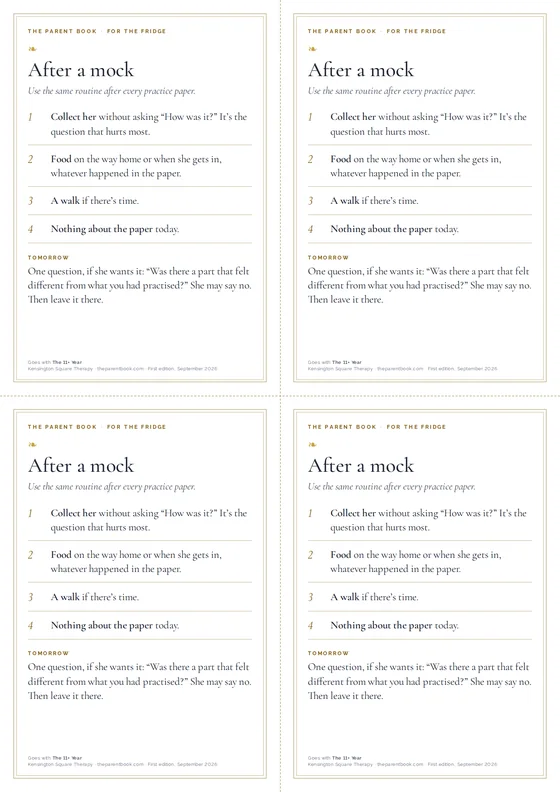 After a mock
For the fridge · A4, four cards to cut · PDF, 55 KB · With a subscription
After a mock
For the fridge · A4, four cards to cut · PDF, 55 KB · With a subscription
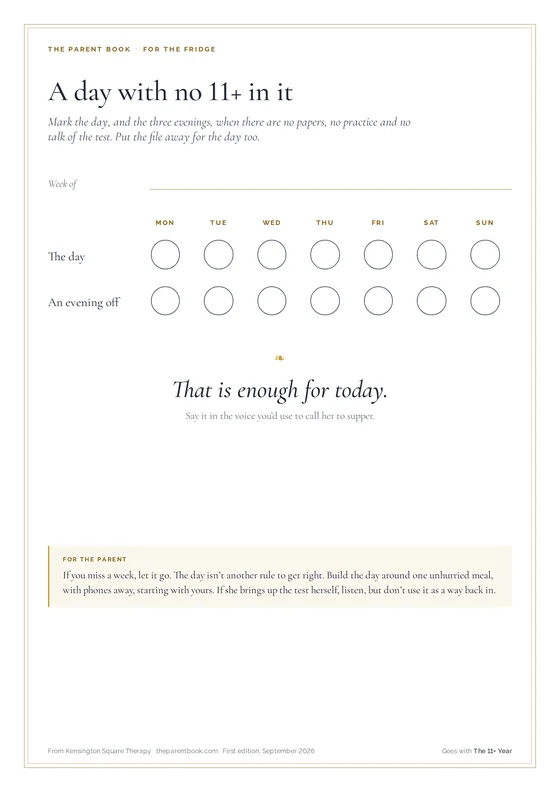 A day with no 11+ in it
For the fridge · A4 · PDF, 66 KB · With a subscription
A day with no 11+ in it
For the fridge · A4 · PDF, 66 KB · With a subscription
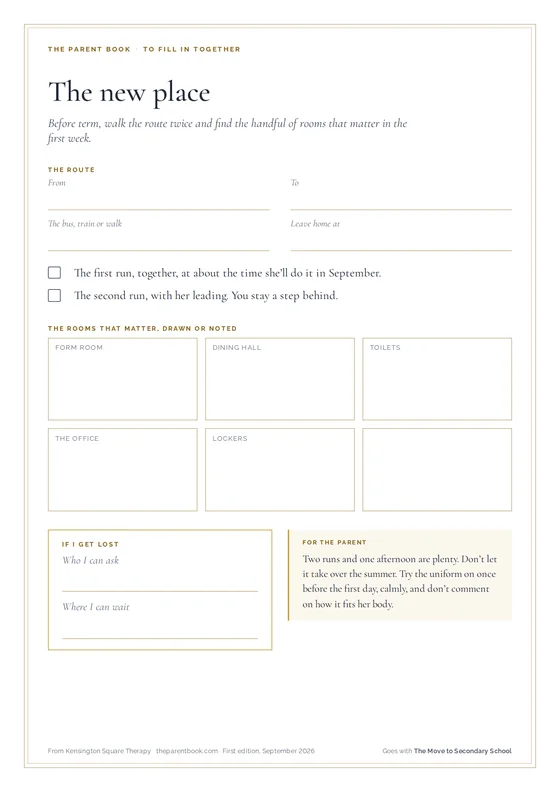 The new place
To fill in together · A4 · PDF, 52 KB · With a subscription
The new place
To fill in together · A4 · PDF, 52 KB · With a subscription
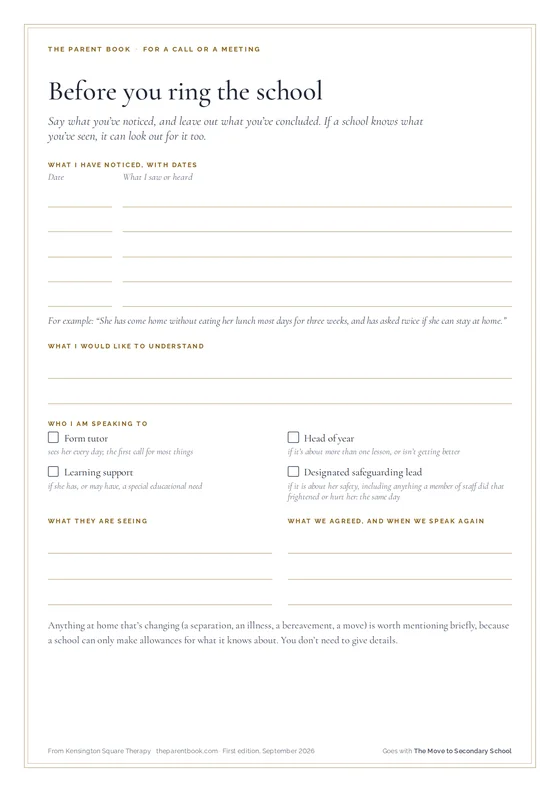 Before you ring the school
For a call or a meeting · A4 · PDF, 58 KB · Free
Before you ring the school
For a call or a meeting · A4 · PDF, 58 KB · Free
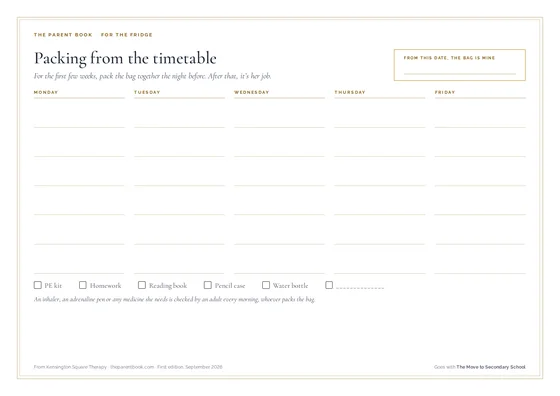 Packing from the timetable
For the fridge · A4 landscape · PDF, 47 KB · With a subscription
Packing from the timetable
For the fridge · A4 landscape · PDF, 47 KB · With a subscription
 What I will miss
To keep · A4, two pages · PDF, 41 KB · With a subscription
What I will miss
To keep · A4, two pages · PDF, 41 KB · With a subscription