Social media
Social media
Most friendships now happen on social media as well as in the playground. These pages cover group chats, follows, who’s in and who’s out, and the constant comparison going on in the background of an eleven-year-old’s evening. They’re for the parent trying to be neither naive nor panicked about the part of her child’s life she can’t see.
What the library says about this, on one page. It is also online at theparentbook.com/help/social-media
What to do first
The feed is designed by people whose job is to keep her attention, and she’s thirteen. If she can’t put it down, that isn’t a flaw in her character.
- Sit next to her and ask her to scroll while you watch. You’re there to understand what she’s actually seeing, not to check up on her.
- Together, unfollow the five accounts that make her feel worst. Choosing what she sees is a skill, and she’ll be more willing to learn it than to be banned.
- Agree one time of day when the phone is somewhere else. Overnight is the one that changes things most.
What helps
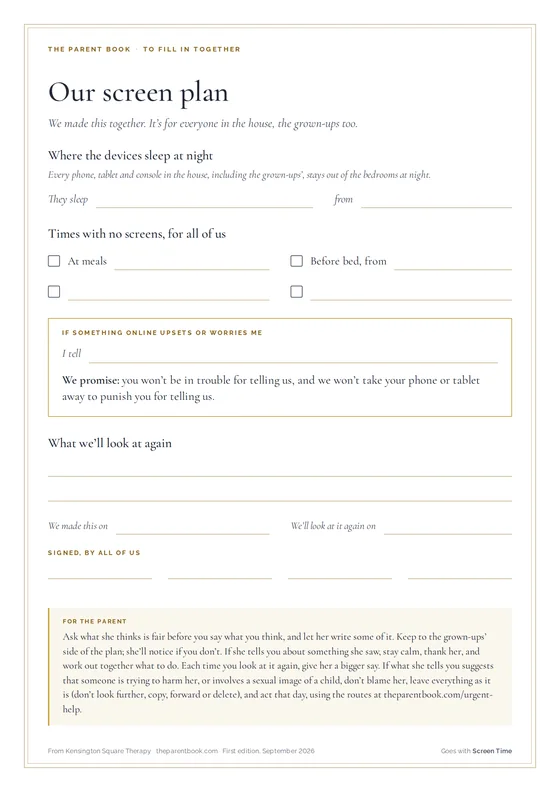
- Keep devices out of bedrooms at night. Charge devices in the kitchen overnight, including yours. What you do counts as much as the rule you set.
- Turn screens off 45 to 60 minutes before bed. The brain needs to wind down before it can sleep. Use the time for reading, a bath or talking together.
Some tips to try
Short pieces from the library, and a first thing to try from each.
-
The Feed Full of Diets and Bodies.
If your daughter’s feed is full of diets and bodies, reset it with her and explain how it works.
- Sit down with her and reset the algorithm together, video by video.
-
The Friends the Algorithm Chose.
The platform chooses what’s in her feed to keep her watching, and it can leave her feeling flat.
- Tell her once, in plain language, what the platform is doing.
-
When the AI Becomes Her Confidant.
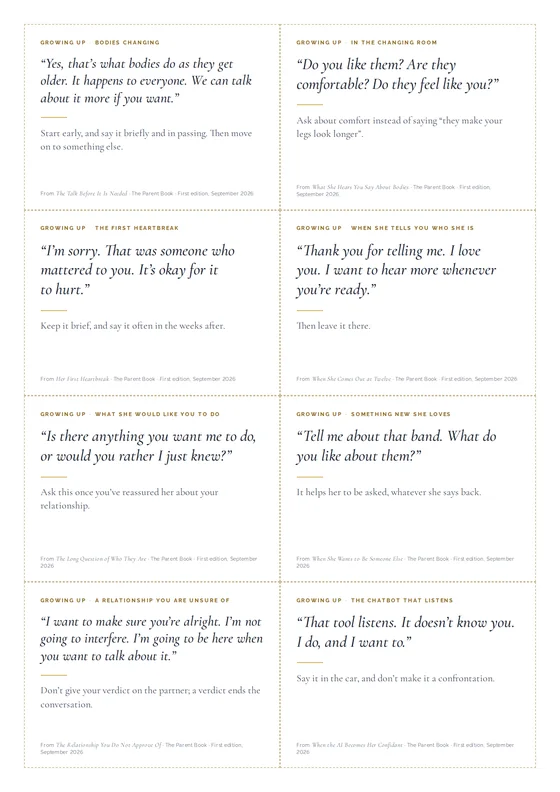
If your child confides in a chatbot, tell her what it is and keep her talking to real people.
- Tell her briefly, in the car, what the chatbot is, without making it a confrontation.
- Make sure she still has people to talk to: you, the school counsellor, a real friend.
- Watch for downloading conversations that an adult should hear.
The rest of each tip, with more to try and why it works, is in the library.
Something to do together
Show me three things. Once a week she shows you three things: the funniest she has seen, the weirdest, and one she thinks you should see. You watch without comment.
What it is for. In our experience, what is on her screen matters more than how long she spends on it. A weekly look, on her terms, lets you be curious without checking up on her, and makes you someone she might tell if something goes wrong.
- The first step. Ask once, casually: “On Sundays, show me three things: the funniest thing you’ve seen this week, the weirdest, and one you think I should see.”
- If something worries you, try not to let it show. Most worries about content can wait until another day, when you can raise them in passing. Sexual or violent content in front of a younger child, anything about self-harm or suicide, and anything suggesting that someone is contacting or hurting her cannot; talk to her calmly that evening.
Safety. Most social media services are for thirteen and over. Every phone charges outside the bedrooms overnight, the adults’ included.
When to get help. If you learn of an adult contacting her, anyone asking her for pictures or personal details, or a sexual image of a child, stay calm, do not blame her, and leave everything as it is (do not look further, copy, forward or delete). Act that day, using the routes under “If you need help right now”, at the foot of every page, and tell the school’s designated safeguarding lead. If what she is shown keeps turning to bodies, food or self-harm, or her mood or eating changes, talk to her school and your GP.
The other two steps, and your part in it, are in the library.
If you want to read further
- Screen Time. For parents who have lost the argument about screen hours, and suspect it was never quite the right argument to have. theparentbook.com/reader/screen-time
- What Screen Time Actually Is. For parents who feel they have lost the argument about screens. theparentbook.com/reader/what-screen-time-actually-is
Worth your time
- A book for you: Behind Their Screens, Emily Weinstein and Carrie James. Two Harvard researchers draw on thousands of teenagers’ own accounts to explain the pressures adults tend to miss, from the obligation to reply to sexting and group-chat cruelty, and how to talk about them. uk.bookshop.org/p/books/behind-their-screens-carrie-james/7ca30f0f954d583c
- A book to read together: Social Media Survival Guide, Holly Bathie. An Usborne guide to starting out on social media safely and kindly, covering privacy, filters, fake news, online pressure and when to step away. A good companion to a first phone. uk.bookshop.org/p/books/social-media-survival-guide-holly-bathie/13811f9c888e3603
- Something to watch: How digital technologies affect adolescent psychological well-being and mental health - Dr Amy Orben, Dr Amy Orben, YouTube. Cambridge psychologist Amy Orben sets out what the research does and does not show about screens and adolescent mental health, and why ‘screen time’ is too blunt a measure. www.youtube.com/watch?v=wTZe5Dxmt3M
- Something to listen to: 152: Will Social Media Harm My Kid?, Ask Lisa: Untangling Family Life, 29 min. What age is right for social media, and practical ways to limit the harm, from the research and from clinical practice. podcasts.apple.com/gb/podcast/152-will-social-media-harm-my-kid/id1525689066?i=1000641004195
Who else can help
This usually starts at school rather than at the surgery. The adults who see your child every day are the first people to tell, and often the fastest route to a change. The GP is there if it persists or deepens.
- Your child’s school. The pastoral lead, the head of year, or the form tutor. Free, already knows your child, and often the quickest way to get something changed at school. Before or alongside anything else. A school cannot act on what it has not been told, and what you bring is often what it did not have.
- Your GP. The gateway to everything the NHS offers a child: paediatric assessment, a referral to CAMHS, and support for you as the parent. Ask for a double appointment. Describe the pattern over weeks rather than the worst single day, and say plainly what you are worried about. Bring a written list; the ten minutes go quickly. www.nhs.uk/service-search/find-a-gp
- Internet Matters. Step-by-step guides to the settings on every device and app, advice by age from nought to eighteen, and guides to AI tools and gaming. When you need to actually change something on a phone tonight. The most practical online safety source in the UK. www.internetmatters.org/advice
- Childnet. Guides to having the conversation, by age, on gaming, sharing images, online bullying and where the line is, from one of the charities behind the UK Safer Internet Centre. When the settings are done and the talking is the hard part. www.childnet.com/parents-and-carers
- Report Harmful Content. Help getting something taken down when you have reported it to the platform and nothing has happened: bullying, threats, impersonation, content about self-harm. After the in-app report has failed. They reply within three days. reportharmfulcontent.com
The full list for social media, with what each organisation does and when it is the right call, is at theparentbook.com/help/social-media/services
Published by Kensington Square Therapy. Company No. 16707111. Written by therapists registered with the British Association for Counselling and Psychotherapy (BACP) and the National Counselling and Psychotherapy Society (NCPS). This page is not therapy, and not a substitute for professional support. The full library is at theparentbook.com.
Everything the library holds on social media
Go further
Chapters
- Screen TimeFor parents who have lost the argument about screen hours, and suspect it was never quite the right argument to have.
- What Screen Time Actually IsFor parents who feel they have lost the argument about screens.
- Your Child’s Online WorldFor parents who have seen something on their child’s phone that they can’t unsee.
- Body ImageFor parents who want their child to grow up comfortable in their own body.
Quick tips
- The Feed Full of Diets and BodiesIf your daughter’s feed is full of diets and bodies, reset it with her and explain how it works.
- The Friends the Algorithm ChoseThe platform chooses what’s in her feed to keep her watching, and it can leave her feeling flat.
- When the AI Becomes Her ConfidantIf your child confides in a chatbot, tell her what it is and keep her talking to real people.
Quick tips open with a subscription.
Things to do together
Activities open with a subscription.