Gaming
Gaming
Gaming is the world most parents recognise but feel least competent in. These pages cover the eight-year-old’s first console, the twelve-year-old’s headset and the older teenager whose evenings are now taken up with games, and they treat gaming as a real part of a child’s social and emotional life.
What the library says about this, on one page. It is also online at theparentbook.com/help/gaming
What to do first
Games are designed to be hard to leave, and when there’s a fight at the end of a session, it’s usually about being interrupted.
- Give warnings in game terms, not clock terms: “finish this round,” not “five minutes.” Most of the conflict comes down to this one detail.
- Find out what he’s actually playing and who he’s playing with. The social side is usually the part he cares about most.
- Put the finish time before something he wants, not something he dreads. Supper works better than homework.
What helps
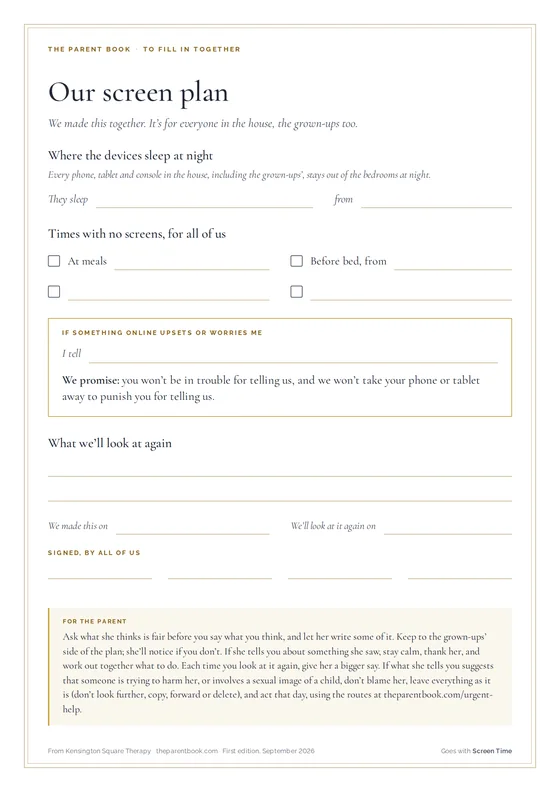
- Keep devices out of bedrooms at night. Charge devices in the kitchen overnight, including yours. What you do counts as much as the rule you set.
- Turn screens off 45 to 60 minutes before bed. The brain needs to wind down before it can sleep. Use the time for reading, a bath or talking together.
Some tips to try
Short pieces from the library, and a first thing to try from each.
-
Before the First Loot Box.
Have the money conversation, and set the controls, before she plays a game with a shop in it.
- Turn off in-game purchases, or set a limit, before she starts.
-
The Game Rated Above Her Age.
Two games with the same age rating can be very different, so check why it got its number and watch it being played before you decide.
- Look up the content descriptors to see why the game got its number.
- Check the chat separately. The NSPCC points out that age ratings don’t include communication features, so a game with a low rating may still let children talk to people they don’t know. Gaming controls can limit chat, or allow it only with friends you’ve approved.
-
The Room He Will Not Leave.
Time on a headset is often time with friends, so start by asking about it.
- Sit next to him for ten minutes on a Saturday, asking about the game.
The rest of each tip, with more to try and why it works, is in the library.
Something to do together
Play her game with her. She picks a game she plays and teaches you how it works. You play beside her as a beginner, and find out what the game involves, including who she can talk to in it.
What it is for. For many children, games are where they relax and where they spend time with their friends. Playing one with her shows her you’re interested in something she cares about, and it teaches you what the game involves: who she can talk to in it, what it costs and how she would block someone.
- The first step. Ask her to choose the game and teach you: “Will you show me how to play this? I’ll probably be hopeless.” Let her pick a time that suits her, and not one that cuts into playing with her friends.
Safety. Check the age rating, and what the game lets players do: chat, voice and buying things. Use the console’s or the game’s settings to limit who can talk to her, and so that nothing can be bought without you. Don’t store a payment card on the console or in the app. Screens off about an hour before bed, and the console stays out of her bedroom overnight.
When to get help. If you learn that someone in a game has asked her for pictures or personal details, asked to meet her or asked her to move to another app, or that there is a sexual image of a child, stay calm, do not blame her, and leave everything as it is (do not look further, copy, forward or delete). Act that day, using the routes under “If you need help right now”, at the foot of every page, and tell the school’s designated safeguarding lead. If she tells you that someone is hurting her, that she is hurting herself, or that she does not want to be alive, stay calm, thank her for telling you, do not promise to keep it secret, and act that day in the same way. If for several weeks gaming has come before sleep, meals and washing, she has dropped things she used to enjoy, or she only sees her friends online, talk to her school and your GP.
The other four steps, and your part in it, are in the library.
If you want to read further
- What Screen Time Actually Is. For parents who feel they have lost the argument about screens. theparentbook.com/reader/what-screen-time-actually-is
Worth your time
- A book for you: Lost in a Good Game, Pete Etchells. Part memoir, part science: a psychologist who grew up playing games explains what the research says about violence and addiction, and why games can matter, sometimes deeply, to the people who play them. uk.bookshop.org/p/books/lost-in-a-good-game-why-we-play-video-games-and-what-they-can-do-for-us-pete-etchells/8d9b4c835621612d
- A book to read together: Emmy Levels Up, Helen Harvey. Emmy is brilliant at an online game and has a growing audience, but is bullied at school over her looks and background. Shows gaming as a real source of confidence and friendship, not only a problem. uk.bookshop.org/p/books/emmy-levels-up-helen-harvey/d938131e99876c01
- Something to watch: The top 3 parental controls to use on Roblox | Internet Matters, Internet Matters, YouTube. One minute showing the three Roblox parental controls most worth switching on, covering chat, spending and content. Quick and specific. www.youtube.com/watch?v=VkMuSv0rRWw
- Something to listen to: 2. Leon Xiao: The House Always Wins. The Home Loses., Tech Shock - from Parent Zone, 42 min. Video game law researcher Leon Xiao explains loot boxes, gacha mechanics and other gambling-like features in children’s games. Neither host nor guest is anti-gaming, which makes the warnings more persuasive. podcasts.apple.com/gb/podcast/2-leon-xiao-the-house-always-wins-the-home-loses/id1535431770?i=1000770087432
Who else can help
This usually starts at school rather than at the surgery. The adults who see your child every day are the first people to tell, and often the fastest route to a change. The GP is there if it persists or deepens.
- Your child’s school. The pastoral lead, the head of year, or the form tutor. Free, already knows your child, and often the quickest way to get something changed at school. Before or alongside anything else. A school cannot act on what it has not been told, and what you bring is often what it did not have.
- Your GP. The gateway to everything the NHS offers a child: paediatric assessment, a referral to CAMHS, and support for you as the parent. Ask for a double appointment. Describe the pattern over weeks rather than the worst single day, and say plainly what you are worried about. Bring a written list; the ten minutes go quickly. www.nhs.uk/service-search/find-a-gp
- Internet Matters. Step-by-step guides to the settings on every device and app, advice by age from nought to eighteen, and guides to AI tools and gaming. When you need to actually change something on a phone tonight. The most practical online safety source in the UK. www.internetmatters.org/advice
- Childnet. Guides to having the conversation, by age, on gaming, sharing images, online bullying and where the line is, from one of the charities behind the UK Safer Internet Centre. When the settings are done and the talking is the hard part. www.childnet.com/parents-and-carers
- UK Safer Internet Centre. The UK’s online safety centre, run by Childnet, the IWF and SWGfL. Their parents’ pages give age-by-age guidance and settings for each platform, written for people who have read enough alarming material. For the everyday side of online life rather than an emergency. Reading and guides; there is no parent helpline here. Guides and reading. The helpline on their site is for professionals, not parents. Email only, Mon-Fri working hours saferinternet.org.uk/guide-and-resource/parents-and-carers
The full list for gaming, with what each organisation does and when it is the right call, is at theparentbook.com/help/gaming/services
Published by Kensington Square Therapy. Company No. 16707111. Written by therapists registered with the British Association for Counselling and Psychotherapy (BACP) and the National Counselling and Psychotherapy Society (NCPS). This page is not therapy, and not a substitute for professional support. The full library is at theparentbook.com.
Everything the library holds on gaming
Go further
Quick tips
- Before the First Loot BoxHave the money conversation, and set the controls, before she plays a game with a shop in it.
- The Game Rated Above Her AgeTwo games with the same age rating can be very different, so check why it got its number and watch it being played before you decide.
- The Room He Will Not LeaveTime on a headset is often time with friends, so start by asking about it.
Quick tips open with a subscription.
Things to do together
Activities open with a subscription.