
Child development
Child development
Children grow into people slowly, and these pages cover each stage: attachment in the early years, the magical thinking of the preschool child, learning to get on with others in middle childhood, and the long process of becoming a separate person in adolescence. They’re for parents who want to know what stage of development lies behind a question.
What the library says about this, on one page. It is also online at theparentbook.com/help/child-development
What to do first
Development is uneven by nature. Children get to things in a different order and in a different month, and most of what looks like a delay is within the normal range.
- Write down what you’ve noticed and when, and don’t compare her with a friend’s child.
- Ask the school or nursery what they see. They see a lot of children, and you have one.
- If something has stalled or gone backwards, see the GP. Going backwards is the sign to act on quickly.
Some tips to try
Short pieces from the library, and a first thing to try from each.
-
The Late Talker.
If she is three and not talking like other children, there is an established route to help.
- Use the existing UK pathway: health visitor, GP, local speech and language service.
- You can reach the health visitor, the GP and the local authority’s speech and language therapy service through a referral from the nursery or one you make yourself.
-
The Party She Needs to Leave.
Some children run out of social energy long before the party ends, and going home is how they recover.
- Let her leave when she needs to, without treating her as unusual.
-
Toilet Training as a Family Project.
Toilet training works when her body and brain are ready, whatever the timetable says.
- Wait for the signs that she’s ready, whatever the schedule says.
The rest of each tip, with more to try and why it works, is in the library.
Something to do together
Cooking one thing together. Cook one dish together each week, side by side, and give her a real job. If she wants to talk, she can do it while she chops.
What it is for. A child who will not sit down to talk will often stand next to you and chop. Cooking gives her a real job, and she can talk without anyone looking straight at her.
- The first step. Choose one dish and a time you can keep. A supper you were making anyway works better than a special project; she can pick it from two or three you suggest.
Safety. Raw flour and raw cake mixture should not be eaten, even from the bowl. Keep hot pans out of reach of the youngest, and check for allergies when a friend cooks too. Under eleven, if she helps at the hob, an adult stays beside her and handles the hot pan. From eleven, the hob is hers once she has done it beside you a few times, with an adult in the kitchen.
When to get help. If she tells you that someone is hurting her, that she is hurting herself, or that she does not want to be alive, turn off the hob, stay with her, thank her for telling you, do not promise to keep it secret, and act that day, using the routes under “If you need help right now”, at the foot of every page. If her eating narrows over several weeks, she is losing weight, or food talk turns to “clean” and “bad”, ask your GP for an early appointment and say plainly what you have seen.
The other four steps, and your part in it, are in the library.
If you want to read further
- Anxiety, by Age. For parents whose child’s worry has started to make decisions for her, with what helps at each age and when to ask for help. theparentbook.com/reader/anxiety-by-age
- Big Feelings and Co-Regulation. For parents whose child has just had a meltdown, on how to help her through it. theparentbook.com/reader/big-feelings-and-co-regulation
Worth your time
- A book for you: The Philosophical Baby, Alison Gopnik. A developmental psychologist explores what babies and young children are really doing when they play, pretend and imagine, and why their minds are so good at learning. Reflective rather than practical. uk.bookshop.org/p/books/the-philosophical-baby-what-children-s-minds-tell-us-about-truth-love-the-meaning-of-life-alison-gopnik/a7ee68859323990b
- A book to read together: Blame My Brain: The Amazing Teenage Brain Revealed, Nicola Morgan. Nicola Morgan explains, with humour and sound science, why the teenage brain is still under construction, from shifting sleep to risk taking. Reassuring for a teenager who feels out of step, and useful for parents too. uk.bookshop.org/p/books/blame-my-brain-the-amazing-teenage-brain-revealed-the-ultimate-bestselling-guide-to-teenage-behaviour-and-mental-health-packed-with-advice-for-teens-a/3faccd95aef097dc
- Something to watch: Experiences Build Brain Architecture, Center on the Developing Child at Harvard University, YouTube. A short animation explaining that the brain is built over time, from the bottom up, and that early relationships and experiences shape whether that foundation is sturdy or fragile. www.youtube.com/watch?v=VNNsN9IJkws
- Something to listen to: The Teenage Brain Explained with Prof Sarah-Jayne Blakemore, MQ Open Mind, 60 min. Cambridge neuroscientist Sarah-Jayne Blakemore explains how the adolescent brain develops, why friends and social belonging matter so much to teenagers, and what this means for families and schools. podcasts.apple.com/gb/podcast/the-teenage-brain-explained-with-prof-sarah/id1271690765?i=1000732726710
Who else can help
For almost everything, the NHS is the right first move, and it costs nothing.
- Your GP. The gateway to everything the NHS offers a child: paediatric assessment, a referral to CAMHS, and support for you as the parent. Ask for a double appointment. Describe the pattern over weeks rather than the worst single day, and say plainly what you are worried about. Bring a written list; the ten minutes go quickly. www.nhs.uk/service-search/find-a-gp
- Your child’s school. The pastoral lead, the head of year, or the form tutor. Free, already knows your child, and often the quickest way to get something changed at school. Before or alongside anything else. A school cannot act on what it has not been told, and what you bring is often what it did not have.
- NHS Best Start in Life (Start for Life). The NHS’s pages for pregnancy, babies and toddlers: feeding, sleep, bonding, potty training, early learning and school readiness, plus your local Family Hub. For the under-fives, as the first place to check. www.nhs.uk/start-for-life
- NCT (National Childbirth Trust). The early-years charity. Calm, evidence-based pages on toddlers, sleep and development, local groups, and a daily infant feeding line. For the under-fives. The phone line is for feeding questions; everything else is on the site and in the groups. The phone line is for feeding questions only. Charged at your standard call rate, not free. NCT Infant Feeding Line 0300 330 0700 · Every day 8am-midnight www.nct.org.uk/information
- Action for Children Parent Talk. A free one-to-one webchat with a trained parenting coach, and a library of articles by age on behaviour, sleep, neurodiversity and family life. When you want to talk it through with someone in writing, this week, without a referral. Free one-to-one webchat with a parenting coach, Mon-Fri, with evening slots on Mon and Thu; check the site for current times · Parent Talk+ by phone or video for parents of children with additional needs, up to eight free sessions parents.actionforchildren.org.uk
The full list for child development, with what each organisation does and when it is the right call, is at theparentbook.com/help/child-development/services
Published by Kensington Square Therapy. Company No. 16707111. Written by therapists registered with the British Association for Counselling and Psychotherapy (BACP) and the National Counselling and Psychotherapy Society (NCPS). This page is not therapy, and not a substitute for professional support. The full library is at theparentbook.com.
Everything the library holds on child development
Go further
Chapters
Quick tips
- The Late TalkerIf she is three and not talking like other children, there is an established route to help.
- The Party She Needs to LeaveSome children run out of social energy long before the party ends, and going home is how they recover.
- Toilet Training as a Family ProjectToilet training works when her body and brain are ready, whatever the timetable says.
- Giving Her Words for the Hard ThingA young child rarely has words for something hard; give her a simple phrase for what her body feels.
- The Boy Whose Voice Is ChangingOnce his voice starts to crack, have a short, matter-of-fact talk with him about puberty.
- The Day She Asked About SexGive a brief, accurate answer when your child asks how babies are made, then stop.
- The Extroverted Parent and the Introvert ChildAn extroverted parent often mistakes an introverted child’s temperament for shyness or low confidence.
- The First Bra ConversationTake her question about a first bra seriously, and treat the shopping as an everyday errand.
- The Talk Before It Is NeededAim for eighteen short conversations about puberty over two or three years, starting early.
- When the Heritage Tongue SlipsIf she used to answer you in Urdu and now answers only in English, keep speaking Urdu to her.
All 30 quick tips on child development
Quick tips open with a subscription.
Things to do together
Activities open with a subscription.
To print
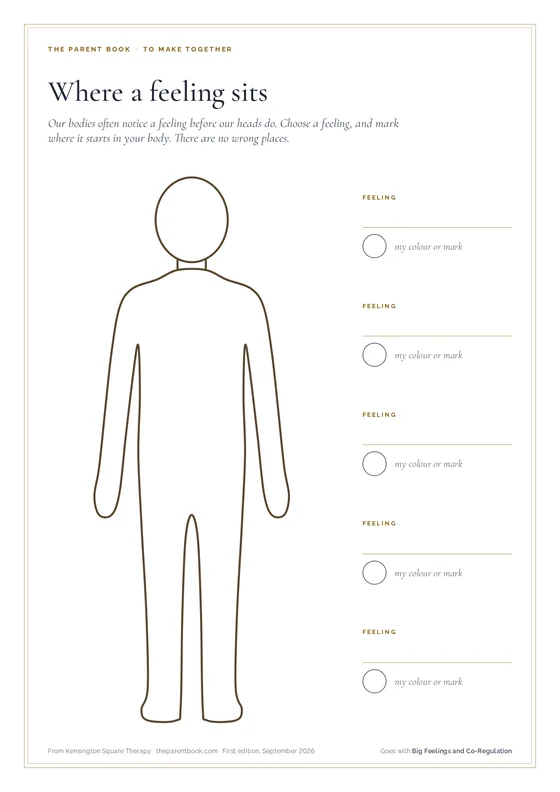 Where a feeling sits
To make together · A4, two sides · PDF, 62 KB · With a subscription
Where a feeling sits
To make together · A4, two sides · PDF, 62 KB · With a subscription
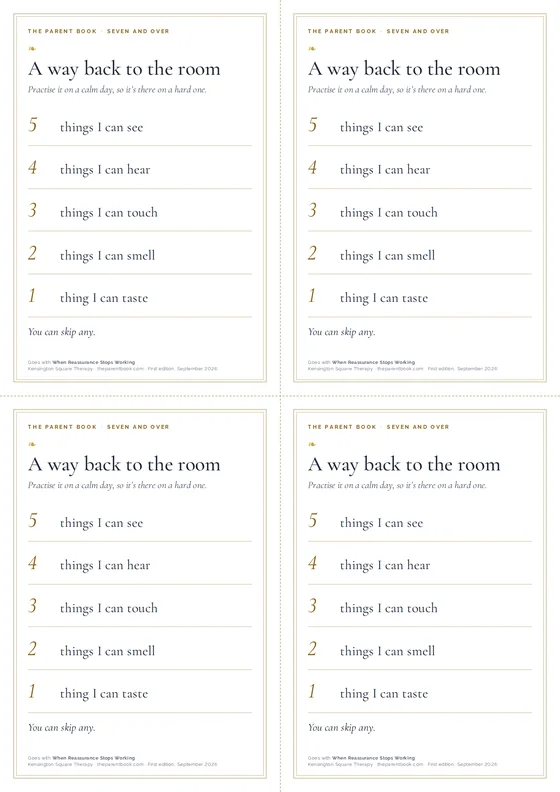 A way back to the room
Pocket card · A4, four cards to cut, two sides · PDF, 68 KB · With a subscription
A way back to the room
Pocket card · A4, four cards to cut, two sides · PDF, 68 KB · With a subscription
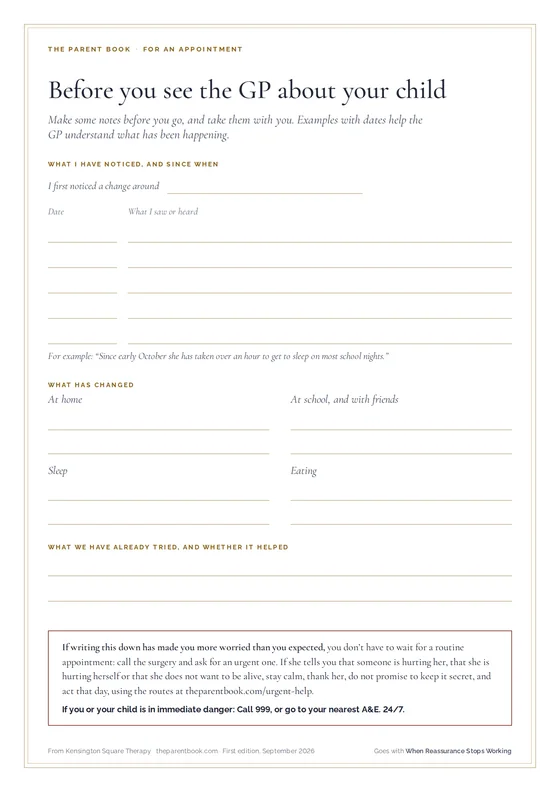 Before you see the GP about your child
For an appointment · A4, two sides · PDF, 72 KB · Free
Before you see the GP about your child
For an appointment · A4, two sides · PDF, 72 KB · Free
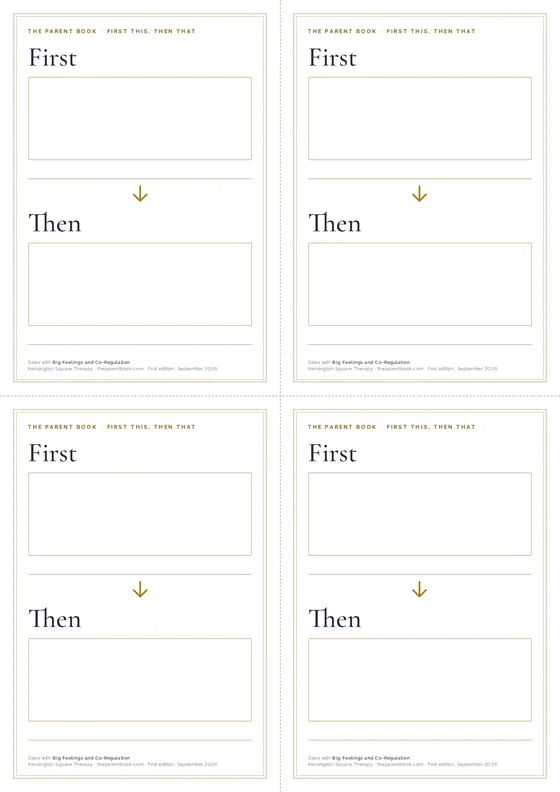 First this, then that
Cards to cut out · A4, four cards to cut, two sides · PDF, 64 KB · With a subscription
First this, then that
Cards to cut out · A4, four cards to cut, two sides · PDF, 64 KB · With a subscription
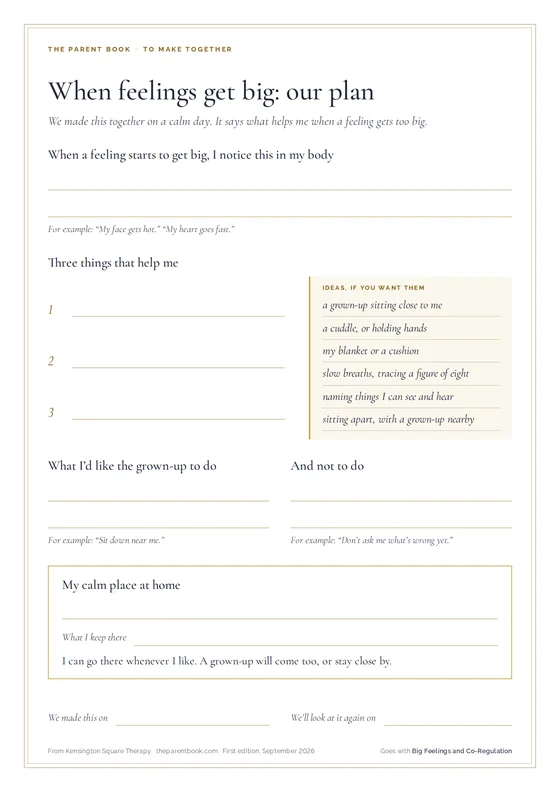 When feelings get big: our plan
To make together · A4, two sides · PDF, 66 KB · With a subscription
When feelings get big: our plan
To make together · A4, two sides · PDF, 66 KB · With a subscription
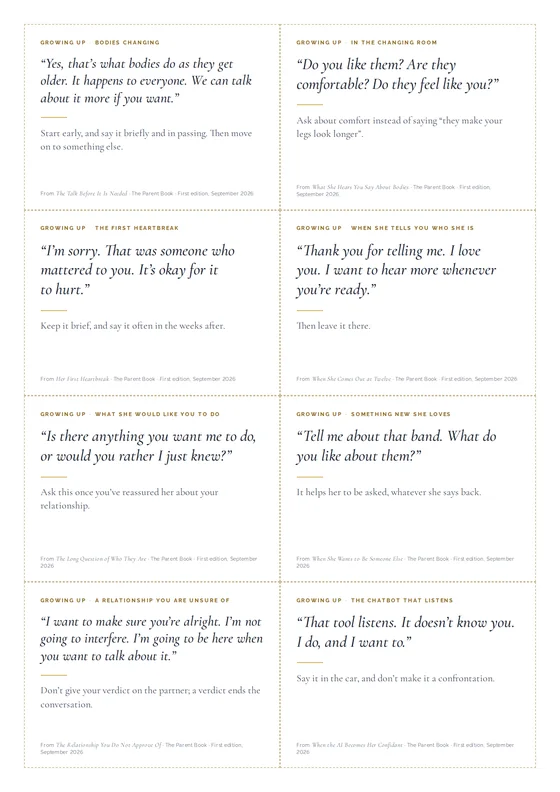 What to say: growing up
Cards to cut out · A4, eight cards to cut · PDF, 62 KB · With a subscription
What to say: growing up
Cards to cut out · A4, eight cards to cut · PDF, 62 KB · With a subscription
Growing up and identity
Every subjectWho else can help with child developmentUrgent help