Sexuality
Sexuality
Sexuality is part of who a child is, and who she is becoming, in relation to other people. We’ve written about it carefully for every age, from a young child’s question about what a body is to the mid-teens conversation about what intimacy is for. These pages are for the parent who wants to be available without being intrusive.
What the library says about this, on one page. It is also online at theparentbook.com/help/sexuality
What to do first
If a young person has told you about this, she has chosen you. What she’ll remember is your face in the first two seconds, not the words.
- Say “thank you for telling me”, and say “I love you”. Everything else can come later.
- Don’t tell anyone else, including family, without asking her first. It’s for her to decide who knows, and when.
- Go on as normal afterwards. Behaving exactly as you did before is the most reassuring thing you can do.
Some tips to try
Short pieces from the library, and a first thing to try from each.
-
Finding the Words for Gender and Sexuality.
Ask her which words she uses, use them, and let her tell you when you get it wrong.
- Ask once, lightly: “What words do you use? Tell me when I get it wrong.”
-
The Long Question of Who They Are.
A teenager needs to be able to try out a thought aloud before they know whether it fits.
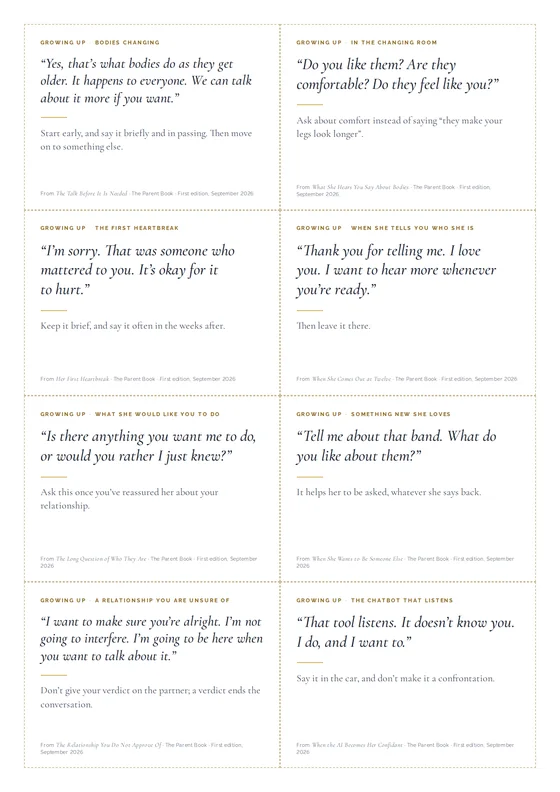
- Start with: “Thank you for telling me. I love you. I want to understand.”
- If your teenager tells you something personal, reassure them about your relationship before anything else: “Thank you for telling me. I love you. I want to understand.” Then ask: “Is there anything you want me to do, or would you rather I just knew?” Ask who else knows, and who they would want to know. What they have told you is theirs to tell, so it does not go to relatives, friends or school without their permission, and who they are is never, on its own, a reason to tell anyone. Safety overrides that: if someone is hurting them, if they are hurting themselves, or if they have talked about not wanting to be here, say what you need to do and why, and stay beside them while you do it.
- You may need time yourself, too. Take your own questions to another adult you trust, or to a counsellor, so your teenager doesn’t have to settle them for you. If you want to talk to a parent who has been where you are, there is a parent-run charity for the parents and families of LGBT+ people, and its helpline is answered by parents. FFLAG (parents and families of LGBT+ people), 0300 688 0368. Wed-Thu 10am-8pm; Fri-Sat 10am-6pm. Outside those hours the line is closed. Samaritans answer at any hour on 116 123, and Shout answer if you text the word SHOUT to 85258. Anna Freud’s family-wellbeing pages cover looking after yourself while you are supporting your child, which is the part parents most often skip. The lines below are for you as much as for them.
-
When She Comes Out at Twelve.
When she tells you something that doesn’t fit what the family assumed, keep your first reply brief and warm.
- Keep your answer brief and warm: “Thank you for telling me. I love you.”
The rest of each tip, with more to try and why it works, is in the library.
If you want to read further
- When Your Child Is Working Out Who They Are. For parents whose child has raised a question about who they are, and who weren’t prepared for it. theparentbook.com/reader/when-your-child-is-working-out-who-they-are
Worth your time
- A book for you: Girls & Sex, Peggy Orenstein. Drawing on interviews with more than seventy young women, a journalist examines what girls are learning about pleasure, consent and their own bodies, and argues that parents need to talk about much more than risk. uk.bookshop.org/p/books/girls-sex-navigating-the-complicated-new-landscape-peggy-orenstein/230d6bee2404f719
- A book to read together: Doing It!, Hannah Witton. A UK sex educator and YouTuber writes for older teenagers about consent, contraception, sexuality, pornography and relationships, with guest contributors. Frank and funny, it assumes young people want real information. uk.bookshop.org/p/books/doing-it-let-s-talk-about-sex-hannah-witton/97e20124cebfed1d
- Something to watch: Tea and Consent, Thames Valley Police, YouTube. The well-known animation that explains sexual consent by comparing it with offering someone a cup of tea. Clear, funny and hard to misunderstand. www.youtube.com/watch?v=pZwvrxVavnQ
- Something to listen to: 104: How Do I Support My LGBTQ+ Daughter?, Ask Lisa: Untangling Family Life, 30 min. A teenager has come out to her mother as gay but does not want her father told. Damour explains how worried children can be about coming out, and how to handle the confidence and practical questions. podcasts.apple.com/gb/podcast/104-how-do-i-support-my-lgbtq-daughter/id1525689066?i=1000597375131
Who else can help
A child’s sexuality is not something to treat, and most of this is conversation at home. Tell the school if your child is being bullied or left out, and ask for the designated safeguarding lead if you are worried about pressure from someone older, online or off; if it cannot wait, or the school is closed, use the routes under “If you need help right now”. See the GP if her mood drops and stays low.
- Your child’s school. The pastoral lead, the head of year, or the form tutor. Free, already knows your child, and often the quickest way to get something changed at school. Before or alongside anything else. A school cannot act on what it has not been told, and what you bring is often what it did not have.
- Your GP. The gateway to everything the NHS offers a child: paediatric assessment, a referral to CAMHS, and support for you as the parent. Ask for a double appointment. Describe the pattern over weeks rather than the worst single day, and say plainly what you are worried about. Bring a written list; the ten minutes go quickly. www.nhs.uk/service-search/find-a-gp
- Brook. The young people’s sexual health charity. Calm pages for parents on puberty, periods and talking about sex and relationships at home. When the question has arrived in the back of the car. Reading; the clinics are for young people themselves. www.brook.org.uk/parents-and-carers
- YoungMinds. The UK’s young people’s mental health charity, with a free Parents Helpline, webchat and email, and a plain A to Z of the things parents worry about. When you want to talk through a worry about your child with someone who has heard it before, or read a clear first explanation of a named concern. Not a crisis line. Parents Helpline 0808 802 5544 · Mon, Thu, Fri 9.30am-4pm; Tue, Wed 9.30am-6pm · Webchat Mon-Fri 9.30am-4pm; email parents@youngminds.org.uk · Outside those hours the parents line is closed. The urgent routes on this page are open when it is not. www.youngminds.org.uk/parent/parents-helpline
The full list for sexuality, with what each organisation does and when it is the right call, is at theparentbook.com/help/sexuality/services
Published by Kensington Square Therapy. Company No. 16707111. Written by therapists registered with the British Association for Counselling and Psychotherapy (BACP) and the National Counselling and Psychotherapy Society (NCPS). This page is not therapy, and not a substitute for professional support. The full library is at theparentbook.com.
Everything the library holds on sexuality
Go further
Quick tips
- Finding the Words for Gender and SexualityAsk her which words she uses, use them, and let her tell you when you get it wrong.
- The Long Question of Who They AreA teenager needs to be able to try out a thought aloud before they know whether it fits.
- When She Comes Out at TwelveWhen she tells you something that doesn’t fit what the family assumed, keep your first reply brief and warm.
- Coming Out to the Rest of the FamilyWhen she comes out at sixteen, let her decide who in the family is told next, and when.
- The Day She Asked About SexGive a brief, accurate answer when your child asks how babies are made, then stop.
Quick tips open with a subscription.