
Attachment
Attachment
Attachment is the bond that forms between a baby and the adults around her in the first years and goes on developing, in subtler ways, through childhood. It isn’t a parenting style or a verdict on you. These pages are for you if you want to see more clearly what’s happening between you and your child.
What the library says about this, on one page. It is also online at theparentbook.com/help/attachment
What to do first
Attachment is built and rebuilt all the time, through the everyday business of putting things right when they go wrong. That means it isn’t something you either got right or missed, and it’s never too late to strengthen it.
- Find ten minutes a day that are hers alone, with no agenda and no phone. Doing it regularly counts for more than how long it lasts.
- Put things right out loud every time something goes wrong between you, however small. Children learn to feel secure by watching a relationship survive being damaged.
- If your child came to you through adoption, fostering or kinship, or if there was trauma early in her life, get specialist support rather than general advice.
Some tips to try
Short pieces from the library, and a first thing to try from each.
-
The Day the Fostered Child Arrives.
A fostered child’s first 72 hours with you are for learning that your home is calm and predictable.
- Keep the first 72 hours slow and low-stakes.
-
Leaving the House She Loved.
Give her time to say goodbye to the places she loved before the boxes go.
- Photograph the doorframe, the garden corner and the view from her window.
-
She Follows You From Room to Room.
After something hard, a young child needs adults who are predictable, calm and in the room with her.
- Slow the household down while she recovers.
The rest of each tip, with more to try and why it works, is in the library.
Something to do together
Ten minutes where she leads. Ten minutes most days when she chooses what you play and you follow her lead. You don’t teach, correct or ask questions, and she never has to earn it.
What it is for. When she decides what happens and you follow, she gets your full attention without having to ask for it. A child who can count on that has less need to look for attention in ways you’d rather she didn’t.
- The first step. Pick a time you can keep most days, and tell her once: “Every day after tea, you and I get ten minutes, and you choose what we play.”
Safety. Beads, little bricks and other small pieces are a choking hazard for children under three; keep them off the floor if a younger child is about.
When to get help. If, in her play or in words, she tells you that someone is hurting her, that she is hurting herself, or that she does not want to be alive, don’t question her or interpret it; stay calm, thank her for telling you, do not promise to keep it secret, and act that day, using the routes under “If you need help right now”, at the foot of every page. If her behaviour is becoming more frequent, more severe or harder to manage over several weeks, or is affecting her learning, friendships or life at home, talk to her nursery or school and to your GP or health visitor.
The other four steps, and your part in it, are in the library.
If you want to read further
- Trauma in Childhood. For parents whose child has been through something hard, or whose family has. theparentbook.com/reader/the-shape-of-trauma-in-childhood
- When a Child Is Grieving. For parents whose child has lost someone, or something, that was there last week. theparentbook.com/reader/when-something-is-lost
Worth your time
- A book for you: Raising a Secure Child, Kent Hoffman, Glen Cooper and Bert Powell, with Christine M. Benton. The parents’ version of Circle of Security, an attachment programme used in many UK perinatal and early years services. It helps parents read a child’s cues and notice their own ‘shark music’ when needs feel hard to meet. uk.bookshop.org/p/books/raising-a-secure-child-how-circle-of-security-parenting-can-help-you-nurture-your-child-s-attachment-emotional-resilience-and-freedom-to-explore-bert/1bf1fc5e8495c40f
- A book to read together: Cleo the Crocodile Activity Book for Children Who Are Afraid to Get Close, Karen Treisman. A story about a crocodile who snaps to keep others away, followed by activities to help a child explore trust and closeness. Designed for foster, adoptive and kinship families working with a therapist or on their own. uk.bookshop.org/p/books/cleo-the-crocodile-activity-book-for-children-who-are-afraid-to-get-close-karen-treisman/efbfa3106a1ea2d8?ean=9781785925511
- Something to watch: Circle of Security Animation, Circle of Security International, YouTube. The Circle of Security map in four minutes: a child goes out to explore and comes back for comfort, and the parent’s job is to be the secure base and safe haven at each point on the circle. www.youtube.com/watch?v=1wpz8m0BFM8
- Something to listen to: Professor Helen Minnis & Understanding Childhood Trauma, MQ Open Mind, 49 min. Glasgow child psychiatrist Helen Minnis discusses how maltreatment, neurodevelopment and mental health are connected across childhood, and what services make a difference for children who have experienced trauma. podcasts.apple.com/gb/podcast/professor-helen-minnis-understanding-childhood-trauma/id1271690765?i=1000658556405
Who else can help
For almost everything, the NHS is the right first move, and it costs nothing.
- Your GP. The gateway to everything the NHS offers a child: paediatric assessment, a referral to CAMHS, and support for you as the parent. Ask for a double appointment. Describe the pattern over weeks rather than the worst single day, and say plainly what you are worried about. Bring a written list; the ten minutes go quickly. www.nhs.uk/service-search/find-a-gp
- Your child’s school. The pastoral lead, the head of year, or the form tutor. Free, already knows your child, and often the quickest way to get something changed at school. Before or alongside anything else. A school cannot act on what it has not been told, and what you bring is often what it did not have.
- Anna Freud. The Anna Freud Centre’s family wellbeing resources: careful, research-led reading on children’s emotional development, separation, self-care for parents, and supporting a child through treatment. When you want depth from a clinical source rather than a quick explainer. Reading only; there is no helpline. www.annafreud.org/resources/family-wellbeing
- Place2Be. Parenting Smart, written by the child mental health specialists who work in primary schools: short, practical articles and films on friendships, behaviour, worries and routines. For a child of five to eleven, when you want something you can read in ten minutes and try tonight. Place2Be’s counselling itself is only through partner schools. parentingsmart.place2be.org.uk
- Action for Children Parent Talk. A free one-to-one webchat with a trained parenting coach, and a library of articles by age on behaviour, sleep, neurodiversity and family life. When you want to talk it through with someone in writing, this week, without a referral. Free one-to-one webchat with a parenting coach, Mon-Fri, with evening slots on Mon and Thu; check the site for current times · Parent Talk+ by phone or video for parents of children with additional needs, up to eight free sessions parents.actionforchildren.org.uk
The full list for attachment, with what each organisation does and when it is the right call, is at theparentbook.com/help/attachment/services
Published by Kensington Square Therapy. Company No. 16707111. Written by therapists registered with the British Association for Counselling and Psychotherapy (BACP) and the National Counselling and Psychotherapy Society (NCPS). This page is not therapy, and not a substitute for professional support. The full library is at theparentbook.com.
Everything the library holds on attachment
Go further
Chapters
- Trauma in ChildhoodFor parents whose child has been through something hard, or whose family has.
- When a Child Is GrievingFor parents whose child has lost someone, or something, that was there last week.
- When Parents SeparateFor parents in the middle of a separation who are watching closely to see how their child is coping.
Quick tips
- The Day the Fostered Child ArrivesA fostered child’s first 72 hours with you are for learning that your home is calm and predictable.
- Leaving the House She LovedGive her time to say goodbye to the places she loved before the boxes go.
- She Follows You From Room to RoomAfter something hard, a young child needs adults who are predictable, calm and in the room with her.
- The Grandparent Who Was a Third ParentThe grandmother who did the school run was part of the parenting.
- The Second Child, and the FirstWhen a new baby arrives, every first child wants to know whether she is still the one.
- When She Is Too Small for the WordsA child under five needs a short, calm explanation and care she can rely on.
- The First 48 Hours BackAfter a long time apart, everyone at home has changed a little, and nobody wants to say so.
- The First Questions About Birth ParentsWhen she asks about her birth parents at seven, a short, honest answer is what she needs.
- The Grandparent in the Heritage LanguageIf the weekly call with Grandma is in Urdu, keep it that way.
- The Long Shadow of Losing a ParentA child who loses a parent will feel the loss in new ways across the next ten years.
All 19 quick tips on attachment
Quick tips open with a subscription.
Things to do together
- Ten minutes where she leadsTen minutes most days when she chooses what you play and you follow her lead. You don’t teach, correct or ask questions, and she never has to earn it.
- A box for the memoriesAfter a death, make a box together for things that remind her of the person, and a page of what she remembers. She chooses what goes in, and the box is hers.
- Time alone with each childA regular time with each of your children on her own, doing something she chooses. Keep it short enough to protect every week.
- Reading in the same roomFor the last twenty minutes before bed, everyone reads in one room, you included. Keep reading aloud to her for longer than you think she needs it.
Activities open with a subscription.
To print
 What I will miss
To keep · A4, two pages · PDF, 41 KB · With a subscription
What I will miss
To keep · A4, two pages · PDF, 41 KB · With a subscription
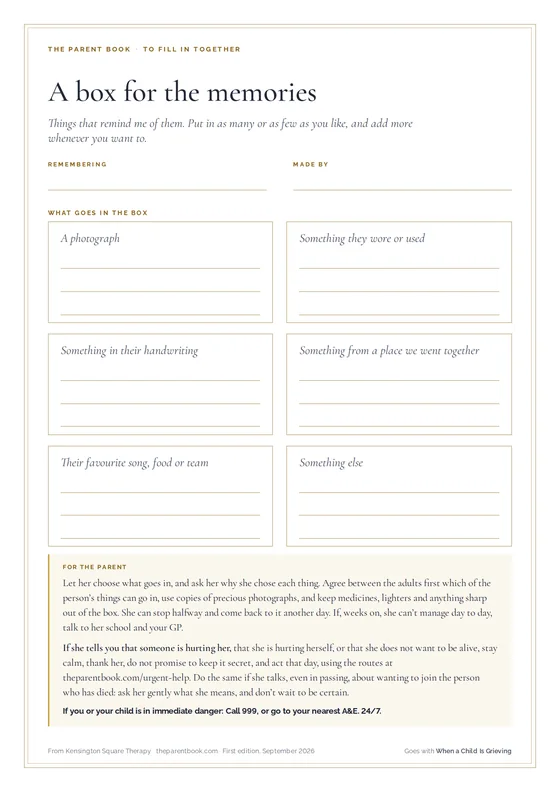 A box for the memories
To fill in together · A4, two pages · PDF, 66 KB · With a subscription
A box for the memories
To fill in together · A4, two pages · PDF, 66 KB · With a subscription
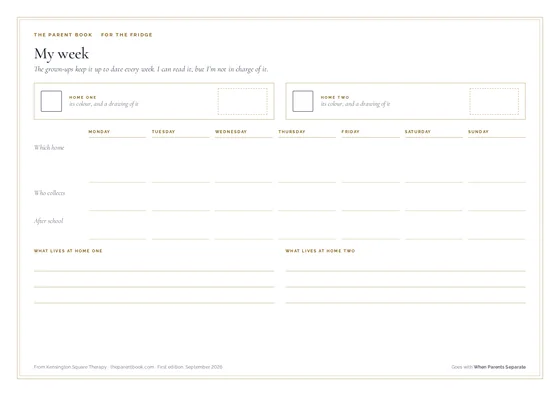 A week across two homes
For the fridge · A4 landscape, two pages · PDF, 55 KB · With a subscription
A week across two homes
For the fridge · A4 landscape, two pages · PDF, 55 KB · With a subscription
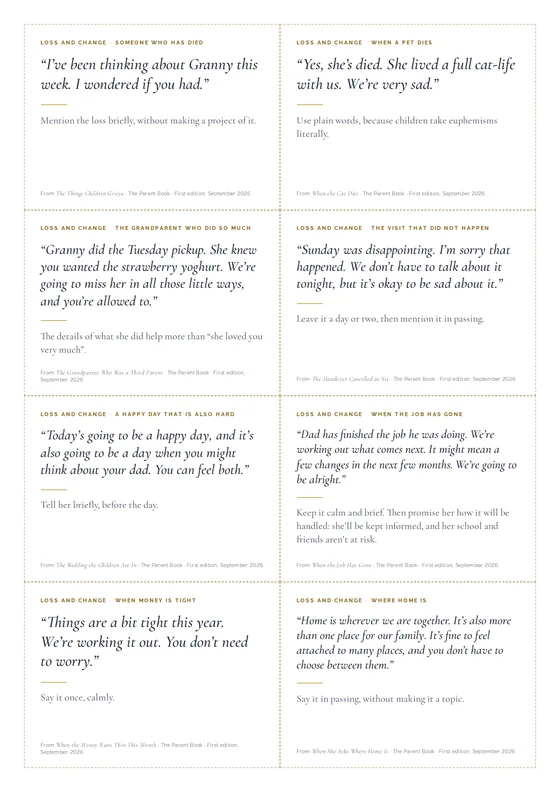 What to say: loss and change
Cards to cut out · A4, eight cards to cut · PDF, 62 KB · With a subscription
What to say: loss and change
Cards to cut out · A4, eight cards to cut · PDF, 62 KB · With a subscription
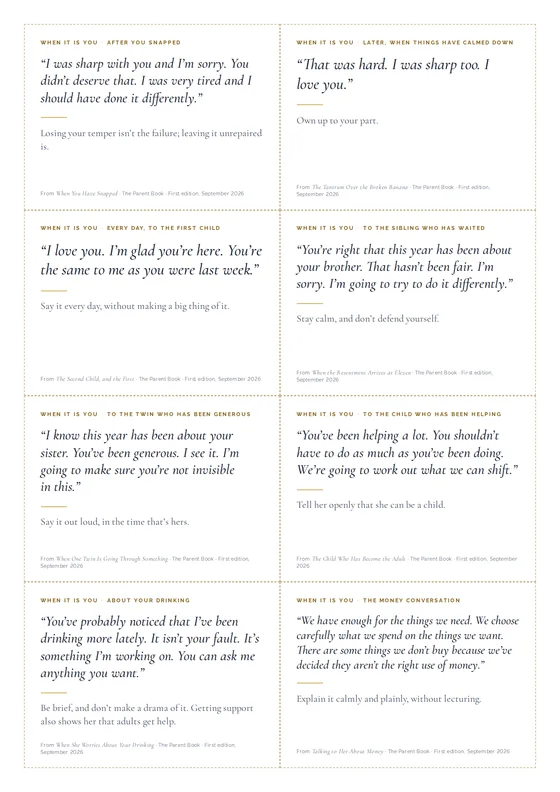 What to say: when it is you
Cards to cut out · A4, eight cards to cut · PDF, 62 KB · With a subscription
What to say: when it is you
Cards to cut out · A4, eight cards to cut · PDF, 62 KB · With a subscription