
Bereavement
Bereavement
These pages are about the death of a grandparent, a parent, a sibling, a friend or a much-loved pet. Children grieve more things, and more often, than adults give them credit for, and their grief comes in waves with pauses in between. The pages are also for the parent who, in most cases, is grieving too.
What the library says about this, on one page. It is also online at theparentbook.com/help/bereavement
What to do first
Children grieve in short bursts. They’ll be devastated and then ask what’s for tea, and that’s normal; it doesn’t mean they don’t care. You don’t have to fix anything.
- Use the real words: “died”, not “lost” or “gone to sleep”. Euphemisms are what frighten young children most.
- Answer only the question you’re asked, and be willing to answer it again next week, and the week after. Going over it again and again is how a child takes it in.
- Tell the school before she goes back, so nobody asks her a cheery question in the corridor on Monday morning.
Some tips to try
Short pieces from the library, and a first thing to try from each.
-
Answering a Grieving Child’s Questions.
A grieving child’s questions often come out of nowhere; answer them briefly, in your everyday voice.
- Answer briefly, in your everyday voice.
- If you’d like someone to talk to, there’s a helpline for bereaved children and young people, and for the adults caring for them. Child Bereavement UK (incorporating Winston’s Wish), 0800 02 888 40. Mon-Fri 8am-8pm, except bank holidays. Outside those hours the line is closed. Samaritans answer at any hour on 116 123, and Shout answer if you text the word SHOUT to 85258. Help is free.
-
The Grandparent Who Was a Third Parent.
The grandmother who did the school run was part of the parenting.
- Name exactly what has been lost: the Tuesday pickup, the strawberry yoghurt.
- Two organisations cover this, and the first has particularly strong material on the death of older family members. Cruse Bereavement Support, 0808 808 1677. Mon, Wed, Thu, Fri 9.30am-5pm; Tue 1pm-8pm. Outside those hours the line is closed. Samaritans answer at any hour on 116 123, and Shout answer if you text the word SHOUT to 85258. Help is free.
- The second is the UK’s children’s bereavement charity. Child Bereavement UK (incorporating Winston’s Wish), 0800 02 888 40. Mon-Fri 8am-8pm, except bank holidays. Outside those hours the line is closed. Samaritans answer at any hour on 116 123, and Shout answer if you text the word SHOUT to 85258. Help is free.
-
The Pregnancy That Did Not Continue.
A child who was told a baby was coming grieves too, so acknowledge her grief openly.
- Acknowledge her grief openly: “We’re very sad. It’s okay to be sad too.”
The rest of each tip, with more to try and why it works, is in the library.
Something to do together
A box for the memories. After a death, make a box together for things that remind her of the person, and a page of what she remembers. She chooses what goes in, and the box is hers.
What it is for. Finding ways to remember someone who has died can help a child feel connected to them. The box gives her memories a place, and something she can go back to when she wants to.
- The first step. In the weeks after the death, offer it once: “Would you like to make a box for things that remind you of Granny?” If she says no, leave it, and offer again another time.
Safety. Put a copy of a precious photograph in the box, and keep the original somewhere safe. Leave medicines, blades, lighters and glass bottles out of the box, whatever her age. A little of the person’s perfume on a scarf keeps the smell without the bottle. If there’s a child under three in the house, keep small objects such as rings in a tin with a firm lid.
When to get help. If she tells you that someone is hurting her, that she is hurting herself, or that she does not want to be alive, stay calm, thank her for telling you, do not promise to keep it secret, and act that day, using the routes under “If you need help right now”, at the foot of every page. Do the same if she talks, even in passing, about wanting to join the person who has died, and don’t wait to be certain. Grief often comes in waves. Let her school know about the death in any case, and talk to the school and your GP if, weeks on, she can’t manage day to day, has been refusing school for a long time, or is very anxious or panicky.
The other four steps, and your part in it, are in the library.
If you want to read further
- When a Child Is Grieving. For parents whose child has lost someone, or something, that was there last week. theparentbook.com/reader/when-something-is-lost
- The Conversations Parents Avoid. For parents who need to tell their child something hard and don’t know how to start. theparentbook.com/reader/the-conversations-parents-avoid
Worth your time
- A book for you: A Child’s Grief, Winston’s Wish. Written by the bereavement charity Winston’s Wish, now part of Child Bereavement UK, for any adult supporting a child after a death: how to explain what has happened, what grief looks like, and activities to try.
- A book to read together: A Monster Calls, Patrick Ness, from an idea by Siobhan Dowd. Conor’s mum is dying, and a monster arrives to make him face the truth he cannot say. Illustrated by Jim Kay, it is one of the finest novels about grief before a death. uk.bookshop.org/p/books/a-monster-calls-patrick-ness/5e2118e1a724e74a
- Something to watch: Child Bereavement UK, Child Bereavement UK, YouTube. A library of short, practical guidance films on explaining death, funerals and grief to children of different ages, and on supporting grieving teenagers. www.youtube.com/@childbereavementchar
- Something to listen to: Grief In Common, Child Bereavement UK. Child Bereavement UK’s podcast in which bereaved young people talk openly about losing a parent or sibling, grief at school and university, anniversaries, and how grief changes over time. podcasts.apple.com/gb/podcast/grief-in-common/id1691282195
Who else can help
Grief is not an illness, and most grieving children need the people around them more than any treatment. Tell the school, so the adults who see your child every day know what has happened. See the GP if, weeks on, she still cannot manage ordinary days. If she talks about hurting herself, about wanting to die, or about wanting to be with the person who has died, act that day, using the routes under “If you need help right now”.
- Your child’s school. The pastoral lead, the head of year, or the form tutor. Free, already knows your child, and often the quickest way to get something changed at school. Before or alongside anything else. A school cannot act on what it has not been told, and what you bring is often what it did not have.
- Your GP. The gateway to everything the NHS offers a child: paediatric assessment, a referral to CAMHS, and support for you as the parent. Ask for a double appointment. Describe the pattern over weeks rather than the worst single day, and say plainly what you are worried about. Bring a written list; the ten minutes go quickly. www.nhs.uk/service-search/find-a-gp
- Child Bereavement UK (incorporating Winston’s Wish). The UK’s children’s bereavement charity, now including Winston’s Wish. A free helpline, live chat and WhatsApp, and bookable calls with a bereavement specialist, for grieving children and young people up to twenty-five and for families where a child has died. As early as you like after a death, and again later if the grief resurfaces. They will also know what exists near you. Child Bereavement UK helpline 0800 02 888 40 · Mon-Fri 8am-8pm, except bank holidays · Live chat and email via the website; WhatsApp or text 07418 341800 · Outside those hours the line is closed. Samaritans answer at any hour on 116 123, and Shout answer if you text the word SHOUT to 85258. www.childbereavementuk.org/Pages/Category/child-bereavement-uk-support-services
- Grief Encounter. A children’s bereavement charity based in London, with a free weekday helpline and email, and counselling, workshops and family days from its own centres. When you want a London service that can see your child in person, or a second voice alongside Child Bereavement UK. grieftalk helpline 0808 802 0111 · Mon-Fri 9am-5pm · Email bereavementsupport@griefencounter.org.uk www.griefencounter.org.uk
- Cruse Bereavement Support. The UK’s bereavement charity, with a free helpline, local branches and staff trained in complex loss, including bereavement by suicide. When you are grieving alongside your child and need support of your own, or when the loss is one the rest of the family is finding hard to speak about. Cruse Bereavement Support National Helpline 0808 808 1677 · Mon, Wed, Thu, Fri 9.30am-5pm; Tue 1pm-8pm · Email and web form; local branches for one-to-one and group support; Hope Again (hopeagain.org.uk) for young people · Outside those hours the line is closed. Samaritans answer at any hour on 116 123, and Shout answer if you text the word SHOUT to 85258. www.cruse.org.uk/get-support/helpline
The full list for bereavement, with what each organisation does and when it is the right call, is at theparentbook.com/help/bereavement/services
Published by Kensington Square Therapy. Company No. 16707111. Written by therapists registered with the British Association for Counselling and Psychotherapy (BACP) and the National Counselling and Psychotherapy Society (NCPS). This page is not therapy, and not a substitute for professional support. The full library is at theparentbook.com.
Everything the library holds on bereavement
Go further
Chapters
Quick tips
- Answering a Grieving Child’s QuestionsA grieving child’s questions often come out of nowhere; answer them briefly, in your everyday voice.
- The Grandparent Who Was a Third ParentThe grandmother who did the school run was part of the parenting.
- The Pregnancy That Did Not ContinueA child who was told a baby was coming grieves too, so acknowledge her grief openly.
- The Things Children GrieveChildren grieve more things, and more often, than adults give them credit for.
- When the Cat DiesFor many children, a pet’s death is their first significant bereavement, and the grief is real.
- The Long Shadow of Losing a ParentA child who loses a parent will feel the loss in new ways across the next ten years.
- The Sibling Who Has DiedShe has lost a brother and become the only child in the house.
- When the Placement EndsA placement ending is a real loss for carer and child, and it doesn’t always end the relationship.
- When the Grandparent Becomes IllThe grandparent who looked after the children now needs looking after.
- The Conversation With the Children About Your IllnessFit what you tell the children to their age, and expect to come back to it over weeks.
All 12 quick tips on bereavement
Quick tips open with a subscription.
Things to do together
- A box for the memoriesAfter a death, make a box together for things that remind her of the person, and a page of what she remembers. She chooses what goes in, and the box is hers.
- Marking the endingIn the last weeks at a school, offer her a few pages for what she will miss, and perhaps a card for a teacher. It is up to her, and she keeps what she makes.
Activities open with a subscription.
To print
 What I will miss
To keep · A4, two pages · PDF, 41 KB · With a subscription
What I will miss
To keep · A4, two pages · PDF, 41 KB · With a subscription
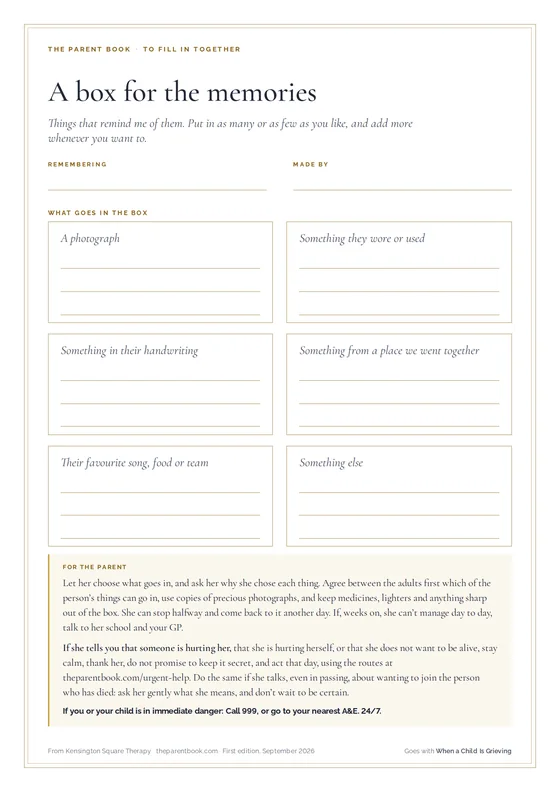 A box for the memories
To fill in together · A4, two pages · PDF, 66 KB · With a subscription
A box for the memories
To fill in together · A4, two pages · PDF, 66 KB · With a subscription
 What to say: loss and change
Cards to cut out · A4, eight cards to cut · PDF, 62 KB · With a subscription
What to say: loss and change
Cards to cut out · A4, eight cards to cut · PDF, 62 KB · With a subscription
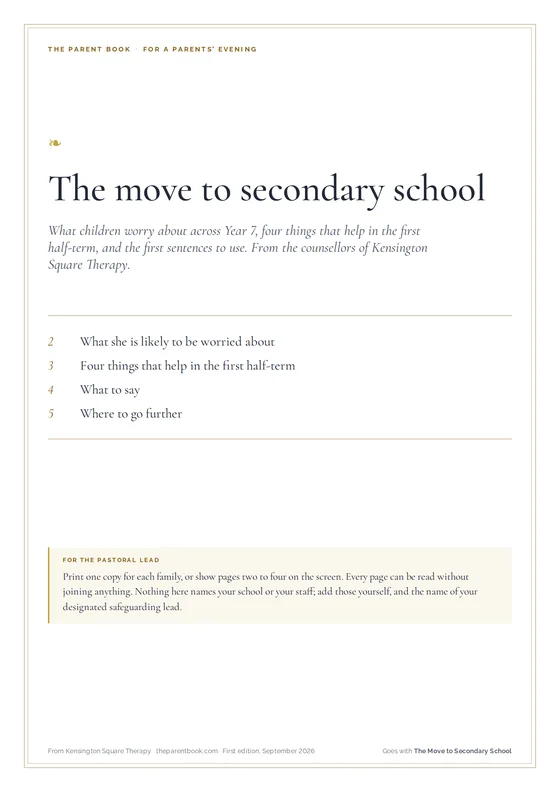 The move to secondary school, for a parents’ evening
For a parents’ evening · A4, five pages · PDF, 170 KB · Free
The move to secondary school, for a parents’ evening
For a parents’ evening · A4, five pages · PDF, 170 KB · Free