
ADHD
ADHD
Some children are diagnosed early and others much later, and the child diagnosed late is often a girl who was missed for years. These pages are for the parent before the assessment and after it, and for the parent whose child is learning to work with the brain she has, which may not be the one the school expected.
What the library says about this, on one page. It is also online at theparentbook.com/help/adhd
What to do first
ADHD is a difference in how attention and impulse are regulated. It isn’t a sign of too little effort or too little parenting, and children with it are usually trying harder than the children around them.
- Change the environment before you try to change the child: give one instruction at a time, write it down where you can, and have a fixed place for things.
- Ask the school for a SENCo meeting, and ask what adjustments are already in place.
- See the GP about the assessment route, and take the school’s account with you. Waits are long, so start now, and don’t wait for the assessment before starting the adjustments.
Some tips to try
Short pieces from the library, and a first thing to try from each.
-
Homework in Short Blocks.
For a child with ADHD, homework goes better in short timed blocks, one instruction at a time, with you nearby.
- Split homework into fifteen- to twenty-minute blocks, with a break between each.
-
Building the Structure Her Brain Needs.
Her brain needs structure from outside, and you’re the one who has to provide it.
- Treat the scaffolding as structure her brain needs.
-
Executive-Function Meltdown vs Emotional Meltdown.
An emotional meltdown and an executive-function meltdown look the same, but they need different responses.
- Work out which kind of meltdown it is, because each needs a different response.
The rest of each tip, with more to try and why it works, is in the library.
Something to do together
Getting out of the door. A short list by the door, made with her, of the things that go with her each morning. She ticks them off as they go in the bag, and you point at the list instead of reminding her.
What it is for. Some children can be told what to take every morning and still leave without it. For a child with ADHD, keeping a list in her head while everything else is going on is especially hard. A list by the door puts the reminder where she needs it, so that you can point at it instead of saying it all again.
- The first step. On a calm evening, ask her what gets left behind: “What are the things that always go missing in the mornings?” Make the list from her answers, in her words: three or four things, not eight.
Safety. An inhaler, an adrenaline pen or any medicine she needs is checked by an adult every morning, whoever packs the bag. It is never left to the list.
When to get help. If mornings are still a battle after several weeks with the list, if she is losing and forgetting things at school as well as at home and it is affecting her work or friendships, or if you have been wondering whether she has ADHD, talk to one of her teachers or the SENCo, and to your GP. If she dreads going, or mornings bring stomach aches or tears about school, talk to her school, and take her to the GP if the stomach aches keep coming back. If she tells you that someone is hurting her, that she is hurting herself, or that she does not want to be alive, stay calm, thank her for telling you, do not promise to keep it secret, and act that day, using the routes under “If you need help right now”, at the foot of every page.
The other five steps, and your part in it, are in the library.
If you want to read further
- Neurodiversity, and the Conversation with the School. For parents whose child has been working harder and longer than other children to do things that come more easily to them. theparentbook.com/reader/neurodiversity-and-the-conversation-with-the-school
Worth your time
- A book for you: Taking Charge of ADHD, Russell A. Barkley. The standard parent guide from one of the field’s leading researchers, covering diagnosis, medication, school and an eight-step behaviour programme. Dense in places, but the reference parents return to. uk.bookshop.org/p/books/taking-charge-of-adhd-fourth-edition-the-complete-authoritative-guide-for-parents-russell-a-barkley/7cbe4aa1946ca4ad
- A book to read together: All Dogs Have ADHD, Kathy Hoopmann. Photographs of dogs bounding, chewing and gazing out of windows illustrate the traits of ADHD with affection and humour. Good for younger children and for a first conversation after diagnosis. uk.bookshop.org/p/books/all-dogs-have-adhd-an-affirming-introduction-to-adhd-kathy-hoopmann/378585394f801693
- Something to watch: ADHD and Executive Function - Dr. Russell Barkley | Child Mind Institute, Child Mind Institute, YouTube. Russell Barkley explains ADHD as a problem of executive function and self-regulation, not knowledge, which is why children with ADHD know what to do but cannot always do it. www.youtube.com/watch?v=GR1IZJXc6d8
- Something to listen to: Episode 23: Q&A part 3: Medications, ADHDUK podcast, 38 min. Paediatrician Max Davie and his co-host answer questions from ADHD UK’s community about ADHD medication, in a UK prescribing context. A calm starting point before a clinic appointment. podcasts.apple.com/gb/podcast/episode-23-q-a-part-3-medications/id1566197438?i=1000683585238
Who else can help
Assessment usually begins at school rather than at the surgery. The GP is the referral route, but a school that has already tried and recorded support makes everything after it faster.
- The SENCo at your child’s school. The member of staff responsible for special educational needs. They hold the assessment routes, the in-school support, and the paperwork an EHCP needs. Ask for a meeting in writing, and ask what is already being tried under the graduated approach. This conversation usually has to happen before anything statutory can.
- Your local SENDIASS. The free, impartial SEND information, advice and support service every local authority in England must provide: SEN support, EHC needs assessments, exclusions, and what to do when you and the school disagree. As soon as special educational needs are in the picture. Search your borough’s name with SENDIASS, or use the national finder. councilfordisabledchildren.org.uk/about-us-0/networks/information-advice-and-support-services-network/find-your-local-ias-service
- ADHD UK. A national ADHD charity with free online support groups, including one for parents, plain guides to getting a child assessed and to the SEND system, and template letters for exam access arrangements. When you suspect ADHD, while you wait for assessment, and when school needs a nudge. Use the free groups; the paid course is not what we are pointing you to. Use the free groups and guides. The paid course and the coaching marketplace are not what we are pointing you to. adhduk.co.uk
- SENDIASS (your local SEND information and advice service). Every local authority in England funds a free, impartial advice service for parents of children with special educational needs: SEN support, EHC assessments and plans, exclusions, and disagreements with the school. Most offer a phone line, email and drop-ins. Before anything statutory. Search your borough’s name with SENDIASS, or use the national finder. England. Each local authority runs its own; the finder lists them all. councilfordisabledchildren.org.uk/about-us-0/networks/information-advice-and-support-services-network/find-your-local-ias-service
- Contact (for families with disabled children). The charity for families with a disabled child, whether or not there is a diagnosis yet. A free helpline, webchat, benefits advice and local groups. In the early days after a diagnosis, or while you are still waiting for one, when you need someone warm and practical. Contact Helpline 0808 808 3555 · Mon-Fri 9.30am-5pm (Tue opens 10.15am) · Webchat and an online enquiry form via the website; bookable Listening Ear calls contact.org.uk/help-for-families/information-advice-services/our-helpline
The full list for ADHD, with what each organisation does and when it is the right call, is at theparentbook.com/help/adhd/services
Published by Kensington Square Therapy. Company No. 16707111. Written by therapists registered with the British Association for Counselling and Psychotherapy (BACP) and the National Counselling and Psychotherapy Society (NCPS). This page is not therapy, and not a substitute for professional support. The full library is at theparentbook.com.
Everything the library holds on ADHD
Go further
Quick tips
- Homework in Short BlocksFor a child with ADHD, homework goes better in short timed blocks, one instruction at a time, with you nearby.
- Building the Structure Her Brain NeedsHer brain needs structure from outside, and you’re the one who has to provide it.
- Executive-Function Meltdown vs Emotional MeltdownAn emotional meltdown and an executive-function meltdown look the same, but they need different responses.
- Routines That Work for an ADHD ChildAn ADHD child needs a routine that’s more visual and more forgiving, with the prompts outside her head.
- The ADHD Medication ConversationThe decision about medication is yours, made with the prescribing team.
- The Eldest Child You Are Wondering AboutWhen a younger child is assessed, parents often start to see the same patterns in the eldest.
- The Homework Battle Beyond EffortIf an hour of maths ends with two questions done, an ADHD child has usually been working very hard.
- When the Diagnosis Comes at SixteenA diagnosis at sixteen often brings a teenager more relief than her parents expected.
Quick tips open with a subscription.
Things to do together
Activities open with a subscription.
To print
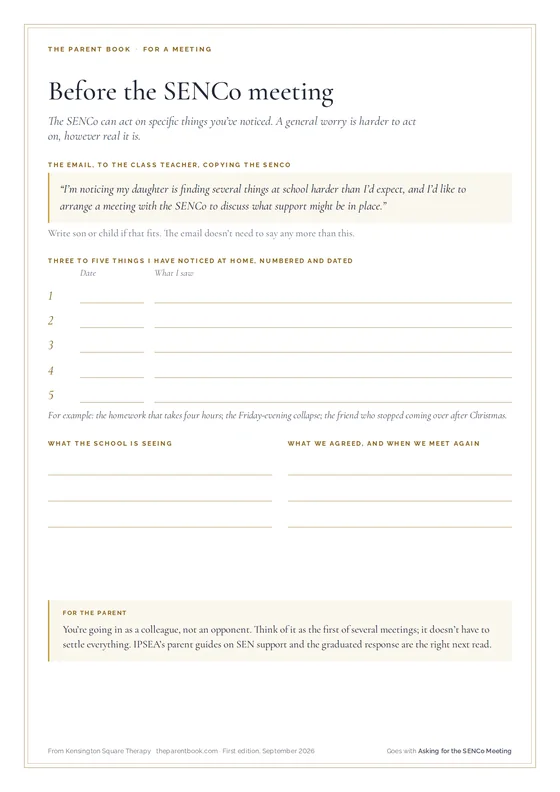 Before the SENCo meeting
For a meeting · A4 · PDF, 65 KB · Free
Before the SENCo meeting
For a meeting · A4 · PDF, 65 KB · Free
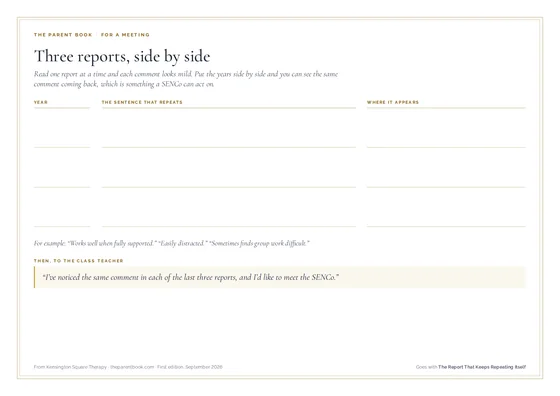 Three reports, side by side
For a meeting · A4 landscape · PDF, 47 KB · Free
Three reports, side by side
For a meeting · A4 landscape · PDF, 47 KB · Free
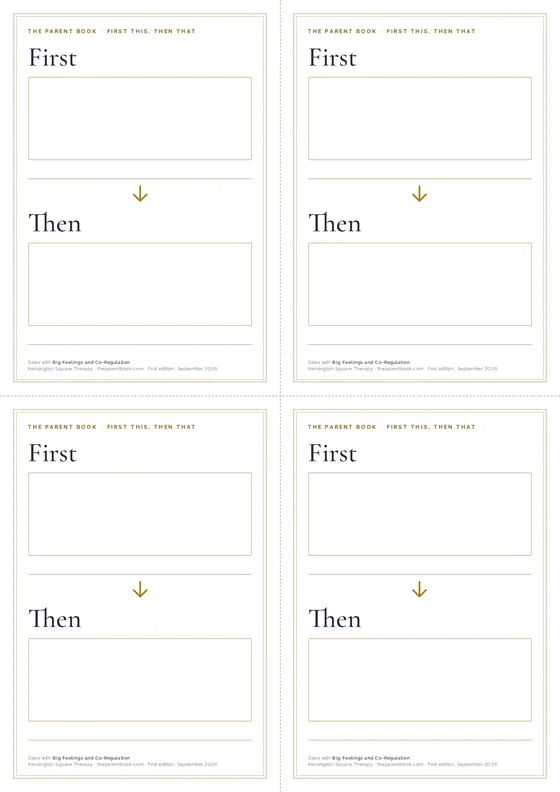 First this, then that
Cards to cut out · A4, four cards to cut, two sides · PDF, 64 KB · With a subscription
First this, then that
Cards to cut out · A4, four cards to cut, two sides · PDF, 64 KB · With a subscription
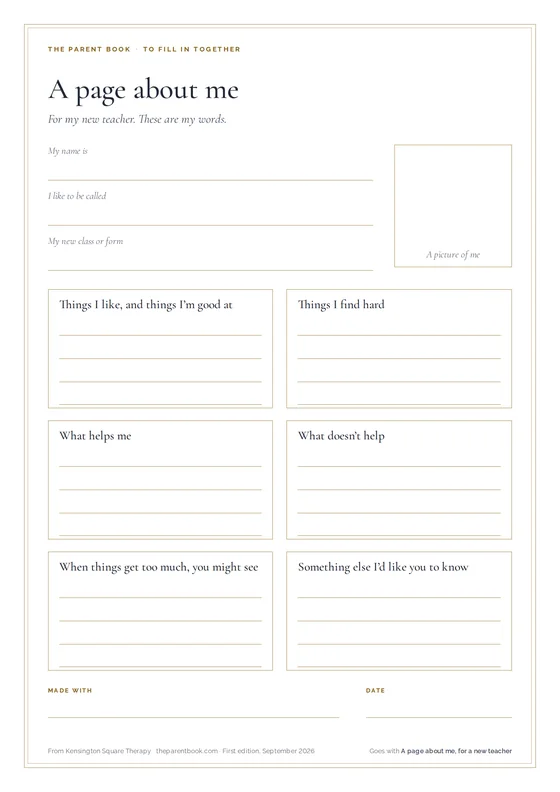 A page about me
To fill in together · A4, two pages · PDF, 67 KB · With a subscription
A page about me
To fill in together · A4, two pages · PDF, 67 KB · With a subscription
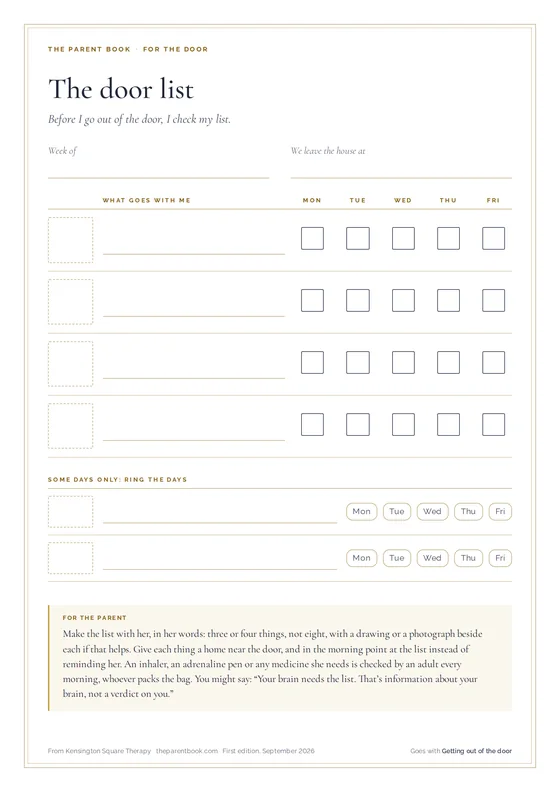 The door list
For the door · A4 · PDF, 74 KB · With a subscription
The door list
For the door · A4 · PDF, 74 KB · With a subscription
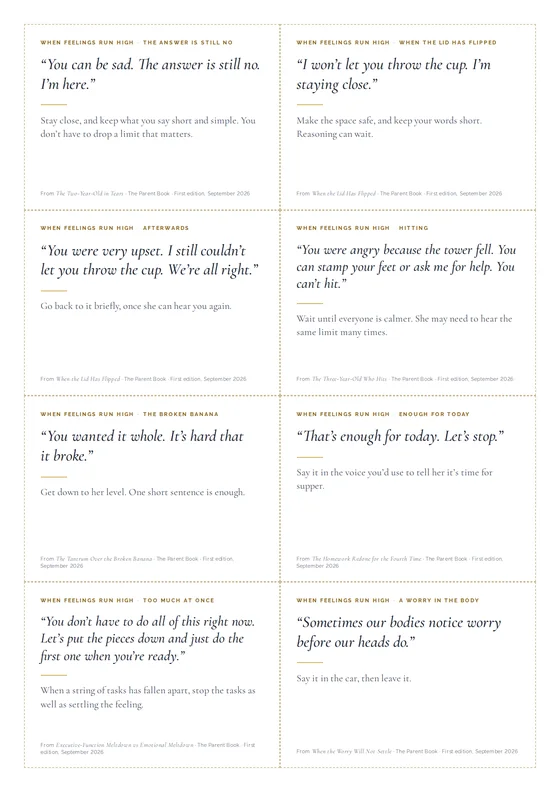 What to say: when feelings run high
Cards to cut out · A4, eight cards to cut · PDF, 61 KB · With a subscription
What to say: when feelings run high
Cards to cut out · A4, eight cards to cut · PDF, 61 KB · With a subscription